Best Probiotics for Dogs 2026: Purina FortiFlora, Visbiome & Vet-Recommended Picks
Honest reviews of the best probiotics for dogs in 2026 - Purina FortiFlora, Visbiome Vet, Proviable, Adored Beast. What actually works for diarrhea, IBD, and gut health.
Best Probiotics for Dogs 2026: Purina FortiFlora, Visbiome & Vet-Recommended Picks
The best probiotic for most dogs is Purina FortiFlora for everyday digestive upset, with Visbiome Vet and Proviable as higher-potency options for IBD or recovery from antibiotics. The evidence is strongest for acute diarrhea and antibiotic recovery; for a healthy dog with no gut issues, it’s low-risk but optional.
Probiotics for dogs have moved from boutique health-food category to mainstream veterinary medicine. The evidence is strongest for specific situations - acute diarrhea, recovery from antibiotic treatment, stress-related GI upset, and inflammatory bowel disease management. The evidence is weaker for general “gut health maintenance” in dogs without GI issues, though the safety profile makes daily supplementation low-risk.
The challenge is product quality. Most over-the-counter probiotics for dogs are mislabeled - contain different strains than claimed, lower CFU (colony-forming units) than stated, or strains that don’t actually colonize dog intestines. Veterinary-grade probiotics are tested for these factors; many supermarket pet probiotics aren’t.
What probiotics actually do: Probiotics introduce beneficial bacteria that help balance the gut microbiome - competing with harmful bacteria, supporting digestion, and modulating immune response. They don’t “boost” immunity or “cure” disease. They support the natural systems that already exist.
At a Glance: Top Picks
| Rank | Probiotic | CFU/dose | Strains | Best For |
|---|---|---|---|---|
| 🥇 #1 | Purina FortiFlora | 1×10⁸ | 1 (E. faecium SF68) | Acute diarrhea, vet standard |
| 🥈 #2 | Visbiome Vet | 1.13×10¹¹ | 8 | IBD, chronic disease |
| 🥉 #3 | Proviable-DC | 5×10⁹ | 7 | Recovery, post-antibiotic |
| #4 | Adored Beast Fido’s Flora | 1×10⁹ | Multiple | Premium daily supplement |
| #5 | Pet Naturals Daily Probiotic | 1×10⁸ | 4 | Budget daily use |
| #6 | Honest Kitchen Pro Bloom | 5×10⁹ | 1 + prebiotics | Topper-style application |
| #7 | VetriScience Probiotic Chewables | 1×10⁹ | 4 | Treat-form delivery |
🥇 #1: Purina FortiFlora
Purina FortiFlora is the probiotic vets recommend most often for acute diarrhea and stress-related GI upset. The single strain (Enterococcus faecium SF68) is among the best-researched dog probiotics - multiple peer-reviewed studies show measurable benefit for acute diarrhea, antibiotic recovery, and stress-related GI issues.
The simplicity is part of its strength. Single-strain products allow consistent dosing without strain interactions or instability issues. The packet form ensures dosing accuracy.
Real-world outcomes: Acute diarrhea typically resolves 1-3 days faster with FortiFlora versus no treatment. For dogs with chronic issues, FortiFlora supports baseline gut health but may not match multi-strain products for complex IBD cases.
Best for: Acute diarrhea, post-vaccination GI upset, stress-related GI issues (boarding, travel), recovery from antibiotics, daily maintenance for dogs with mild sensitivity.
🥈 #2: Visbiome Vet
Visbiome Vet is the premium veterinary probiotic for serious GI conditions. The 113 billion CFU per dose dwarfs other products - most consumer probiotics contain 1-10 billion CFU. The 8-strain composition provides broad-spectrum support, particularly valuable for inflammatory bowel disease (IBD) where multiple gut bacteria are dysregulated.
The product is essentially a veterinary version of Visbiome (formerly VSL#3), the most-researched human probiotic for IBD. The clinical evidence in dogs is strong, particularly for IBD management.
Best for: Diagnosed IBD, chronic enteropathy, severe gut dysbiosis, post-surgical GI recovery, dogs not responding to standard probiotics.
🥉 #3: Proviable-DC
Proviable-DC is the popular over-the-counter multi-strain probiotic. The 7-strain composition provides broader spectrum than FortiFlora’s single strain, useful for general gut health maintenance. The product is well-established and available without veterinary purchase, making it accessible.
The “DC” stands for “Direct-Fed Microbials” - meaning the bacteria are designed to colonize the dog’s intestine directly. This is more relevant for dogs needing to rebuild gut bacteria after antibiotics than for routine maintenance.
Best for: Multi-strain support, post-antibiotic recovery, general gut maintenance, owners preferring over-the-counter products.
#4: Adored Beast Fido’s Flora
A premium boutique probiotic with multiple strains and additional prebiotic support. Marketing emphasizes natural/clean ingredients. Higher price reflects boutique positioning.
Best for: Owners seeking boutique-tier supplementation, willing to pay premium for ingredient transparency, healthy dogs supporting daily microbiome.
#5: Pet Naturals Daily Probiotic
A widely-available daily probiotic at lower price point. 4 strains, 100 million CFU per chew. Reasonable for budget-conscious daily maintenance.
Best for: Budget-conscious owners, mild gut maintenance, treat-form delivery.
#6: Honest Kitchen Pro Bloom
A liquid probiotic to add as food topper. Includes prebiotic support. Single strain plus inulin. Useful for owners feeding dehydrated or home-cooked food.
Best for: Dogs eating home-cooked diets, dogs that refuse capsules and powders, owners wanting probiotic in food rather than supplement.
#7: VetriScience Probiotic Chewables
A chew-form probiotic that dogs treat as treats. Multiple strains at moderate CFU. Convenient form factor.
Best for: Treat-driven dogs, owners wanting easy compliance, daily maintenance without struggle.
When Probiotics Actually Help
The evidence varies by condition. Honest summary:
Strong evidence
- Acute diarrhea: Shortens duration by 1-3 days
- Post-antibiotic GI recovery: Restores microbiome diversity
- Stress-related GI upset: Reduces severity and duration
- Travel and boarding GI issues: Preventive use shows benefit
- Inflammatory bowel disease (IBD): Particularly with multi-strain high-CFU products
Moderate evidence
- Skin allergies and atopic dermatitis: Supportive role
- Behavior in anxious dogs: Mild positive effect
- Recurrent ear infections: May reduce frequency
- Vaginal/urogenital health: Some evidence in studies
Weak or no evidence
- General “immune boosting”: Marketing language, not supported
- Coat improvement: Negligible direct effect
- “Weight loss support”: No credible evidence in dogs
- “Anti-aging” claims: Not supported
Bottom line
For dogs with acute GI issues or specific medical conditions, probiotics have real benefit. For healthy dogs as daily prevention, the benefit is modest but the safety is high - so daily use is reasonable if budget allows.
How to Choose a Probiotic
Step 1: Match to the situation
Acute diarrhea or stress GI: FortiFlora or Proviable-DC. Daily dose for 7-10 days.
Post-antibiotic recovery: Proviable-DC, Visbiome Vet, or FortiFlora. Daily for 2-4 weeks after antibiotic course.
Chronic IBD: Visbiome Vet. Daily long-term under veterinary guidance.
Daily maintenance for healthy dogs: Any moderate-CFU multi-strain product. Pet Naturals, Adored Beast, VetriScience.
Travel/boarding preparation: FortiFlora starting 5-7 days before travel.
Step 2: Verify quality
Look for:
- CFU count clearly stated
- Strain identification by full name (genus + species + strain number)
- Expiration date and storage requirements
- Veterinary endorsement or third-party testing
Red flags:
- “Proprietary blend” without specific strains
- No expiration date
- No storage requirements stated
- Claims of curing specific diseases
Step 3: Calculate dosing
Standard daily dose ranges:
- Small dogs (under 10 kg): 1-5 billion CFU
- Medium dogs (10-25 kg): 5-10 billion CFU
- Large dogs (25-45 kg): 10-20 billion CFU
- Giant dogs (over 45 kg): 20+ billion CFU
For acute diarrhea, double the standard dose for 3-5 days, then return to maintenance.
Step 4: Storage
Most probiotics are sensitive to:
- Heat (above 30°C / 86°F kills bacteria)
- Moisture (degrades quality)
- Light (some strains)
Store as labeled. Many high-CFU products require refrigeration after opening. Mid-tier products tolerate room temperature.
How to Give Probiotics
Powder form (FortiFlora, Visbiome)
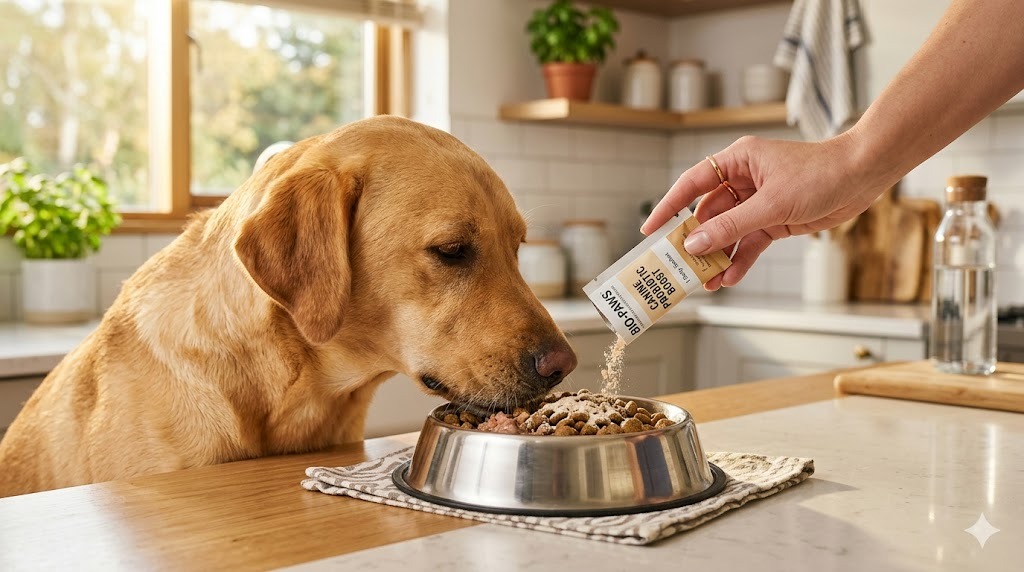
Sprinkle on top of regular food. Most dogs accept readily - many products are designed to be palatable. If dog refuses, mix with a small amount of wet food or low-sodium broth.
Capsule form
Open the capsule and sprinkle contents on food, or give whole if dog tolerates pills. Some capsules are designed to be opened.
Chewable form
Give as a treat. Most dogs accept happily. Watch dose if multiple chews are needed.
Liquid form
Add to food per dosing instructions. Useful for picky eaters or specific medical conditions.
Timing
With or without food works fine. Some studies suggest slight advantage when given with food (food protects bacteria from stomach acid), but the difference is small.
Duration
- Acute issues: 7-14 days
- Post-antibiotic recovery: 2-4 weeks
- Maintenance/IBD: Long-term (months to lifetime)
- Specific event prep: Start 5-7 days before, continue 5-7 days after
Common Mistakes
Buying probiotics for “general health”
Without a specific reason, probiotic benefit is modest. Money may be better spent on other interventions.
Choosing products without identified strains
“Proprietary blend” labels don’t tell you what bacteria you’re getting. Reputable products identify strains by full name.
Wrong storage
Many owners discover their probiotic has been in a hot car or sunny windowsill. Bacteria die in these conditions. Check stored quality.
Combining with antibiotics simultaneously
Antibiotics kill probiotic bacteria. Give probiotics 2-3 hours apart from antibiotics, or continue probiotics after the antibiotic course ends.
Stopping too soon
For acute conditions, give for at least 7 days. For chronic conditions, 4+ weeks before judging effect.
Expecting miracles
Probiotics are supportive, not curative. They improve outcomes for many conditions but don’t substitute for veterinary care.
Prebiotics vs Probiotics
Probiotics
The bacteria themselves - live organisms introduced into the gut.
Prebiotics
Food for beneficial bacteria - fiber, inulin, fructooligosaccharides (FOS). They feed the bacteria already in the gut.
Synbiotics
Combinations of probiotics and prebiotics.
What to use
- Acute issue: probiotic alone is fine
- Chronic gut health: synbiotic (most premium products combine both)
- Healthy dog maintenance: prebiotic-rich diet may be more impactful than added probiotics
Prebiotic-rich foods
- Cooked sweet potato
- Bananas (small amounts)
- Pumpkin
- Plain yogurt (lactose-tolerant dogs only)
- Some commercial foods labeled “gut health”
Frequently Asked Questions
Do dogs really need probiotics?
Healthy dogs with no GI issues don’t strictly need probiotics. For dogs with acute diarrhea, chronic GI disease, on antibiotics, or recovering from illness, probiotics have measurable benefit. Daily probiotic supplementation for healthy dogs is low-risk but modest benefit.
Can I give my dog human probiotics?
Some human probiotic strains work in dogs (Lactobacillus, Bifidobacterium, certain Enterococcus). However, dog-formulated probiotics include strains specifically researched for canine intestines. For specific medical conditions, use vet-recommended dog-formulated products.
Can I give my dog yogurt as a probiotic?
Plain unsweetened yogurt provides minimal probiotic value. The CFU count is far lower than supplements, and many dogs are lactose-intolerant. Acceptable as occasional treat but not effective as therapy.
How long until I see results?
Acute diarrhea: 1-3 days. Chronic GI improvement: 2-4 weeks. IBD management: 4-8 weeks before judging effect.
Are there side effects?
Probiotics are remarkably safe. Mild GI upset can occur initially (slight bloating, gas, occasional soft stool). This usually resolves within a few days. If your dog shows worsening symptoms, discontinue and consult your vet.
Can puppies have probiotics?
Yes. Puppies often benefit from probiotics during transitions (vaccinations, new homes, dietary changes). FortiFlora is widely used in puppies for stress-related diarrhea.
Can pregnant or nursing dogs have probiotics?
Generally yes, but discuss with vet. Some products are not specifically tested in pregnancy.
Should I refrigerate dog probiotics?
Depends on the product. Most high-CFU veterinary products (Visbiome Vet) require refrigeration. Mid-tier consumer products usually don’t. Check the label.
Do probiotics help with food allergies?
Some evidence for support. Probiotics may modulate immune response, potentially reducing some allergy symptoms. They don’t cure food allergies - the dog still needs the appropriate diet.
What if my dog won’t take the probiotic?
Try a different form: chewable instead of powder, liquid instead of capsule. Mix with high-value food (a tiny piece of cheese, peanut butter, or wet food). If dog persistently refuses, ask vet for alternative product.
Our Final Recommendation
For most situations - acute diarrhea, post-antibiotic recovery, stress-related GI - Purina FortiFlora is the right pick. Vet-standard, well-researched, affordable, and effective for the most common situations dogs need probiotics.
For chronic IBD or serious gut disease, Visbiome Vet is the premium tier - highest CFU count, broadest strain diversity, the closest to clinical-grade probiotic available for dogs.
For multi-strain over-the-counter daily use, Proviable-DC provides good broad-spectrum support without requiring veterinary purchase.
For budget-conscious daily maintenance, Pet Naturals Daily Probiotic delivers adequate support at lower cost.
Probiotics are real medicine for specific situations. They aren’t a magic supplement - but for the situations where they help, they help measurably. Use them as part of a broader plan that includes appropriate diet, parasite prevention, and veterinary care.
Related Reading
- Best Sensitive Stomach Dog Food
- Best Joint Supplements for Senior Dogs
- Best Allergy Medication for Dogs
- Best Pet Insurance 2026
- Best Dog Food Brands Ranked
Last updated: June 2026.