Labrador Retriever
The Labrador Retriever is the dog that defined the modern family pet.
🗓️ Last reviewed: July 2026
Full Guide
Deep dive · 25-35 min · everything you need
Overview
The Labrador Retriever is the dog that defined the modern family pet. Strong, friendly, eager-to-please, and almost impossibly cheerful, the Labrador has been the most popular breed in dozens of countries for decades. It is the working dog that learned to live on the couch - equally at home flushing ducks from a freezing marsh, guiding a blind owner through traffic, sniffing for explosives at an airport, or napping under the kitchen table with one ear cocked for the sound of a treat bag.
History & Origins
Despite the name, the Labrador did not come from Labrador. It originated on the island of Newfoundland in the early 1800s, where local fishermen used a smaller, short-coated water dog called the St. John's Water Dog to haul nets and retrieve escaping fish. English aristocrats - notably the Earl of Malmesbury and the Duke of Buccleuch - imported these dogs in the 1820s-30s and refined them as gun dogs for waterfowl shooting.
By 1903 the Kennel Club (UK) had officially recognised the breed. American recognition followed in 1917. Two distinct working lines developed: the heavier, calmer "English" or "show" type and the lighter, faster, more driven "American" or "field" type. The breed reached the top of the AKC popularity charts in 1991 and held the #1 position for 31 consecutive years - an all-time record - before being passed by the French Bulldog in 2022.
Appearance
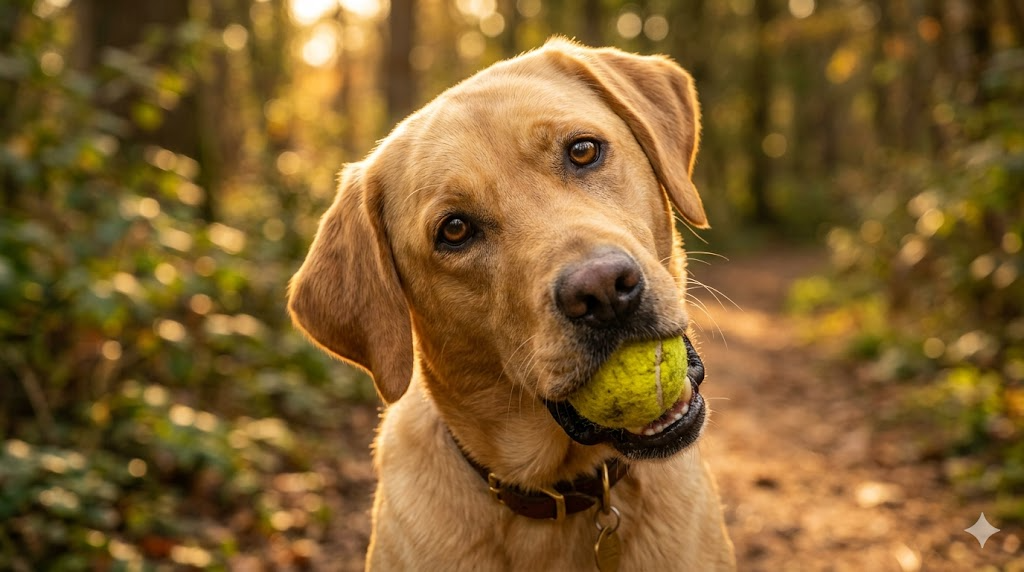
A medium-to-large athletic dog, strong without being heavy. Adults stand 54-62 cm (21½-24½ in) and weigh 25-36 kg (55-80 lb), with females smaller. The body is compact, muscular, and slightly longer than tall.
Key features:
- Coat: short, dense, straight, with a soft weather-resistant undercoat - water just rolls off.
- Tail: famous "otter tail" - thick at the base, tapering, carried level; used as a rudder when swimming.
- Head: broad, with a soft expression, kind eyes, and medium-length drop ears.
- Feet: webbed for swimming.
Three recognised colours: black, yellow (ranging from cream to fox-red), and chocolate. So-called "silver" and "charcoal" Labradors are controversial - usually descended from a Weimaraner cross many generations back. White, brindle, or merle Labradors are not purebred.
Temperament & Character
Labradors are the textbook good-natured dog: friendly with people, friendly with other dogs, friendly with cats they grew up with, friendly with absolutely everyone. They are confident, outgoing, and rarely aggressive. As guard dogs they are useless - most would happily help a burglar carry the silver to the car if there were a biscuit in it.
What new owners under-estimate is the breed's energy and oral fixation. A young Lab will chew, mouth, carry things in its jaws, jump on people, sweep coffee tables clean with its tail, and bound through life with the enthusiasm of a small horse. They mature slowly - most Labs do not mentally settle until 3-4 years of age. After that they tend to become wise, gentle, and quietly devoted lifelong companions.
Care
Coat & Grooming
The double coat is short but dense. Labs shed year-round and "blow coat" twice a year, leaving handfuls of hair on every surface. Brush 2-3 times a week with a slicker or de-shedding tool; daily during heavy shed seasons. Bathing every 6-8 weeks is plenty - too much washing strips the protective oils.
Ears are floppy, warm, and damp after swims - clean weekly and dry thoroughly to prevent infections. Trim nails monthly; brush teeth several times a week.
Exercise & Activity Needs
A Labrador needs real exercise - minimum 60-90 minutes daily for an adult, ideally including off-lead running, swimming, or retrieving. They are athletes; under-exercised Labs become bored, destructive, and overweight in about that order.
Mental work matters as much as physical. The breed was bred to think and cooperate with a hunter, and it deteriorates without a job. Scent games, retrieve drills, obedience training, gun-dog mock work, dock diving, or simply teaching new tricks every week keeps a Lab's brain healthy.
Health & Lifespan
Average lifespan is 11-13 years. The breed is generally robust but prone to:
- Hip and elbow dysplasia - ask for OFA or BVA hip/elbow scores from both parents.
- Exercise-induced collapse (EIC) - a heritable condition causing collapse after intense exercise; DNA tests are available.
- Progressive retinal atrophy (PRA) and hereditary cataracts.
- Obesity - Labs are gold-medal eaters and gain weight effortlessly. Roughly 60% of pet Labs are overweight, dramatically shortening their lives.
- Cancer - particularly haemangiosarcoma and lymphoma in older dogs.
- A specific gene mutation (POMC) makes about one in four Labs feel constantly hungry; these dogs need stricter calorie control.
Feeding & Nutrition
Adult Labradors typically need 2½-3½ cups of quality dry food per day, divided into two meals; working dogs need more. Use a kitchen scale, not a scoop, and weigh portions. Treats - including chewables and human leftovers - should never exceed 10% of daily calories.
Avoid feeding immediately before or after hard exercise; Labs are at moderate risk of gastric dilatation (bloat). Slow-feeder bowls help dogs who inhale food. Adjust calories twice yearly: more in cold, active months, less when activity drops.
Pros & Cons
Pros
- Universally friendly - excellent with kids, strangers, dogs.
- Trainable, intelligent, and versatile in any dog sport.
- Robust health relative to many popular breeds.
- Adaptable from apartments (with exercise) to farms.
- Long, well-documented working history.
Cons
- High energy - bored Labs are destructive.
- Sheds heavily.
- Strong tendency to overeat and become obese.
- Slow to mature emotionally (1-3 years of adolescent chaos).
- Mouthy as puppies; jumps on guests if untrained.
Best Suited For
- Active families with children.
- Owners who run, hike, swim, or hunt.
- First-time dog owners who can commit time to training.
- Service-dog and therapy programmes.
- Anyone wanting one dog that does it all - companion, athlete, ambassador.
Not suited for sedentary owners, very small apartments without daily outings, or anyone allergic to hair on every surface.
Labrador Retriever puppy growth chart
A typical growth curve for a large breed like the Labrador Retriever, estimated from its adult weight of 25-36 kg. Puppies vary with sex, genetics and diet, so treat this as a guide - for your own puppy, use the puppy weight predictor.
| Age | Typical weight | % of adult |
|---|---|---|
| 2 mo | 5.5-7.9 kg | 22% |
| 3 mo | 8.3-11.9 kg | 33% |
| 4 mo | 10.8-15.5 kg | 43% |
| 6 mo | 15-21.6 kg | 60% |
| 9 mo | 20-28.8 kg | 80% |
| 12 mo | 23-33.1 kg | 92% |
| Adult | 25-36 kg | 100% |
Labrador Retriever - frequently asked questions
Are Labradors good with children?
Excellent. Few breeds tolerate kids as patiently. Supervise toddlers around large puppies - a wagging Lab tail can knock over a small child.
Black, yellow, or chocolate - is there a personality difference?
Old folklore says chocolates are wild, yellows lazy, blacks serious. There is no real evidence; differences come from working vs. show lines, not colour.
How much exercise is enough?
A healthy adult needs 60-90 minutes daily of varied activity. Less than 45 minutes consistently produces behaviour problems.
Are Labradors hypoallergenic?
No. They shed heavily and produce significant dander.
Do Labs like water?
Almost universally yes - most will jump into anything wet, from puddles to oceans. Webbed feet, otter tail, and water-resistant coat all evolved for it.
🧠 Test yourself: guess the dog
Three clues from our quiz bank, each about another of our dogs. Can you name them?
Clue 1.This energetic gundog earned its name from the way it 'springs' to flush game birds from cover.
It's the English Springer Spaniel - read the full profile →
Clue 2.This sleek silver-grey gundog from Germany was originally developed to hunt boar, bear, and deer before shifting to birds.
It's the Weimaraner - read the full profile →
Clue 3.This enormous, droopy-jowled mastiff is famed for a calm, affectionate temperament despite its intimidating bulk.
It's the English Mastiff - read the full profile →
💛 Adoptable Labrador Retrievers near you
Real dogs of this breed (and close mixes) waiting in shelters and rescues right now, live from Petfinder. We have no affiliation and earn nothing - if someone catches your eye, the link goes straight to their shelter. New to adopting? Start with our adoption guide.
Widget not loading (some ad-blockers hide it)? Search directly on petfinder.com.