Maine Coon
The Maine Coon is the largest domestic cat breed in the world - a long-coated, tufted-eared, lion-like cat that combines impressive size with a famously gentle and sociable temperament.
🗓️ Last reviewed: June 2026
Overview
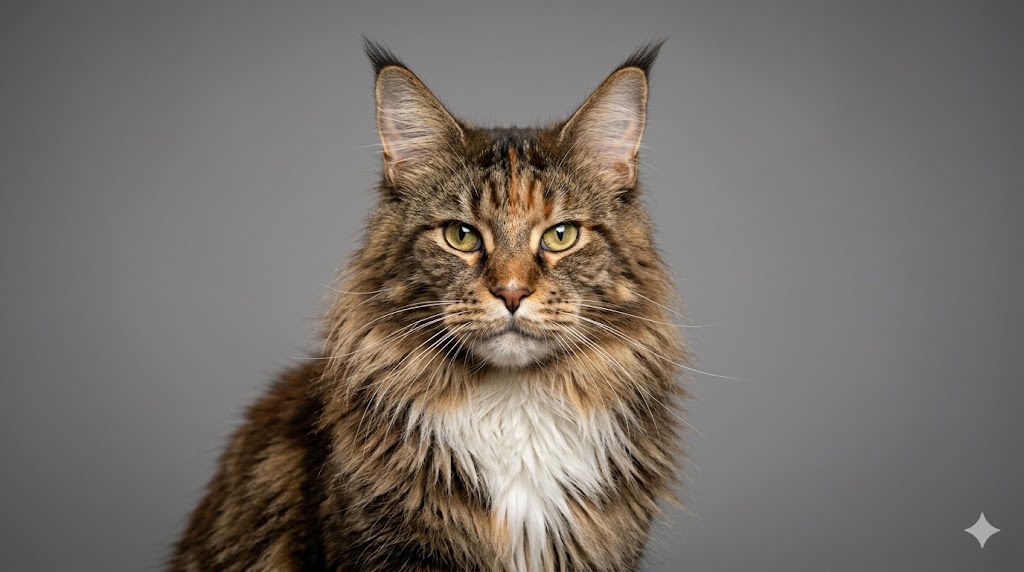
The Maine Coon is the largest domestic cat breed in the world - a long-coated, tufted-eared, lion-like cat that combines impressive size with a famously gentle and sociable temperament. Native to the state of Maine in the northeastern United States, the breed evolved naturally as a working farm cat capable of surviving harsh winters and controlling rodent populations. Modern Maine Coons retain every functional quality of their working ancestors while adding the unique charm that has made them one of the most popular breeds in the world.
History & Origins
The Maine Coon is a true working-cat breed - the result of natural selection rather than designed breeding. Cats arrived in North America on European trading ships and adapted to the New England climate over generations. The harsh Maine winters favoured cats with dense weatherproof coats, large size, tufted paws for snow, and bushy tails for warmth.
Folklore tells of crosses with raccoons (genetically impossible) or with the cats of Marie Antoinette (charming but unverifiable). The most likely origins are 18th-century longhaired ship cats - possibly Norwegian Forest Cats brought by Vikings or Persian-type cats brought by later traders - crossed with local working shorthairs.
The Maine Coon was the first official American show cat. The first cat show in the United States was held in Madison Square Garden in 1895, and a Maine Coon named Cosey won Best in Show. The breed declined when fancier Persian cats arrived but was rescued in the 1950s and 60s by dedicated enthusiasts. CFA recognition came in 1976. The breed is now one of the world's most popular.
Appearance
Large, muscular, long-coated, with a distinctive lion-like ruff. Males weigh 6-8 kg (13-18 lb); females 4-6 kg (9-13 lb). Some exceptional males exceed 11 kg. Adults reach full size around 4 years of age - much later than other breeds.
Key features:
- Coat: medium-long, shaggy, water-resistant double coat. Heavy mane around the neck, britches on the hind legs, and a plumed tail that can be as long as the body.
- Colour: almost any colour and pattern except pointed (Siamese-style). Brown tabby (especially mackerel tabby) is iconic.
- Head: medium-sized with a slightly square muzzle, high cheekbones, and large oval eyes (gold, green, or copper; blue or odd-eyed in white cats).
- Ears: very large, wide-set, with the famous "lynx tips" - long tufts of hair extending from the ear tips. Heavy ear furnishings.
- Body: long, rectangular, muscular, with substantial bone.
- Paws: large, tufted between the toes (functional snowshoe).
- Tail: long, bushy, with hair as long as 15 cm at the tip.
Temperament & Character
The Maine Coon is the "gentle giant" of the cat world. The breed is sociable, affectionate, and remarkably tolerant - typically excellent with children, friendly with strangers, and agreeable with other cats and dogs.
The breed is famously dog-like. Maine Coons often follow their humans from room to room, greet guests at the door, play fetch, walk on harnesses, and learn tricks. Many are vocal, chirping and trilling rather than meowing.
Most Maine Coons are not particularly lap cats. They prefer to be near you rather than on you - supervising activities from the next chair, sitting in the same room, sleeping at the foot of the bed.
The breed retains strong working instincts. Maine Coons hunt mice, climb trees, and enjoy fishing in water bowls or sinks - many are notably comfortable with water.
Care
Coat & Grooming
The long double coat is moderate maintenance. Brush 2-3 times weekly with a long-toothed comb or de-matting tool. Daily during seasonal shedding (twice yearly heavy sheds).
The breed mats around the neck ruff, behind the ears, in the britches, and under the tail. Address mats with a comb rather than scissors - cutting too close risks injuring the cat.
Bathe every 2-3 months or as needed. Many Maine Coons tolerate baths well. Clean ears monthly (the heavy furnishings can trap debris). Trim claws every 2 weeks. Brush teeth several times weekly.
Exercise & Enrichment
The breed is athletic and playful well into adulthood. Provide tall cat trees (sturdy enough for 7 kg of cat), puzzle feeders, interactive wand toys, and scheduled play sessions. Many Maine Coons enjoy harness walks and clicker training.
The breed is intelligent - under-stimulation produces destructive behaviour, vocalisation, and weight gain.
Health & Lifespan
Average lifespan is 12-15 years.
Common concerns:
- Hypertrophic cardiomyopathy (HCM) - the most serious breed-specific issue. DNA test available for the MYBPC3 mutation; annual echocardiogram screening recommended for breeding cats.
- Hip dysplasia - uncommon in cats generally but elevated in Maine Coons due to size.
- Spinal muscular atrophy (SMA) - DNA test available.
- Polycystic kidney disease (PKD).
- Obesity - significant problem given size and food motivation.
- Dental disease.
Choose a breeder who DNA-tests for HCM and SMA and ultrasounds breeding cats annually.
Feeding & Nutrition
Adults typically eat 70-100 g of quality cat food per day, depending on weight and activity. Feed measured meals rather than free-feeding; Maine Coons are prone to obesity.
High-protein, moderate-fat diets suit the breed. Many Maine Coons drink large amounts of water and enjoy fountains. Some require special joint or cardiac-supportive diets in middle age.
Wet food (or a mix of wet and dry) supports hydration and urinary health.
Living With
Litter
Standard provisions: 1 + 1 box per cat, scooped daily, large boxes (Maine Coons need 45+ cm long boxes - many standard boxes are too small). Low-dust unscented litter generally preferred.
Multi-cat households
Maine Coons are typically excellent with other cats, especially when raised together or introduced young. Same-sex pairs can work; opposite-sex pairs are easiest.
Indoor vs outdoor
Indoor-only is safest. The breed is large enough to attract attention from car traffic, dogs, and people. Catios (enclosed outdoor spaces) and harness walks satisfy the breed's outdoor curiosity safely.
Pros & Cons
Pros
- Gentle, sociable, dog-like personality.
- Excellent with children and other pets.
- Trainable and interactive.
- Strikingly beautiful.
- Generally healthy when well-bred.
Cons
- Large size - expensive to feed and medicate.
- HCM risk; cardiac screening essential.
- Long coat requires regular grooming.
- Slow to mature (4 years to full size).
- Premium prices from reputable breeders.
Best Suited For
- Families with children of any age.
- Multi-pet households.
- Owners wanting an interactive, dog-like cat.
- Households with space for a large cat (room to leap, climb).
- People committed to grooming.
Not suited for households without grooming time, owners on a tight budget, or families wanting a quiet, hands-off pet.
Maine Coon - frequently asked questions
How big do Maine Coons get?
Males commonly 6-8 kg; some exceed 11 kg. The breed reaches full size around age 4, much later than other cats.
Are Maine Coons part raccoon?
No - genetically impossible. The name reflects the appearance of the bushy striped tail. The breed is purely domestic cat.
Are they good with kids?
Among the best breeds for families. Patient, gentle, and tolerant of normal childhood handling.
Do they like water?
Many do. The water-resistant coat and a working-cat heritage produce cats that play in water bowls, watch the bath, and sometimes join showers.
Are they hypoallergenic?
No - they shed and produce dander. The breed is decidedly not hypoallergenic despite occasional online claims.
🧠 Test yourself: guess the cat
Three clues from our quiz bank, each about another of our cats. Can you name them?
Clue 1.A sturdy, short-haired cat always seen in shades of blue-grey, it pairs a broad 'jowly' face with a surprisingly small, sweet voice.
It's the Chartreux - read the full profile →
Clue 2.Lacking a normal protective coat, this breed can get sunburned and accumulates oils on its skin that would normally coat fur.
It's the Sphynx - read the full profile →
Clue 3.Often called the Sacred Cat of Burma, this long-haired feline has deep blue eyes, dark points, and four contrasting white feet.
It's the Birman - read the full profile →
💛 Adoptable Maine Coons near you
Real cats of this breed (and close mixes) waiting in shelters and rescues right now, live from Petfinder. We have no affiliation and earn nothing - if someone catches your eye, the link goes straight to their shelter. New to adopting? Start with our adoption guide.
Widget not loading (some ad-blockers hide it)? Search directly on petfinder.com.