Beagle
The Beagle is a small-to-medium scent hound with one of the most expressive faces in the dog world and one of the most powerful noses.
🗓️ Last reviewed: July 2026
Overview
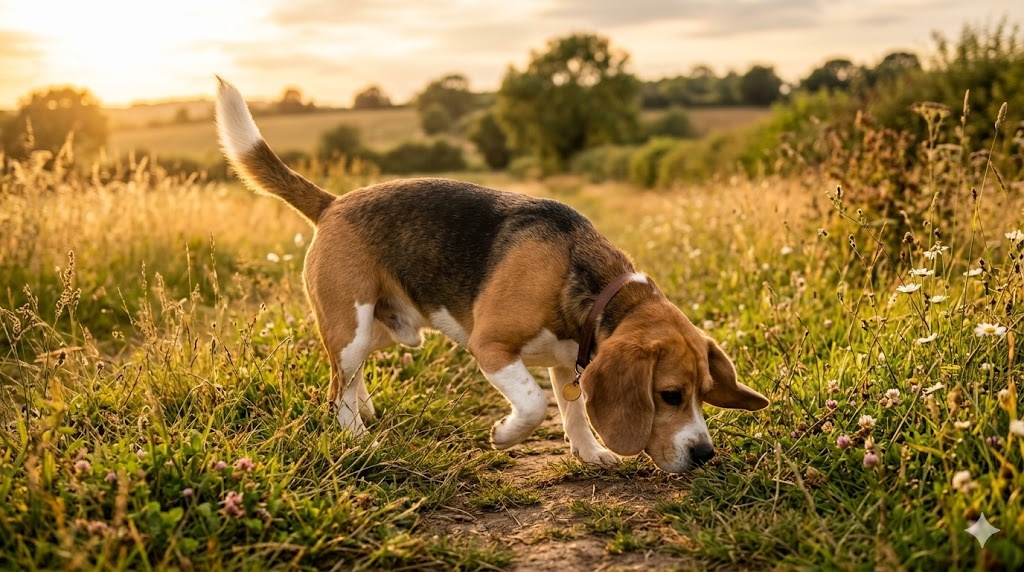
The Beagle is a small-to-medium scent hound with one of the most expressive faces in the dog world and one of the most powerful noses. Cheerful, curious, food-motivated, and famously vocal, the Beagle is built for the field but adapts beautifully to family life - provided owners understand that beneath the soft, big-eyed exterior is a working hunter who lives to follow scent. The breed has been a favourite of British country families, American suburbs, and detection-dog services worldwide.
History & Origins
Small scent hounds have existed in Britain for centuries; references to "beagle" type dogs appear in literature from the 1400s onward. Elizabeth I and James I both kept "Glove Beagles" - tiny hounds said to fit in a glove. The modern Beagle, however, was assembled in the 1830s by the Reverend Phillip Honeywood in Essex, England, who concentrated several local hound lines into a more consistent type. American Beagles arrived in the 1870s and were standardised by the AKC in 1885.
The breed was developed to hunt rabbit and hare in packs, working on foot rather than horseback. The compact size, loud "bay" voice, and remarkable stamina suited the job perfectly. Today most Beagles are companion or detection dogs, but field-bred lines are still used for hunting and trial work.
Appearance
Two AKC size varieties: under 33 cm (13 in) and 33-38 cm (13-15 in) at the shoulder. Weight typically 9-14 kg (20-30 lb). Sturdy, compact, slightly longer than tall.
Key features:
- Head: broad, domed skull, square muzzle, long pendulous ears that reach the nose tip when extended.
- Eyes: large, brown or hazel, with the classic "soft, pleading" expression.
- Coat: short, dense, weather-resistant; lies close to the body.
- Colour: tri-colour (black, tan, white) is most common; also red-and-white, lemon-and-white, and tan-and-white. The tail is typically tipped in white - historically called the "flag" so hunters could spot the dog in long grass.
- Tail: straight, carried up but not curled over the back.
Temperament & Character
Beagles are cheerful, sociable, and curious. They are friendly with people of all ages, get on well with other dogs (they are pack animals by design), and tolerate cats they grew up with. Independence is a defining trait: a Beagle is friendly but does not need constant human attention the way a Lab does.
The breed is famously food-driven. This makes training easier - and makes counter-surfing, garbage-raiding, and weight gain perennial problems. Their nose dominates their brain; a Beagle on a scent will tune out everything, including your call.
Beagles are vocal. They bark, they bay (a distinctive musical howl), and they make a strange vocabulary of grunts, sighs, and moans. Apartment owners and neighbours should be prepared for this.
Care
Coat & Grooming
The short coat is easy: a weekly brush with a rubber curry or hound glove plus a bath every 6-8 weeks. Sheds moderately year-round and more heavily in spring and autumn.
The long floppy ears are the main maintenance point. Trapped moisture causes infections; clean weekly with a vet-approved solution and dry thoroughly. Trim nails monthly, brush teeth several times weekly.
Exercise & Activity Needs
A working hound. Adults need at least 60 minutes of daily exercise, ideally split into a long walk plus play or scent work. Off-leash freedom is risky in unfenced areas - a Beagle will follow an interesting scent for miles.
Mental work matters as much as physical. Scent games, snuffle mats, hidden-treat searches, and tracking activities satisfy the breed's need to use its nose. A under-exercised, under-stimulated Beagle becomes vocal, destructive, and obese in short order.
Health & Lifespan
Average lifespan is 12-15 years - one of the longest among popular breeds.
Common issues:
- Obesity - far and away the biggest health problem. Approximately 50% of pet Beagles are overweight.
- Ear infections from heavy, hairy ears.
- Intervertebral disc disease (IVDD) due to the slightly long back.
- Epilepsy - relatively common.
- Hypothyroidism.
- Cherry eye, glaucoma.
- Beagle Pain Syndrome (steroid-responsive meningitis-arteritis) - a juvenile inflammatory condition.
The breed is generally robust given a healthy weight and routine care.
Feeding & Nutrition
Adults typically eat 3/4 to 1½ cups of quality food per day, split into two meals. Their appetite is enormous; their requirement is modest. Measure portions precisely, weigh treats into the daily total, and ignore the begging eyes.
Beagles will eat almost anything they find, including dangerous items - secure bins, keep medication out of reach, watch what they pick up on walks.
Pros & Cons
Pros
- Friendly, cheerful, sociable - excellent family companion.
- Sturdy, generally healthy, long-lived.
- Easy short coat.
- Compact size suits many homes.
- Naturally good with other dogs.
Cons
- Loud - barks and bays.
- Prone to obesity; will eat almost anything.
- Difficult off-lead recall; follows scent obsessively.
- Sheds steadily.
- Can develop separation issues if isolated.
Best Suited For
- Active families with children.
- Households with other dogs (Beagles are happiest in pairs or packs).
- Owners interested in scent work, tracking, or rabbit hunting.
- Suburban and rural homes with secure fencing.
Not suited for apartment dwellers in noise-sensitive buildings, owners who want a quiet dog, or anyone who can't resist feeding treats.
Beagle puppy growth chart
A typical growth curve for a medium breed like the Beagle, estimated from its adult weight of 9-14 kg. Puppies vary with sex, genetics and diet, so treat this as a guide - for your own puppy, use the puppy weight predictor.
| Age | Typical weight | % of adult |
|---|---|---|
| 2 mo | 2.4-3.8 kg | 27% |
| 3 mo | 3.6-5.6 kg | 40% |
| 4 mo | 4.5-7 kg | 50% |
| 6 mo | 6.1-9.5 kg | 68% |
| 9 mo | 7.7-11.9 kg | 85% |
| 12 mo | 8.7-13.6 kg | 97% |
| Adult | 9-14 kg | 100% |
Beagle - frequently asked questions
Are Beagles good apartment dogs?
Possible with enough exercise and a tolerant building. Be honest about the barking - Beagles are loud, and a frustrated Beagle is much louder.
Are Beagles hard to train?
Not unintelligent - but driven by nose and stomach rather than by pleasing humans. Reward-based training works; expect recall to remain unreliable around strong scents.
Do Beagles smell?
They have a moderate "hound smell" - natural body oils that some owners find more noticeable than in other breeds. Regular baths and ear care control this.
Can Beagles be left alone?
Better in pairs than alone. As pack animals, isolation produces anxiety and excessive vocalising. Daycare or a second dog helps.
Why are Beagles used in laboratories?
Their friendly, accepting temperament and uniform size made them the standard laboratory dog for decades - a tragic abuse of a trusting breed. Rescue Beagles from such facilities often adapt remarkably well to pet life despite traumatic backgrounds.
🧠 Test yourself: guess the dog
Three clues from our quiz bank, each about another of our dogs. Can you name them?
Clue 1.A big, wolf-like sled dog with a dense double coat, it is famously friendly and vocal, often woo-wooing instead of barking.
It's the Alaskan Malamute - read the full profile →
Clue 2.This small companion dog's name translates roughly to 'little lion' in Chinese, and it was bred for centuries inside imperial palaces.
It's the Shih Tzu - read the full profile →
Clue 3.This profusely coated working dog's slightly curled lips prevent drooling and icicles in frigid cold.
It's the Samoyed - read the full profile →
💛 Adoptable Beagles near you
Real dogs of this breed (and close mixes) waiting in shelters and rescues right now, live from Petfinder. We have no affiliation and earn nothing - if someone catches your eye, the link goes straight to their shelter. New to adopting? Start with our adoption guide.
Widget not loading (some ad-blockers hide it)? Search directly on petfinder.com.