Quaker (Monk) Parakeet
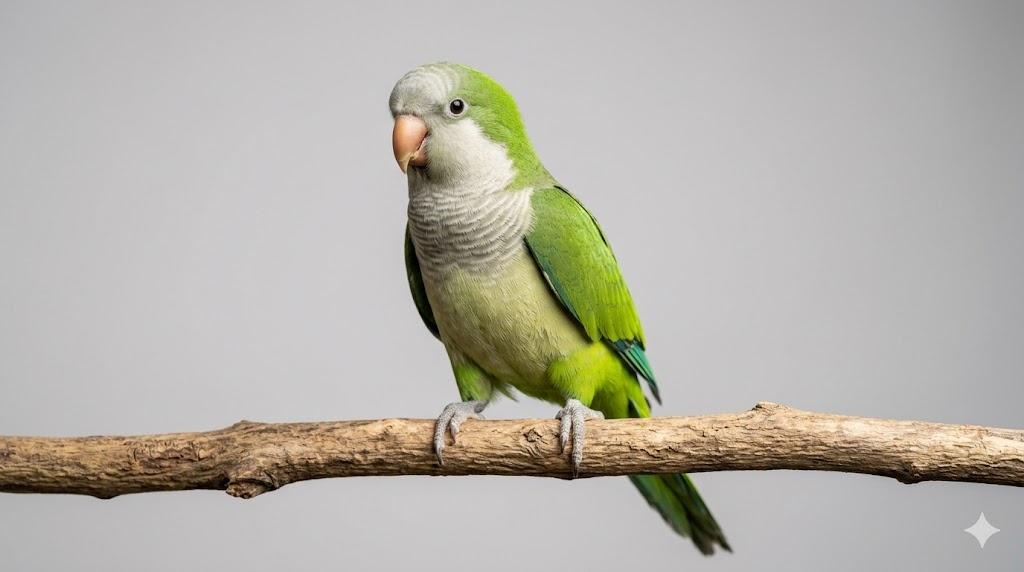
The Quaker Parakeet (Myiopsitta monachus) - also called the Monk Parakeet - is a small bright-green parrot native to South America with a unique distinction: it is the only parrot that builds large communal stick nests instead of nesting in tree cavities.
🗓️ Last reviewed: June 2026
Overview
The Quaker Parakeet (Myiopsitta monachus) - also called the Monk Parakeet - is a small bright-green parrot native to South America with a unique distinction: it is the only parrot that builds large communal stick nests instead of nesting in tree cavities. Outgoing, social, and talented at talking, Quakers combine parrot intelligence with a manageable apartment-friendly size.
Natural History & Origin
Native to temperate South America (Argentina, southern Brazil, Bolivia, Paraguay, Uruguay). The species has established feral populations in the US, Spain, and elsewhere through escaped pets. This has led to illegal status in several US states (California, Pennsylvania, Connecticut, others) due to agricultural concerns.
Appearance
Adults weigh 90-130 g, length 28-30 cm.
Colour: green body with grey breast and face. Mutations include blue, cinnamon, lutino, white.
Temperament & Noise
Bold, outgoing, social, intelligent. Quakers bond strongly with family and are typically friendly with multiple people. Talented talkers - many learn dozens of words clearly.
Moderately loud - not as quiet as canaries, not as loud as conures. Manageable for most apartments.
Quakers can be territorial about their cage or chosen "nest area" - provide adequate space and respect their territory.
Housing & Flight
Minimum cage: 75 × 60 × 75 cm. Bar spacing 1.6-2 cm.
Provide:
- Many toys (Quakers are nest-builders and love to weave, shred, manipulate).
- Variety of perches.
- Daily out-of-cage time.
- Foraging puzzles.
Diet
- Pellets (60%).
- Fresh vegetables daily - abundant variety.
- Sprouted seeds.
- Limited fruit.
Health & Lifespan
20-30 years.
Common concerns:
- Fatty liver disease.
- PBFD.
- Aspergillosis.
- Feather plucking from stress.
Pros & Cons
Pros:
- Bold, outgoing personality.
- Excellent talker.
- Manageable size and noise level.
- Long-lived for size.
- Trainable.
Cons:
- Illegal in some US states.
- Can be territorial.
- 20-30 year commitment.
- Nippy if not socialised.
Best Suited For
- First-time small-parrot owners (where legal).
- Apartment dwellers.
- Households wanting an interactive talking bird.
Not suited for households in states where the species is illegal.
Quaker (Monk) Parakeet - frequently asked questions
Are Quakers legal?
Varies by US state. Illegal in California, Connecticut, Georgia, Hawaii, Kentucky, Pennsylvania, Rhode Island, Tennessee, Wyoming. Legal but restricted in others. Most countries outside the US allow them.
Are they good talkers?
Yes - among the best small-parrot talkers. Many learn 50+ words clearly.
Are they good with kids?
With older children, yes. They can be territorial; respect their cage space.
How long do they live?
20-30 years.
🧠 Test yourself: guess the bird
Three clues from our quiz bank, each about another of our birds. Can you name them?
Clue 1.Native to Australasia, this crested parrot may be salmon-crested, sulphur-crested, or even smoky-black, and uses powder down to clean its plumage.
It's the Cockatoo - read the full profile →
Clue 2.This tiny aviary bird has a short, conical, cone-shaped bill perfectly built for cracking small seeds.
It's the Finch (Zebra & Society) - read the full profile →
Clue 3.Sold in bright peach-faced and masked varieties, this little hookbill can become nippy without daily attention.
It's the Lovebird - read the full profile →
Social Needs
Strongly bonded to humans. Single bird with significant interaction works well; pairs can also succeed.