Chartreux
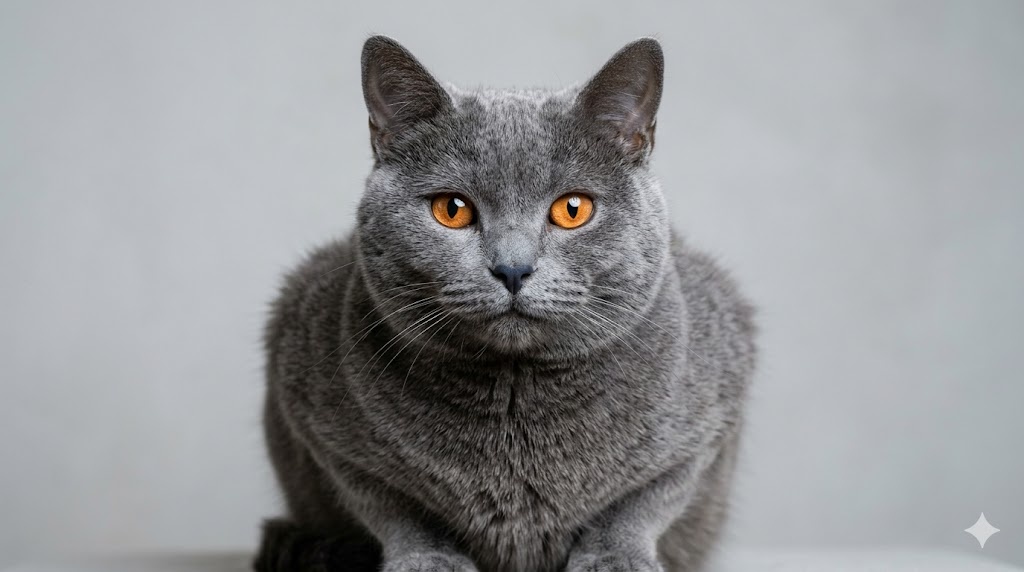
The Chartreux is the national cat of France - a robust, blue-grey, copper-eyed cat with a quiet dignified temperament and a permanent half-smile.
🗓️ Last reviewed: June 2026
Overview
The Chartreux is the national cat of France - a robust, blue-grey, copper-eyed cat with a quiet dignified temperament and a permanent half-smile. The breed has lived in France for at least 500 years and was reportedly kept by French monks at the Grande Chartreuse monastery. Calm, sturdy, and devoted, the Chartreux is one of the most peaceful breeds to live with.
History & Origins
Documented in France from the 1500s. The Chartreux was nearly extinct after World War II; surviving cats were carefully outcrossed with British Shorthair to preserve the breed. CFA recognition came in 1987.
Appearance
Medium-large, robust, with a "potato on toothpicks" build (heavy body, fine-boned legs). Adults weigh 4-7 kg (9-15 lb).
- Coat: medium-short, dense, water-resistant double coat with a slightly woolly texture.
- Colour: blue (slate-grey) only. Silvery sheen on the tips.
- Eyes: copper or gold, round, expressive.
- Head: rounded with full cheeks and a slight permanent smile.
- Body: stocky, muscular, with surprisingly fine bones.
Temperament & Character
Quiet, calm, devoted. The Chartreux is famously silent - many barely meow at all. Bonds strongly with family without being demanding. Excellent with children and other pets.
Care
Coat & Grooming
The dense water-resistant coat is moderate maintenance. Weekly brushing; daily during seasonal shed. Bathing can be challenging - the coat repels water.
Health & Lifespan
12-15 years.
- Patellar luxation.
- Polycystic kidney disease (rare).
- Hip dysplasia.
The breed is generally healthy.
Pros & Cons
Pros: quiet, devoted, sturdy, healthy, family-tolerant. Cons: dense coat sheds; uncommon and pricey.
Chartreux - frequently asked questions
Chartreux vs Russian Blue vs British Blue Shorthair?
All three are blue-grey breeds. Chartreux: French, copper eyes, dense water-resistant coat, slight smile. Russian Blue: Russian, green eyes, plush silvery coat. British Blue: British, copper eyes, plush cobby coat, broader face.
Are they really silent?
Largely yes - the breed is famously quiet, with many cats barely vocalising at all.
🧠 Test yourself: guess the cat
Three clues from our quiz bank, each about another of our cats. Can you name them?
Clue 1.One of the few naturally spotted domestic cats, this breed appears in artwork from the time of the pharaohs.
It's the Egyptian Mau - read the full profile →
Clue 2.A medium-large, even-tempered cat known for its dense coat and especially the classic silver tabby with bold swirling markings, it is one of the most popular pedigreed cats in its homeland.
It's the American Shorthair - read the full profile →
Clue 3.Legend says this color-pointed cat earned its pure white paws, like gloves, as a blessing from a temple goddess in old Burma.
It's the Birman - read the full profile →
💛 Adoptable Chartreuxs near you
Real cats of this breed (and close mixes) waiting in shelters and rescues right now, live from Petfinder. We have no affiliation and earn nothing - if someone catches your eye, the link goes straight to their shelter. New to adopting? Start with our adoption guide.
Widget not loading (some ad-blockers hide it)? Search directly on petfinder.com.