Cornish Rex
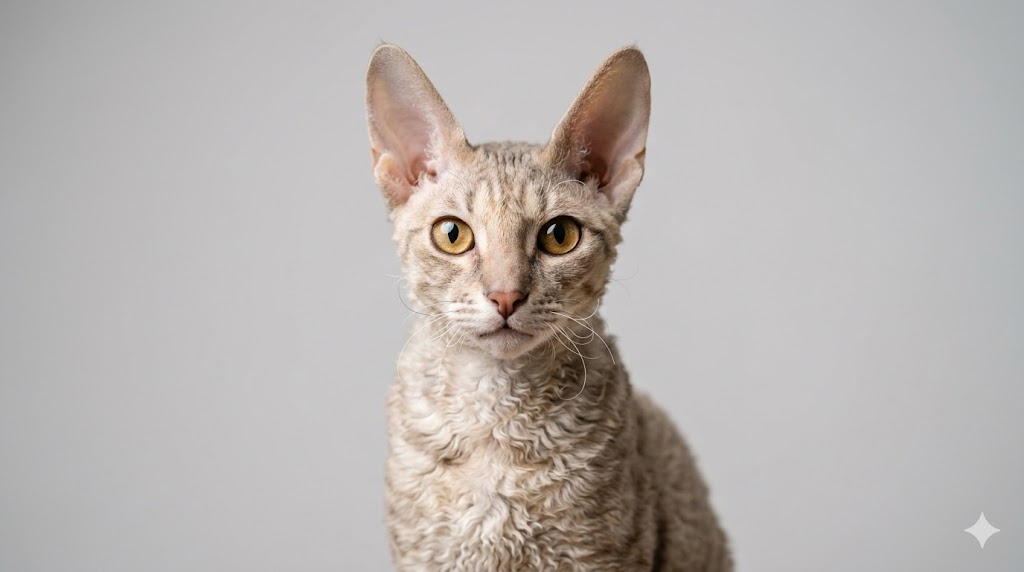
The Cornish Rex is a slim, athletic cat with a uniquely curly coat consisting only of soft down - no guard hairs and no awn hairs.
🗓️ Last reviewed: June 2026
Overview
The Cornish Rex is a slim, athletic cat with a uniquely curly coat consisting only of soft down - no guard hairs and no awn hairs. Combined with large ears, prominent cheekbones, and a slender body that looks almost greyhound-like, the breed has one of the most distinctive appearances in any cat species. The Cornish Rex is also playful, intelligent, and intensely people-oriented.
History & Origins
In 1950 a curly-coated kitten named Kallibunker was born in a litter of farm cats in Cornwall, England. The owner consulted a geneticist who identified the curly coat as a recessive mutation. Kallibunker was bred back to his mother to produce more curly kittens, founding the breed.
The Cornish Rex gene is genetically different from the Devon Rex gene; the two breeds arose independently. CFA recognition came in 1964.
Appearance
Medium-sized, slim, elegant. Adults weigh 2.5-4.5 kg (6-10 lb).
Key features:
- Coat: very short, soft, curly, consisting only of undercoat - no rougher outer guard or awn hairs. The texture is often compared to crushed velvet or astrakhan.
- Colour: all colours and patterns.
- Head: egg-shaped with prominent cheekbones, a high-bridged Roman nose, and large oval eyes.
- Ears: very large, set high.
- Body: slim, racy, with an arched back and tucked waist - clearly built for speed.
- Tail: long, slender, covered in curly fur.
Temperament & Character
Playful, affectionate, intelligent. The Cornish Rex is one of the most active cats - agile, fast, and energetic well into adulthood. The breed is people-oriented and dislikes being alone.
Most Cornish Rex are vocal, social, and dog-like in their attachment. The breed learns fetch, walks on harnesses, and enjoys interactive play.
Care
Coat & Grooming
The down-only coat is delicate. Very light weekly brushing or rubbing; over-brushing damages the curl. Bathe every 4-6 weeks - skin oils accumulate without normal coat absorption.
Clean ears weekly (large ears collect wax). Trim claws every 2 weeks. Brush teeth daily.
Cold-sensitive - sweaters and warm beds in cool homes.
Exercise & Enrichment
High. Cat trees, climbing structures, daily play. The breed loves to run, leap, and explore vertically.
Health & Lifespan
Average lifespan is 11-15 years.
Common concerns:
- Hypertrophic cardiomyopathy.
- Patellar luxation.
- Dental disease.
- Skin issues (oil accumulation, hereditary baldness in some lines).
- Heat sensitivity - both cold and hot extremes are difficult.
Feeding & Nutrition
50-70 g per day. The breed's high metabolism may require slightly more than other small cats.
Living With
Indoor only.
Cold and people-oriented.
Pros & Cons
Pros
- Distinctive, elegant appearance.
- Affectionate, playful, dog-like.
- Low-shedding; often tolerated by allergy sufferers.
- Highly intelligent.
Cons
- Cold-sensitive.
- Cannot tolerate being alone.
- Premium prices.
- HCM risk.
Best Suited For
- Households home most of the day.
- Allergy-sensitive owners.
- Active homes wanting an interactive cat.
Not suited for cold drafty households, working households without coverage.
Cornish Rex - frequently asked questions
Cornish vs Devon Rex - which is curlier?
Cornish has only down hair (softest, most uniform curl). Devon has all three hair types in curly form (slightly coarser, more varied curl).
Are they hypoallergenic?
Not fully - they produce Fel d 1 normally. Many allergy sufferers tolerate them due to less coat.
Do they need clothing?
In cool homes, yes. Sweaters help maintain comfortable body temperature.
Are they good with kids?
Excellent - playful, friendly, tolerant.
How long do they live?
11-15 years on average.
🧠 Test yourself: guess the cat
Three clues from our quiz bank, each about another of our cats. Can you name them?
Clue 1.Weighing among the least of any pedigreed cat, this big-eyed breed traces to street cats of a tropical port nation.
It's the Singapura - read the full profile →
Clue 2.This semi-longhair carries the same agouti ticking as the Abyssinian, with each hair banded in multiple colors.
It's the Somali - read the full profile →
Clue 3.This large cat from eastern Turkey is unusual for enjoying water, and its body is mostly white with colored markings only on head and tail.
It's the Turkish Van - read the full profile →
💛 Adoptable Cornish Rexs near you
Real cats of this breed (and close mixes) waiting in shelters and rescues right now, live from Petfinder. We have no affiliation and earn nothing - if someone catches your eye, the link goes straight to their shelter. New to adopting? Start with our adoption guide.
Widget not loading (some ad-blockers hide it)? Search directly on petfinder.com.