Devon Rex
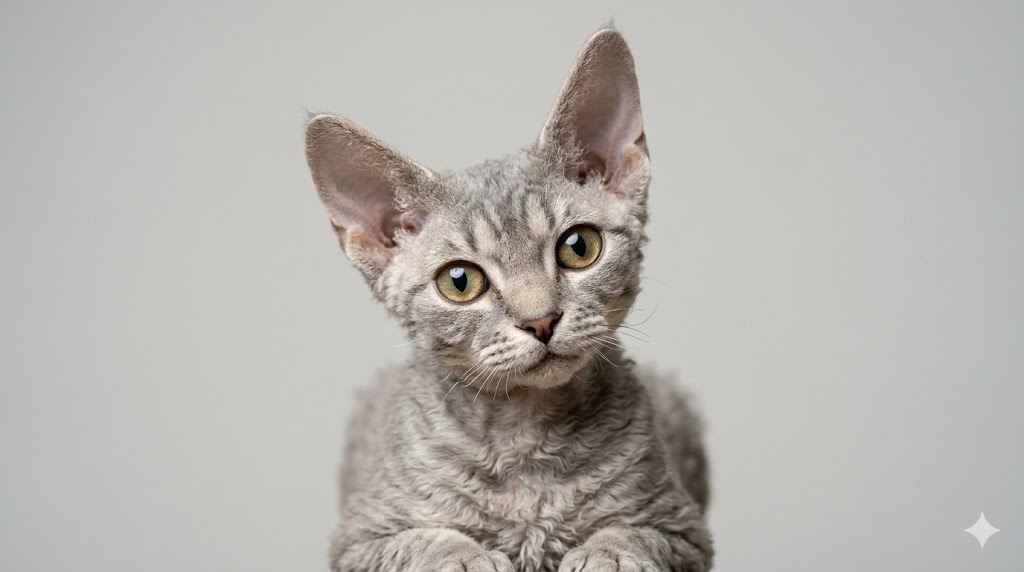
The Devon Rex is a small, elf-like cat with enormous ears, big eyes, and a curly coat.
🗓️ Last reviewed: June 2026
Overview
The Devon Rex is a small, elf-like cat with enormous ears, big eyes, and a curly coat. Often called the "pixie of the cat fancy" or the "monkey in a cat suit," the Devon Rex combines a uniquely whimsical appearance with one of the most playful, mischievous, and people-oriented temperaments in any breed. The breed is also low-shedding and often tolerated by allergy sufferers.
History & Origins
In 1959 in Devon, England, a stray feral tom and a domestic queen produced a litter that included a curly-coated kitten named Kirlee. Kirlee was initially mistaken for a Cornish Rex but proved genetically distinct - the Devon curl gene is recessive and different from the Cornish gene. The Devon Rex breed was developed from Kirlee.
CFA recognition came in 1979.
Appearance
Small to medium, slim, with a distinctive elf face. Adults weigh 2.5-4 kg (6-9 lb).
Key features:
- Coat: short, curly, soft, with significantly less hair than typical cats. The whiskers are also curled and may be brittle.
- Colour: all colours and patterns.
- Head: broad with prominent cheekbones, a short muzzle, and very large eyes set wide.
- Ears: enormous, low-set, with wide bases.
- Body: slender, long-legged, fine-boned.
- Tail: long, slender, covered in short curly hair.
Temperament & Character
Playful, mischievous, intensely social. Devon Rex are among the most people-oriented cats - they follow owners constantly, climb on shoulders, sit on heads, and demand involvement in every activity. The breed is famously "lap-loving" and warm-seeking (the thin coat provides little insulation).
Most are excellent with children, friendly with strangers, and tolerant of other pets. The breed is intelligent - fetch, harness walks, and trick training all work.
Care
Coat & Grooming
The thin curly coat is delicate. Light weekly brushing with a soft cloth; over-brushing damages the curl. Bathe every 4-6 weeks - skin oils accumulate more than in haired breeds.
Clean ears weekly (large ears collect wax). Trim claws every 2 weeks. Brush teeth daily.
The breed needs warmth - sweaters in cool homes, heated beds, lap time.
Exercise & Enrichment
High. Cat trees, climbing structures, daily play. Many Devon Rex enjoy shoulder-riding and walking on harnesses.
Health & Lifespan
Average lifespan is 9-15 years.
Common concerns:
- Hereditary myopathy - DNA test available.
- Hypertrophic cardiomyopathy.
- Patellar luxation.
- Hip dysplasia.
- Skin problems - yeast infections, oily skin.
- Dental disease.
Feeding & Nutrition
50-70 g per day, possibly more due to higher caloric needs (less coat = more thermoregulation).
Living With
Indoor only.
The breed is cold-sensitive and very people-oriented; outdoor life is not appropriate.
Pros & Cons
Pros
- Low-shedding; often tolerated by allergy sufferers.
- Affectionate, playful, dog-like.
- Distinctive elf-like appearance.
- Highly trainable.
Cons
- Cold-sensitive - sweaters required in many homes.
- Cannot tolerate being alone.
- Higher food costs.
- Premium prices.
Best Suited For
- Households home most of the day.
- Allergy-sensitive owners.
- Active households wanting an interactive cat.
Not suited for working homes without coverage or cold drafty households.
Devon Rex - frequently asked questions
Are Devon Rex hypoallergenic?
Not fully, but the thin curly coat sheds minimally and produces less dander. Many allergy sufferers tolerate them.
Devon Rex vs Cornish Rex - what's the difference?
Different genes (both produce curly coats but independently). Devon has a curly coat with some guard hairs and curlier whiskers; Cornish has only down hair (no guards) and a different head shape. Both share curly playful temperament.
Are they good with kids?
Excellent - playful, affectionate, tolerant.
Why are they so warm-seeking?
The thin coat provides little insulation; the breed feels cold more easily than haired cats and seeks warmth - laps, beds, sunny windows.
Do they need warm clothes?
Many do. In cool homes (under 20°C), sweaters and heated beds make Devon Rex more comfortable.
🧠 Test yourself: guess the cat
Three clues from our quiz bank, each about another of our cats. Can you name them?
Clue 1.This sleek, fine-boned cat is essentially a same-shaped relative of the Siamese but in hundreds of colors.
It's the Oriental Shorthair - read the full profile →
Clue 2.Bold and dog-like, this cheetah-patterned cat is graded by generation, with the first cross being the most wild-blooded.
It's the Savannah - read the full profile →
Clue 3.The tri-color 'mi-ke' pattern of this Asian breed inspired the waving lucky-cat figurine.
It's the Japanese Bobtail - read the full profile →
💛 Adoptable Devon Rexs near you
Real cats of this breed (and close mixes) waiting in shelters and rescues right now, live from Petfinder. We have no affiliation and earn nothing - if someone catches your eye, the link goes straight to their shelter. New to adopting? Start with our adoption guide.
Widget not loading (some ad-blockers hide it)? Search directly on petfinder.com.