Ragdoll
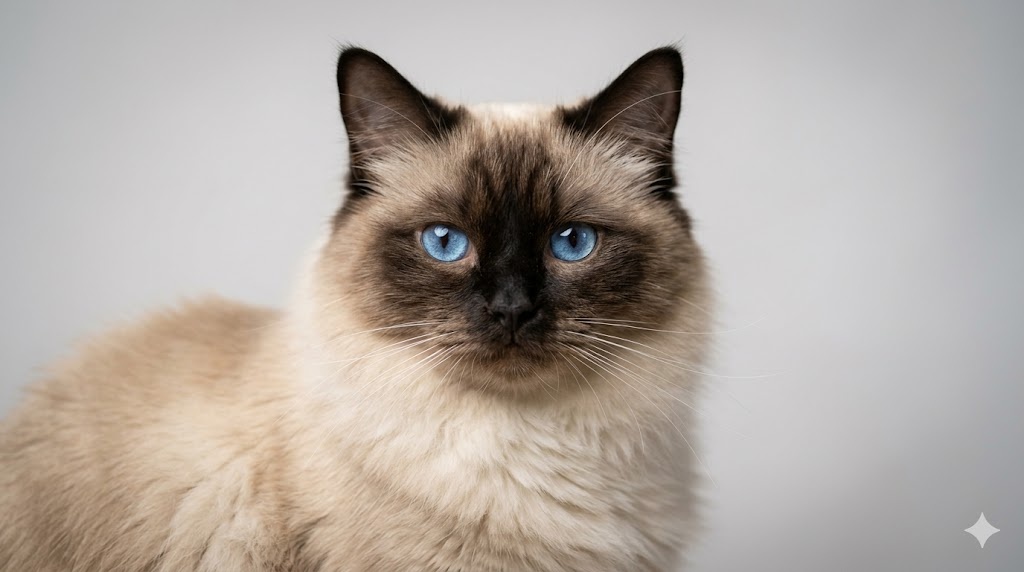
The Ragdoll is a large, semi-longhaired blue-eyed cat famous for going limp in your arms - the trait that gave the breed its name.
🗓️ Last reviewed: June 2026
Overview
The Ragdoll is a large, semi-longhaired blue-eyed cat famous for going limp in your arms - the trait that gave the breed its name. Affectionate, docile, and dog-like in its attachment to people, the Ragdoll is among the most family-tolerant of all cat breeds. The breed is also relatively young (1960s) and entirely the product of one Californian breeder's vision, making the Ragdoll one of the few breeds with a single, well-documented origin story.
History & Origins
The breed was created in Riverside, California, in the 1960s by Ann Baker from a semi-feral white longhaired cat named Josephine. Josephine and her offspring displayed unusual traits - large size, blue eyes, pointed coats, and the famous "going limp when handled" behaviour. Baker registered the breed name "Ragdoll" and patented her cats, an unusual move that controlled the breed for years.
In 1975 a group of breeders broke from Baker's organisation to register the Ragdoll with mainstream cat clubs. CFA recognition came in 1993. The breed grew rapidly in popularity and is now one of the most-registered breeds globally.
The trademark "ragdoll" limpness has been studied; it appears to be a learned behaviour combined with the breed's exceptionally relaxed disposition, not a genetic defect.
Appearance
Large, semi-longhaired, blue-eyed. Males weigh 5-9 kg (12-20 lb); females 4-6 kg. Full size by age 3-4.
Key features:
- Coat: medium-long, silky, plush, with minimal undercoat. Less prone to matting than the Persian.
- Colour: pointed pattern (Siamese-style - dark mask, ears, legs, tail) in six colours: seal, blue, chocolate, lilac, red, cream. Three patterns: colourpoint (no white), mitted (white feet/chin), bicolour (more white).
- Eyes: large, oval, brilliant blue. All Ragdolls have blue eyes.
- Head: broad modified wedge with rounded contours.
- Body: long, broad chest, heavy bone. Soft and substantial when held.
Temperament & Character
Docile, affectionate, and unfailingly gentle. The Ragdoll is among the most family-tolerant cats - friendly with children, accepting of dogs, agreeable with other cats. The breed bonds strongly with people and dislikes being alone.
Most Ragdolls are lap cats. They follow their humans, greet them at the door, sleep on the bed, and want physical contact most of the day. The breed is quiet - soft voices, gentle requests.
Ragdolls are notably non-aggressive - many do not defend themselves against rough handling or other animals, which makes them strictly indoor cats. The breed has been described as having "no defensive instinct."
Care
Coat & Grooming
The plush semi-long coat is easier than expected. Brush 2-3 times weekly with a stainless-steel comb. Mats are uncommon thanks to the silky texture.
Bathe every 2-3 months or as needed. Clean ears monthly. Trim claws every 2 weeks. Brush teeth several times weekly.
Exercise & Enrichment
Moderate playfulness. Ragdolls are not athletic in the way of Bengals or Abyssinians but enjoy daily play sessions with wand toys and puzzle feeders. Many learn to fetch and walk on harnesses.
Health & Lifespan
Average lifespan is 12-15 years.
Common concerns:
- Hypertrophic cardiomyopathy (HCM) - major concern. Ragdoll-specific MYBPC3 mutation; DNA test available.
- Polycystic kidney disease (PKD).
- Bladder stones.
- Obesity.
- Dental disease.
Choose a breeder DNA-testing for HCM and PKD plus annual cardiac ultrasound on breeding cats.
Feeding & Nutrition
Adults typically eat 60-90 g of quality cat food per day. Measured portions; the breed gains weight easily.
Living With
Litter
Standard provisions. Most Ragdolls are easy to litter-train.
Multi-cat households
Ragdolls are excellent with other cats. Their non-confrontational nature makes them ideal companions to most cat personalities.
Indoor vs outdoor
Indoor-only is absolutely required. The breed has no defensive instincts and is regularly killed when allowed outside - by cars, dogs, predators, and aggressive cats. Catios and harness walks are safe alternatives.
Pros & Cons
Pros
- Exceptionally docile, family-tolerant.
- Excellent with children and other pets.
- Beautiful, distinctive appearance.
- Easier coat than Persians or other longhairs.
- Quiet and gentle.
Cons
- HCM and PKD risks; choose tested breeder.
- Strictly indoor cats - no defensive instincts.
- Premium prices from reputable breeders.
- Slow to mature (3-4 years).
- Prone to obesity.
Best Suited For
- Families with children of any age.
- Multi-pet households.
- Owners wanting a cuddly, lap-friendly cat.
- First-time cat owners.
- Indoor-only households.
Not suited for households where cats must defend themselves, owners wanting an active hunter, or homes that allow outdoor access.
Ragdoll - frequently asked questions
Do Ragdolls really go limp when held?
Most do, to varying degrees. The trait is partly learned and partly the breed's exceptional relaxation; it's not a genetic anaesthetic.
Are Ragdolls good with children?
Outstanding - patient, gentle, tolerant. Among the best breeds for families.
Do they shed a lot?
Less than expected for a longhaired breed. The silky single-layered coat sheds moderately.
Can Ragdolls go outside?
No. Their non-defensive temperament makes outdoors dangerous. Use catios and harnesses.
Ragdoll vs Maine Coon - which is better?
Both are large, sociable, family-tolerant. Ragdoll is calmer and more lap-oriented. Maine Coon is more athletic and dog-like in following you around. Maine Coon coat sheds more. Both have HCM risk; check breeder screening.
🧠 Test yourself: guess the cat
Three clues from our quiz bank, each about another of our cats. Can you name them?
Clue 1.Nicknamed the 'swimming cat,' this Turkish breed has a water-resistant coat and color restricted to its head and tail.
It's the Turkish Van - read the full profile →
Clue 2.With huge ears, a wedge-shaped head, and a loud voice, this svelte cat is chatty and intensely people-focused.
It's the Oriental Shorthair - read the full profile →
Clue 3.Arising from a curly-coated stray near a Devon tin mine, this cat carries a different curl gene than its Cornish cousin.
It's the Devon Rex - read the full profile →
💛 Adoptable Ragdolls near you
Real cats of this breed (and close mixes) waiting in shelters and rescues right now, live from Petfinder. We have no affiliation and earn nothing - if someone catches your eye, the link goes straight to their shelter. New to adopting? Start with our adoption guide.
Widget not loading (some ad-blockers hide it)? Search directly on petfinder.com.