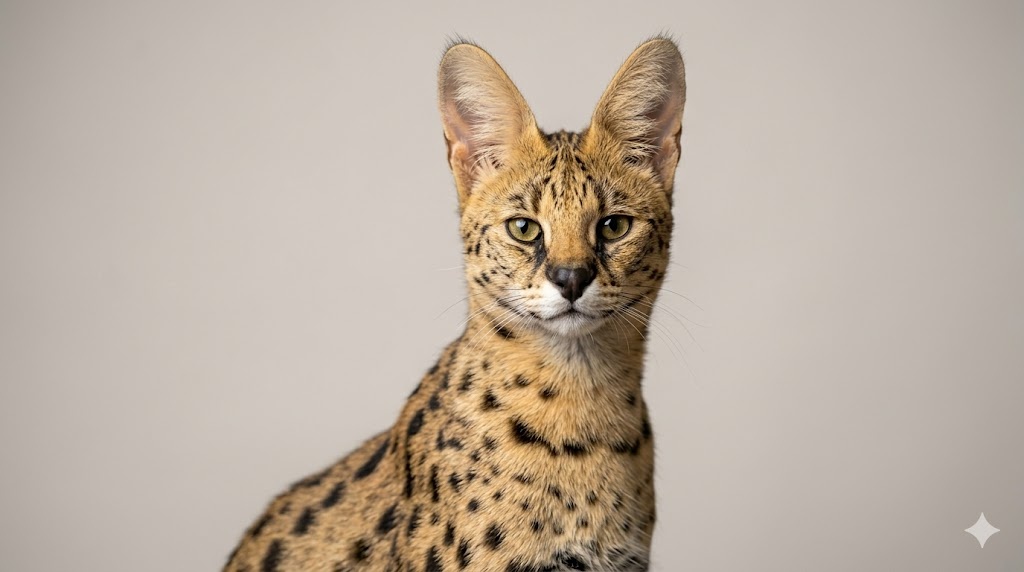
The Savannah is a tall, exotic-looking hybrid cat created by crossing a domestic cat with the wild African Serval.
Coming soon. Subscribe to the newsletter to get notified when this video drops.
The Savannah is a tall, exotic-looking hybrid cat created by crossing a domestic cat with the wild African Serval. The result is one of the most dramatic-looking cats in existence β long-legged, spotted, with huge ears β and one of the most controversial pet cats due to wild ancestry and resulting regulations.
The first Savannah was bred in 1986 by Judee Frank in Pennsylvania, who crossed a Serval with a domestic cat. Patrick Kelley and Joyce Sroufe developed the breed further in the 1990s. TICA recognition came in 2012.
Savannahs are classified by generation:
Many jurisdictions restrict F1βF3 Savannahs. F4+ are typically legal but check local laws.
Large to very large, long-legged. F1 males can reach 9β11 kg (20β25 lb) and shoulder height of 50 cm β the tallest domestic cats. Later generations are smaller.
Active, curious, intensely bonded. The breed is intelligent, energetic, and demanding. Many enjoy water, harness walks, and dog-like activities.
F1βF2 Savannahs retain noticeable wild behaviour β territorial, demanding, sometimes destructive. F4+ are more domestic but still active and challenging.
Very low-maintenance.
Enormous. Climbing structures, daily play, harness walks, ideally a catio.
12β20 years.
Pros: stunning appearance, dog-like personality, athletic, intelligent. Cons: legal restrictions, very expensive, demanding, not for typical homes.
Is owning a Savannah legal? Varies. F1βF3 are restricted or banned in many places. F4+ are typically legal but verify local laws.
How big do they get? F1 males can be 10+ kg and 50 cm tall at the shoulder β the tallest domestic cats. Later generations are smaller.
Are they aggressive? F4+ generally domestic. F1βF2 retain noticeable wild traits and are not appropriate pets for most homes.
Cost? F1 Savannahs sell for $20,000+. F4+ for $1,500β$5,000.
The Savannah Cat β The Serval Hybrid Giant
10β11 minutes
Massive spotted Savannah F1 standing tall on long legs, intense gold eyes, leaning forward. Caption: "BIGGEST HOUSE CAT".
Photograph of a large tall F1 Savannah cat standing on impressively long slim legs, golden coat with distinct black solid spots, very tall pointed ears, slender long neck, intense amber eyes, leaning forward attentively, soft savanna grass background blurred, golden hour lighting, 85mm lens at f/2.8, professional cat photography, ultra-sharp focus on eyes.
The Savannah is the largest domestic cat in the world β a Serval hybrid that can stand 18 inches at the shoulder. Today we cover the breed creation, the legal status, the demanding temperament, true care requirements, health, and whether the Savannah is the right cat for you.
β± Timestamps 00:00 Intro Hook 01:00 Origin: First Serval-Domestic Cross in 1986 02:30 Temperament: Energy of a Working Dog 04:00 Care: Space, Stimulation, Diet 05:30 Health: Robust but Specialised Care 07:00 Training: Highly Trainable 08:30 3 Biggest Mistakes New Savannah Owners Make 10:00 Is The Savannah Right For You? 11:00 Outro
π Subscribe for a new breed each week.
"The Savannah is the tallest pedigreed house cat in the world. An F1 Savannah can stand eighteen inches at the shoulder and weigh up to twelve kilograms. It is the result of crossing the African Serval with a domestic cat. The Savannah is not for most owners. It is a specialised breed with significant legal, financial, and lifestyle requirements. Today: the breed creation, what life is actually like with one, and whether the Savannah belongs in any normal household."
"In 1986, Pennsylvania breeder Judee Frank produced the first documented Serval-domestic cross β a single kitten she named Savannah. The breed was developed slowly over the next twenty years by a small group of breeders. TICA accepted the Savannah in 2001. CFA does not recognise the breed. Savannahs are categorised by generation from the Serval ancestor: F1 β 50% Serval. Very large. Strict regulations. F2 β 25% Serval. Still large. F3 β 12.5%. F4 onwards β considered fully domestic. Legal status varies. New York City bans Savannahs. Hawaii bans them. Australia bans imports. Several countries restrict F1βF3. Always check local law before any purchase. Modern pet Savannahs are usually F4 or later β large, athletic, distinctively spotted, but legally and behaviourally manageable."
"Savannahs are athletic, intelligent, intensely energetic, and deeply bonded. They run. They jump β vertically eight feet from standing. They climb. They open doors. They chase. They want to participate in everything. Voice is moderate but distinctive. Chirps, hisses, growls, and unusual vocalisations from the Serval ancestry. Bonding is intense. Many Savannahs become one-person cats with deep attachment. Energy must be channelled. Without enough exercise, the Savannah becomes destructive. With other animals β variable. Often dominant. Best as the only cat or paired with another active Savannah. Many love water β joining showers, splashing in baths."
"Coat is short and easy. Weekly rubber mitt. Space is essential. Savannahs need a large home, ideally with a serious catio or outdoor enclosure. Apartments are inadequate. Multiple tall cat trees. Wall shelves. Vertical runways throughout the home. Two to three daily interactive play sessions. Diet: high-protein. Many breeders recommend partial raw diets. Lower-generation Savannahs may need specialised diets. Nails fortnightly. Teeth daily. Indoor or full catio only. Outdoor freedom is illegal in many places and dangerous everywhere."
"Lifespan twelve to twenty years. Health concerns: Hypertrophic cardiomyopathy. Annual cardiac ultrasound. Pyruvate kinase deficiency β DNA testable. Anaesthetic sensitivities. Discuss with vet before any procedure. Vaccines: live attenuated vaccines may not be safe; consult an exotic-experienced vet. Otherwise robust but specialised. Find an exotic-experienced vet before bringing a Savannah home."
"Savannahs are among the most trainable cats. They walk on lead, learn dozens of tricks, fetch, and respond to recall. Train from kittenhood. Targets: name, recall, sit, lie down, fetch, harness wear, agility. Leash training is essential β outdoor exercise must be supervised. Litter solved by the breeder. Scratching: large robust sisal posts."
"Mistake one: ignoring local laws. Buying a Savannah where it is banned creates serious problems. How to avoid: check national, state, and city law before buying. Confirm in writing. Mistake two: inadequate space and enrichment. Bored Savannahs destroy homes. How to avoid: large home, catio, vertical climbing structures, multiple daily play sessions. Mistake three: wrong generation choice. F1βF3 are not appropriate pet cats for most owners. How to avoid: choose F4 or later. Discuss generation explicitly with the breeder."
"Checklist: Savannahs are legal where you live. You have a large home and catio space. You can provide multiple daily interactive sessions. You can budget for premium diet and specialised vet care. You are an experienced cat owner. Tick all five β and you may be ready for an F4 Savannah. Otherwise β choose a Bengal, Maine Coon, or active mixed-breed instead. The Savannah is not a starter cat."
"That is the Savannah β the tallest house cat in the world, the Serval hybrid, the breed that demands genuine commitment. Spectacular. Loyal. Demanding. Next breed? Comment below. Subscribe and the bell. Next week: the Tonkinese β the playful mid-point between Burmese and Siamese." (End screen: subscribe button, 'watch next: Tonkinese' thumbnail, channel logo)