Scottish Fold
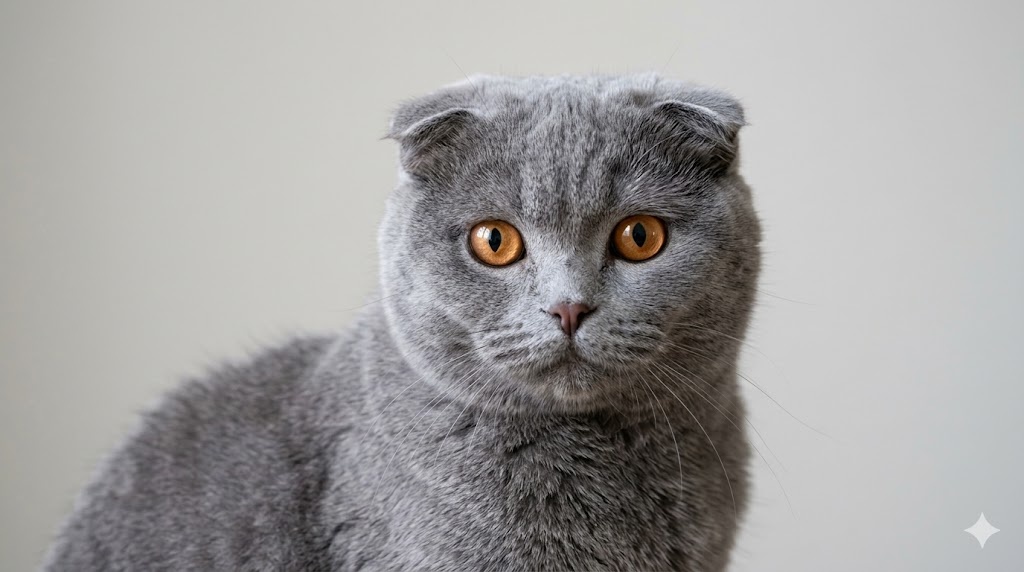
The Scottish Fold is a medium-sized, owl-like cat famous for its small folded ears - a genetic mutation that produces the breed's unique appearance.
🗓️ Last reviewed: June 2026
Overview
The Scottish Fold is a medium-sized, owl-like cat famous for its small folded ears - a genetic mutation that produces the breed's unique appearance. Sweet-natured, calm, and increasingly popular through internet fame (Taylor Swift's cats, "Maru" the Japanese star, and countless cat memes), the Scottish Fold is also one of the most welfare-controversial breeds in existence: the same gene that folds the ears also causes painful skeletal disease in every Scottish Fold to some degree.
History & Origins
In 1961 a Scottish farmer named William Ross noticed an unusual white cat with folded ears on a neighbouring farm. The cat, named Susie, became the foundation of the Scottish Fold breed when Ross acquired one of her kittens. By 1966 the breed had been registered in Britain.
In 1971 the Governing Council of the Cat Fancy (GCCF) in Britain withdrew recognition over welfare concerns about the ear-folding gene. The breed continued in the United States and elsewhere; CFA recognition came in 1973.
The ear-folding gene (Fd) is a dominant mutation in the TRPV4 gene. The same gene causes osteochondrodysplasia - abnormal cartilage and bone development - to varying degrees in every Scottish Fold. Heterozygous folds (Fd/fd) have mild to moderate disease; homozygous folds (Fd/Fd) have severe disease. Reputable breeders never breed two folds together, and outcross to British Shorthair, American Shorthair, or Scottish Straight (the non-folded variant) to reduce - but not eliminate - disease severity.
Several countries now ban Scottish Fold breeding entirely on welfare grounds.
Appearance
Medium-sized, round, with small folded ears. Adults weigh 3.5-6 kg (8-13 lb).
Key features:
- Coat: two varieties - Scottish Fold (short, dense, plush) and Scottish Fold Longhair / Highland Fold (long, soft, with a ruff).
- Colour: virtually all colours and patterns.
- Ears: small, folded forward and downward, lying close to the head. Three degrees of fold - single (slight), double (tighter), triple (almost flat). Tighter folds = more severe genetic disease.
- Eyes: large, round, wide-set, very expressive.
- Head: round, broad, with full cheeks.
- Body: medium, balanced, somewhat rounded.
Scottish Straights - the non-folded littermates - look like normal British Shorthair-type cats with upright ears and do not carry the disease-causing gene.
Temperament & Character
Sweet, calm, and gentle. Scottish Folds are typically friendly with family, tolerant of children and other pets, and adaptable to most households. The breed is moderately playful as adults and not particularly demonstrative - quiet, affectionate, undemanding.
Many Scottish Folds adopt unusual postures - sitting upright with paws on belly ("Buddha position"), sleeping flat on their backs, sitting like little owls. The "Scottish Fold sit" is breed-typical.
Pain from skeletal disease can make the breed less playful than expected. Many show subtle reluctance to jump, run, or climb - interpreted as "calm temperament" but actually reflecting joint pain.
Care
Coat & Grooming
Shorthair: brush 1-2 times weekly. Longhair: brush 2-3 times weekly.
Clean ears weekly with extra care - the folded ears trap debris and wax, requiring more frequent cleaning than upright ears. Trim claws every 2 weeks. Brush teeth several times weekly.
Exercise & Enrichment
Moderate. Provide low platforms (high jumps may be painful), interactive toys, and gentle play. Watch for limping, reluctance to jump, or stiff movement - signs of skeletal disease.
Health & Lifespan
Average lifespan is 11-15 years.
The defining health concern is osteochondrodysplasia - abnormal cartilage development affecting joints throughout the body. Every Scottish Fold has it to some degree. Symptoms include stiff tail, painful joints, lameness, and reduced mobility. Severity varies from mild to crippling. There is no cure; management includes pain relief, joint supplements, weight control, and surgery in severe cases.
Other concerns:
- Hypertrophic cardiomyopathy (HCM).
- Polycystic kidney disease (PKD).
- Ear infections - folded ears trap debris.
- Obesity - worsens skeletal disease.
Choose a breeder who outcrosses to non-folded breeds, never breeds fold-to-fold, and openly discusses welfare. Consider adopting a Scottish Straight (non-folded littermate) for the same temperament without the disease.
Feeding & Nutrition
Adults typically eat 50-80 g of quality cat food per day. Joint-supportive diets with EPA/DHA, glucosamine, and chondroitin are reasonable from young adulthood given the universal skeletal disease.
Living With
Litter
Standard provisions.
Multi-cat households
Tolerant of other cats.
Indoor vs outdoor
Indoor-only is safest. Skeletal disease makes the breed less able to defend itself or escape danger.
Pros & Cons
Pros
- Sweet, calm, family-tolerant temperament.
- Striking, distinctive appearance.
- Adaptable to apartments and homes.
- Generally quiet.
Cons
- Universal skeletal disease - welfare concern.
- Banned in several countries.
- Ear infections require careful management.
- HCM and PKD risks.
- Premium prices despite welfare issues.
Best Suited For
- Owners willing to budget for lifelong joint care.
- Calm households.
- Apartment dwellers.
Not suited for anyone uncomfortable with the breed's welfare issues - Scottish Straight or British Shorthair are healthier alternatives with similar temperament.
Scottish Fold - frequently asked questions
Why is Scottish Fold breeding controversial?
The ear-fold gene also causes painful skeletal disease in every dog. The trait has been described as "deformed for aesthetics." Several countries - Germany, Austria, Belgium, the Netherlands, and the UK Kennel Club - restrict or ban Scottish Fold breeding.
Are all Scottish Folds in pain?
All carry the gene and have some degree of skeletal abnormality. Some live relatively comfortably; others suffer significantly. Severity is not always visible.
Can I have a Scottish Fold without the disease?
A Scottish Straight - the non-folded littermate - has the same temperament and body type but normal ears and joints. Many breeders sell Scottish Straights at reduced prices.
Why are folded ears so popular?
The cute "owl-like" appearance and internet fame. The welfare cost is not always understood by buyers.
Are they good with kids?
With respectful older children, yes. The breed's calm temperament suits family life, but watch for signs of joint pain.
🧠 Test yourself: guess the cat
Three clues from our quiz bank, each about another of our cats. Can you name them?
Clue 1.Born white, this docile longhaired breed develops its dark color points on ears, face, and tail as it grows.
It's the Ragdoll - read the full profile →
Clue 2.Named with a French-sounding word for its waves, this rex cat has curly whiskers and a wash-and-wear coat.
It's the LaPerm - read the full profile →
Clue 3.This long-haired cat blends a flat-faced body type with the blue eyes and dark color points of a Siamese.
It's the Himalayan - read the full profile →
💛 Adoptable Scottish Folds near you
Real cats of this breed (and close mixes) waiting in shelters and rescues right now, live from Petfinder. We have no affiliation and earn nothing - if someone catches your eye, the link goes straight to their shelter. New to adopting? Start with our adoption guide.
Widget not loading (some ad-blockers hide it)? Search directly on petfinder.com.