Siamese
The Siamese is one of the oldest, most recognisable, and most opinionated cats in the world.
🗓️ Last reviewed: June 2026
Overview
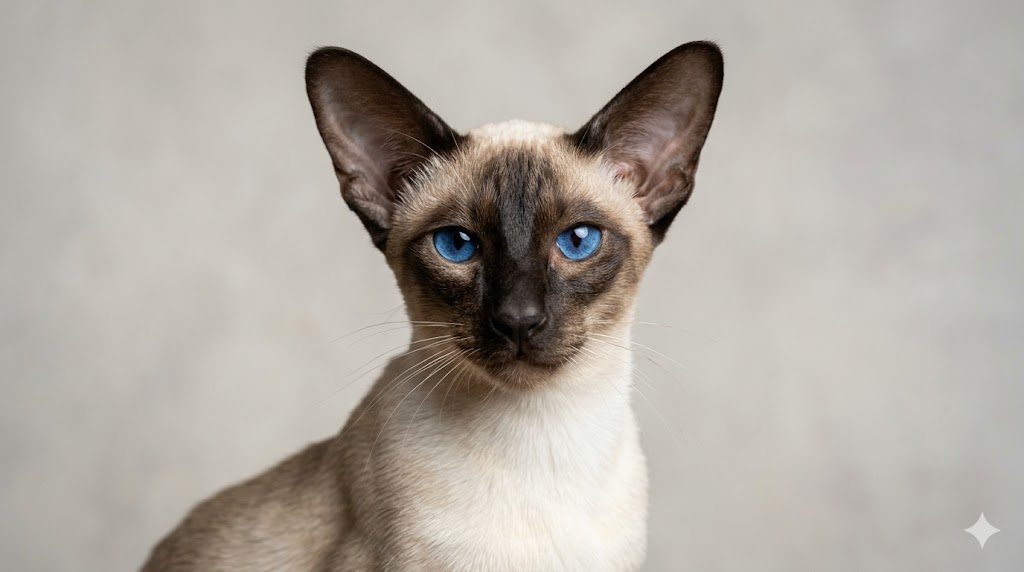
The Siamese is one of the oldest, most recognisable, and most opinionated cats in the world. Originating in ancient Siam (modern Thailand), the breed combines a striking pointed coat, brilliant blue eyes, and a personality that owners universally describe as "more dog than cat." The Siamese is the talkative cat of the species - vocal, demanding, intelligent, and intensely bonded to its chosen humans.
History & Origins
Siamese cats have lived in the temples and royal palaces of Siam for at least 700 years. The Tamra Maew (Cat Book Poems), a Thai manuscript from the 14th century, depicts pointed cats that closely resemble modern Siamese. The breed was considered sacred - given as royal gifts and kept by Buddhist monks.
The first Siamese reached the West in 1878, when US President Rutherford B. Hayes received one as a diplomatic gift from the American consul in Bangkok. The breed reached Britain in 1884 and was an immediate sensation. The CFA recognised the breed at its 1906 founding.
Two distinct types now exist. The Traditional ("Applehead" or "Thai") Siamese maintains the older rounded body and broader face. The Modern ("Show") Siamese, developed in the mid-20th century, has an extreme wedge head, very fine bones, and an elongated body. Show Siamese is far more common in pedigree registries today.
Appearance
Medium-sized, long, fine-boned. Adults weigh 3.5-5.5 kg (8-12 lb). Adults are slim, almost gaunt in show type.
Key features:
- Coat: very short, fine, glossy, close-lying.
- Colour and pattern: pointed - pale cream or fawn body with darker "points" on the face mask, ears, legs, and tail. Four traditional colours: seal point, blue point, chocolate point, lilac point. Many other variants (red, cream, tortie, lynx points) exist but are sometimes registered as separate Colorpoint Shorthair or Oriental breeds.
- Eyes: brilliant blue, almond-shaped, slanted toward the ears.
- Head: long, tapering wedge in show type; rounder applehead in traditional type.
- Ears: very large, set wide, continuing the wedge.
- Body: long, slender, fine-boned, tubular.
- Tail: very long, thin, tapering.
Temperament & Character
Vocal, intelligent, demanding, intensely bonded. The Siamese is the textbook "more dog than cat" - follows its humans, greets them at the door, plays fetch, walks on harnesses, learns tricks readily. The breed is highly social and dislikes being alone.
Siamese cats are famous for their voice - loud, distinctive, hoarse "meow" used to communicate constantly. They demand attention, conversation, and participation in household life.
Most Siamese form an intense bond with one or two primary people. Strangers may be ignored or treated with suspicion. The breed can be jealous, territorial, and possessive.
The Siamese is intelligent - among the most trainable cat breeds - and benefits from clicker training, puzzle feeders, and interactive enrichment.
Care
Coat & Grooming
The short coat is very low-maintenance: weekly rub-down with a soft cloth or rubber mitt. Sheds minimally.
Bathe every 2-3 months. Clean ears monthly (the very large ears collect debris). Trim claws every 2 weeks. Brush teeth daily - dental disease is common.
Exercise & Enrichment
High. Provide cat trees, interactive wand toys, puzzle feeders, daily play sessions. Many Siamese learn to fetch, walk on harnesses, and perform tricks. The breed is intelligent enough to need real mental work.
A bored Siamese vocalises constantly, opens cabinets, knocks objects off shelves, and develops anxiety.
Health & Lifespan
Average lifespan is 12-18 years.
Common concerns:
- Progressive retinal atrophy.
- Amyloidosis (liver and kidney).
- Dental disease - particularly severe.
- Hypertrophic cardiomyopathy.
- Asthma - elevated rates in this breed.
- Mediastinal lymphoma.
- Crossed eyes and kinked tails - once breed-typical, now selectively bred out; rare in modern cats.
- Hereditary myopathy.
The breed is long-lived when well-bred.
Feeding & Nutrition
Adults typically eat 40-70 g of quality cat food per day. Siamese maintain lean weight naturally and tend to be picky eaters. Establish a calm consistent feeding routine.
Living With
Litter
Standard provisions. Easy to litter-train.
Multi-cat households
Variable. Many Siamese prefer other Siamese or oriental-type cats. Bonds with non-cat-savvy housemates can be challenging due to vocal intensity.
Indoor vs outdoor
Indoor-only or supervised outdoor. Most Siamese are happy indoors with enrichment.
Pros & Cons
Pros
- Highly intelligent and trainable.
- Affectionate, deeply bonded.
- Long-lived.
- Very low grooming.
- Dog-like personality.
Cons
- Loud and vocal - not for noise-sensitive households.
- Demanding of attention.
- Cannot tolerate being alone for long.
- Asthma and dental issues common.
- Can be jealous or territorial.
Best Suited For
- Owners who want a vocal, interactive companion.
- Households with someone home most of the day.
- Multi-Siamese homes (the breed often prefers its own).
- Single-person or couple households (often bonds to one primary person).
- Active owners willing to engage in training and play.
Not suited for working households without coverage, noise-sensitive neighbours, or owners wanting a quiet hands-off cat.
Siamese - frequently asked questions
Why are they so loud?
The Siamese voice is breed-typical - a hoarse loud "meow" used to communicate continuously. Training reduces unwanted vocalisation but the breed will always be vocal.
Modern vs Traditional Siamese - what's the difference?
Traditional (Applehead/Thai) has a rounder face, sturdier body, and gentler temperament. Modern (Show) has an extreme wedge head, very fine bones, more extreme appearance. Traditional is generally healthier; Modern is the show standard.
Are they good with kids?
With respectful older children, yes. The breed bonds intensely and can be jealous of attention; not ideal with multiple toddlers.
Do they really walk on leashes?
Yes - among the easiest cat breeds to harness train.
Are they hypoallergenic?
No - they produce Fel d 1 normally. Shedding is minimal, which helps some allergy sufferers.
🧠 Test yourself: guess the cat
Three clues from our quiz bank, each about another of our cats. Can you name them?
Clue 1.One of the oldest cat breeds, named for the region of its origin, this placid feline sports a luxuriant flowing coat.
It's the Persian - read the full profile →
Clue 2.This large, thick-coated Russian cat is a national treasure of its homeland and is often considered more tolerant for allergy sufferers.
It's the Siberian - read the full profile →
Clue 3.Nicknamed the 'swimming cat,' this Turkish breed has a water-resistant coat and color restricted to its head and tail.
It's the Turkish Van - read the full profile →
💛 Adoptable Siameses near you
Real cats of this breed (and close mixes) waiting in shelters and rescues right now, live from Petfinder. We have no affiliation and earn nothing - if someone catches your eye, the link goes straight to their shelter. New to adopting? Start with our adoption guide.
Widget not loading (some ad-blockers hide it)? Search directly on petfinder.com.