Australian Cattle Dog
The Australian Cattle Dog - also known as the Blue Heeler or Red Heeler - is a tough, intelligent, intensely driven herding dog developed in the Australian outback to move semi-wild cattle across vast distances.
🗓️ Last reviewed: June 2026
Overview
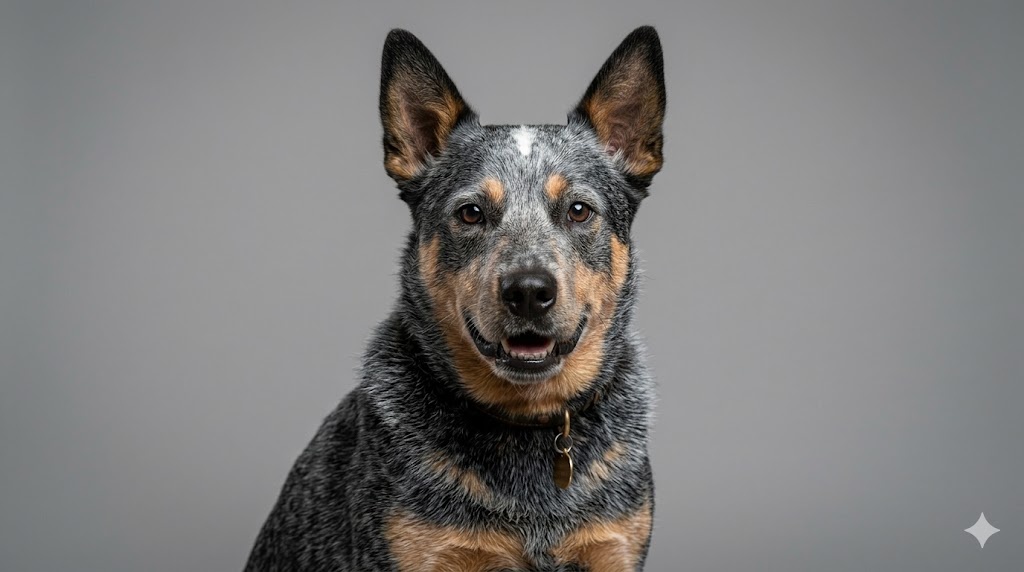
The Australian Cattle Dog - also known as the Blue Heeler or Red Heeler - is a tough, intelligent, intensely driven herding dog developed in the Australian outback to move semi-wild cattle across vast distances. Compact, weatherproof, and built for endurance, the breed is one of the hardest-working dogs in existence and one of the most challenging to live with as a pet. Behind the speckled blue or red coat is a dog that needs serious daily work, will herd anything that moves, and bonds with one person more intensely than with a family.
History & Origins
European settlers in Australia faced a unique challenge: enormous distances, semi-wild cattle, and no herding breed that could handle the work. Imported British collies overheated, lacked stamina, and barked too much, spooking the cattle.
The breed developed in the 1840s and onward through crosses involving Smithfield (an early English herder), Dingo (wild Australian dog), blue merle Collie, Dalmatian (for stamina alongside horses), and Black-and-Tan Kelpie. The result was a tough, weatherproof, silent-working dog that drove cattle by heel-nipping rather than barking - earning the "heeler" name.
The Australian Cattle Dog Club was formed in 1959. The AKC recognised the breed in 1980.
In 1999 the Guinness Book of World Records noted Bluey, an Australian Cattle Dog, as the longest-lived dog ever recorded - 29 years and 5 months. Bluey worked cattle and sheep until age 20.
Appearance
Medium-sized, compact, muscular. Adults stand 43-51 cm (17-20 in) and weigh 15-22 kg (33-50 lb).
Key features:
- Coat: short, dense, weather-resistant double coat.
- Colour: two colour varieties - Blue (blue or blue-mottled with or without black, blue, or tan markings) and Red (red speckled with or without darker red markings). Puppies are born white and develop colour as they mature.
- Head: broad with a moderate stop, dark oval eyes, and erect pricked ears.
- Tail: long, set low, carried in a slight curve.
Temperament & Character
Intensely loyal, brave, and demanding. The Australian Cattle Dog forms profound attachment to one primary person - usually one, occasionally two - and treats everyone else as varying degrees of stranger. The breed is reserved with unfamiliar humans, watchful with strangers, and absolute in its devotion to its chosen person.
Drive is enormous. The breed was selected for working all day in hot conditions over rough terrain; modern Cattle Dogs cannot turn off without serious active management. Most need a job, a sport, or a working role.
Herding behaviour around children, pets, and visitors is universal. Heel-nipping toward running kids is breed-typical and must be addressed by training. Prey drive is high.
Care
Coat & Grooming
The short double coat is low-maintenance: weekly brushing with a rubber curry, daily during the twice-yearly shed. Bathe every 6-8 weeks.
Clean ears weekly. Trim nails every 3 weeks. Brush teeth several times weekly.
Exercise & Activity Needs
Among the highest of any breed. Adults need at least 90-120 minutes of vigorous daily exercise - running, herding, agility, scent work, sport. Walking is preparation, not exercise.
Mental work is equally essential. The breed excels at agility (dominant in mid-size classes), obedience, herding, flyball, scent work, treibball, and competitive disc.
A bored Cattle Dog is one of the most destructive and difficult dogs imaginable. Daily structure is non-negotiable.
Health & Lifespan
Average lifespan is 12-16 years - among the longest of any working breed. Bluey's 29-year record is extraordinary but the breed's normal lifespan is exceptional.
Common concerns:
- Progressive retinal atrophy - DNA test available.
- Hip dysplasia - moderate.
- Deafness - congenital deafness is significantly elevated in this breed (around 10% of dogs have unilateral or bilateral deafness). BAER testing is available for puppies.
- Hereditary cataracts.
- Elbow dysplasia.
- Polioencephalomyelopathy - a rare neurological condition; DNA test.
- Neuronal ceroid lipofuscinosis (NCL) - DNA test.
The breed is generally robust given the working heritage.
Feeding & Nutrition
Adults typically eat 1½-2 cups of quality food per day in two meals. Working dogs need much more. The breed maintains lean condition naturally when exercised properly.
Pros & Cons
Pros
- Extraordinarily intelligent and trainable.
- Athletic and tireless.
- Long-lived for a working breed.
- Devoted to primary person.
- Easy short coat.
Cons
- Industrial-scale exercise and engagement needs.
- Reserved/aloof with strangers; one-person dog.
- Herding nip toward children.
- Reactive with unfamiliar dogs.
- Significant rate of congenital deafness.
- Destructive without enough work.
Best Suited For
- Active rural homes (especially with livestock).
- Sport homes (agility, herding, obedience).
- Single-person or couple-led households (the breed bonds to one).
- Outdoor enthusiasts (runners, hikers, cyclists).
- Working ranches and farms.
Not suited for sedentary owners, apartment dwellers without serious daily activity, families with very young children, full-time-office homes, or first-time owners.
Australian Cattle Dog puppy growth chart
A typical growth curve for a medium breed like the Australian Cattle Dog, estimated from its adult weight of 15-22 kg. Puppies vary with sex, genetics and diet, so treat this as a guide - for your own puppy, use the puppy weight predictor.
| Age | Typical weight | % of adult |
|---|---|---|
| 2 mo | 4.1-5.9 kg | 27% |
| 3 mo | 6-8.8 kg | 40% |
| 4 mo | 7.5-11 kg | 50% |
| 6 mo | 10.2-15 kg | 68% |
| 9 mo | 12.8-18.7 kg | 85% |
| 12 mo | 14.6-21.3 kg | 97% |
| Adult | 15-22 kg | 100% |
Australian Cattle Dog - frequently asked questions
Are Australian Cattle Dogs good family pets?
For active, experienced families committed to daily structured work - yes. For ordinary pet homes - usually no. The breed's drive and reserved temperament overwhelm most households.
Why are they called Heelers?
The breed herds cattle by nipping at heels - a quick bite to the lower leg followed by an immediate duck to avoid the kick. Effective with semi-wild cattle but problematic when applied to children.
Are they good with kids?
With careful management - yes, with their own family's older children. Heel-nipping at running children is a real, breed-typical issue that must be addressed.
Can they live with cats?
Possible with early careful introduction. Many cannot tolerate small running animals.
Blue Heeler vs Red Heeler - what's the difference?
Same breed, two colour varieties. Both come from the same litters. Personality, size, and behaviour are essentially identical. The dramatic puppy white-to-coloured coat transformation is fascinating to watch.
🧠 Test yourself: guess the dog
Three clues from our quiz bank, each about another of our dogs. Can you name them?
Clue 1.A breed of this type was the first official mascot of the modern Olympic Games, at Munich 1972.
It's the Dachshund - read the full profile →
Clue 2.Renowned as a police and military dog, this breed is among the fastest and most intelligent of working dogs.
It's the Doberman Pinscher - read the full profile →
Clue 3.Named for a Canadian province, this gentle giant was bred to haul fishing nets and pull carts for fishermen.
It's the Newfoundland - read the full profile →
💛 Adoptable Australian Cattle Dogs near you
Real dogs of this breed (and close mixes) waiting in shelters and rescues right now, live from Petfinder. We have no affiliation and earn nothing - if someone catches your eye, the link goes straight to their shelter. New to adopting? Start with our adoption guide.
Widget not loading (some ad-blockers hide it)? Search directly on petfinder.com.