Belgian Malinois
The Belgian Malinois is a medium-sized herding dog that has, over the past forty years, become the most respected working breed in the world.
🗓️ Last reviewed: June 2026
Overview
The Belgian Malinois is a medium-sized herding dog that has, over the past forty years, become the most respected working breed in the world. Faster, leaner, and more drive-saturated than the German Shepherd, the Malinois dominates modern police, military, and protection work - including the US Navy SEAL teams. This is not a family-friendly working breed. The Malinois is an industrial-grade tool that lives in a few thousand pet homes around the world, and the great majority of those placements struggle.
History & Origins
The Malinois is one of four varieties of the Belgian Shepherd - Groenendael, Tervuren, Malinois, and Laekenois - all developed in the 1890s in Belgium from regional sheep-herding dogs. The four varieties differ only by coat (length and texture) and colour; the underlying structure and temperament are identical. The Malinois has the short coat and is named for the city of Malines (Mechelen).
Through the 20th century, Belgian, Dutch, and French police and military programmes preferred the Malinois for its drive, speed, and durability. By the late 20th century the German Shepherd's joint and health issues drove most major working programmes to switch breeds. Today the Malinois is the standard police and military working dog in much of Europe and increasingly in the US.
The AKC recognised the Belgian Malinois in 1959 as a separate breed from the other Belgian Shepherds.
Appearance
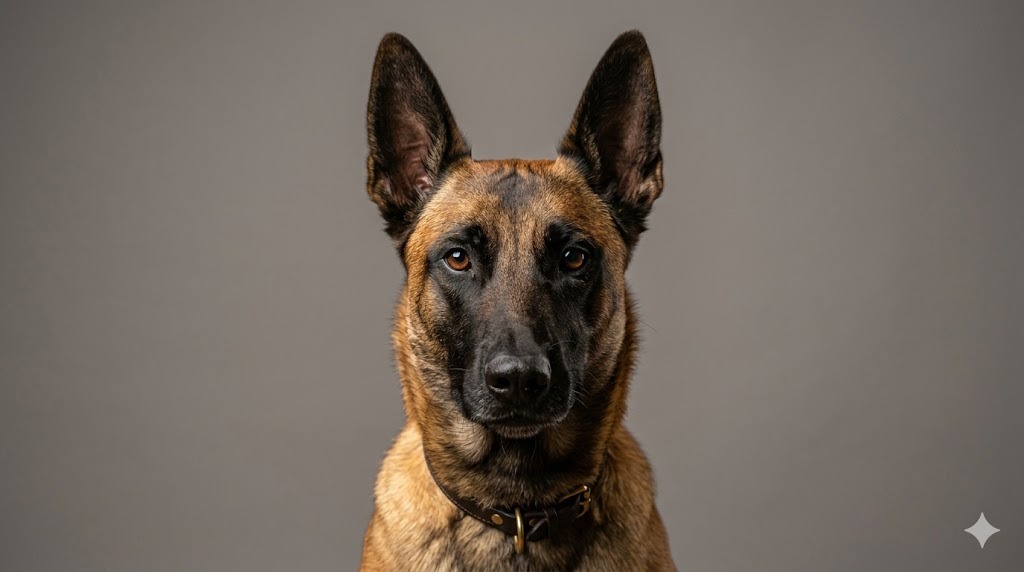
Medium-sized, athletic, square-built. Males stand 61-66 cm (24-26 in) and weigh 25-34 kg (55-75 lb); females are smaller. The build is lean, balanced, and athletic - every line says working dog.
Key features:
- Coat: short, straight, hard, with a dense undercoat.
- Colour: fawn to mahogany with a black mask and black ear edges; black "overlay" on the body is common.
- Head: clean wedge, with erect triangular ears and dark almond eyes.
- Tail: medium-length, carried low at rest, slightly curved when alert.
Temperament & Character
Intense, alert, deeply driven. The Malinois is bred for one thing: work. Drive levels - to chase, bite, retrieve, search - are among the highest of any breed. Most working Malinois cannot turn off without active management.
With family, well-bred Malinois are affectionate and bonded. With strangers they are reserved by default and protective by drive. Around children they vary - many do well with their own family's children, but the breed's intensity often makes contact with unfamiliar children unwise.
Drive and intelligence combined make the Malinois extraordinary in capable hands and disastrous in unprepared ones. The breed needs a job, a structured routine, and a handler who can channel its energy.
Care
Coat & Grooming
The short double coat is low-maintenance: weekly brushing with a rubber curry, daily during the twice-yearly heavy shed. Bathe every 6-8 weeks.
Clean ears weekly. Trim nails every 3 weeks. Brush teeth several times weekly.
Exercise & Activity Needs
Vast. Adults need at least 2 hours of vigorous daily exercise, often more - running, retrieving, structured training, bite work, scent work, agility. Walking is preparation, not exercise, for a Malinois.
The breed thrives on IGP/Schutzhund, KNPV (Dutch protection sport), French Ring, mondioring, and detection work. In pet homes, daily training plus a serious sport is the minimum. Under-stimulated Malinois develop destructive behaviours and obsessive compulsions on a scale that no other breed produces.
Health & Lifespan
Average lifespan is 12-14 years - among the longest of any working breed.
Common concerns:
- Hip and elbow dysplasia - moderate; demand certified parents.
- Cataracts and progressive retinal atrophy.
- Epilepsy.
- Hypothyroidism.
- Pannus (chronic eye condition).
- Hemangiosarcoma in older dogs.
- Anaesthetic sensitivity - some lines react poorly; inform the vet.
The breed is generally robust given its working heritage.
Feeding & Nutrition
Adults typically eat 2½-3½ cups of quality food per day in two meals; working dogs eat much more. The breed maintains lean condition naturally when exercised.
A high-quality performance diet supports working dogs. Joint support from early adulthood is reasonable for sport dogs.
Pros & Cons
Pros
- The world's premier working dog.
- Highly intelligent and trainable.
- Athletic and tireless.
- Long-lived for a working breed.
- Easy short coat.
- Devoted family bond when properly raised.
Cons
- Industrial-scale exercise needs.
- Extreme drive - destructive without channelled work.
- Not appropriate for most homes.
- Strong bite, fast reactions; legal and insurance issues in many regions.
- Reserved with strangers; reactive without socialisation.
- Long, intense adolescence.
Best Suited For
- Police, military, detection, and protection work.
- Sport homes (IGP, KNPV, French Ring, mondioring).
- Experienced working-dog handlers with daily structure.
- Active rural homes with secure high fencing.
Not suited for ordinary family life, first-time owners, sedentary households, apartment dwellers, full-time-office homes, or anyone wanting a "normal" pet.
Belgian Malinois puppy growth chart
A typical growth curve for a large breed like the Belgian Malinois, estimated from its adult weight of 25-34 kg. Puppies vary with sex, genetics and diet, so treat this as a guide - for your own puppy, use the puppy weight predictor.
| Age | Typical weight | % of adult |
|---|---|---|
| 2 mo | 5.5-7.5 kg | 22% |
| 3 mo | 8.3-11.2 kg | 33% |
| 4 mo | 10.8-14.6 kg | 43% |
| 6 mo | 15-20.4 kg | 60% |
| 9 mo | 20-27.2 kg | 80% |
| 12 mo | 23-31.3 kg | 92% |
| Adult | 25-34 kg | 100% |
Belgian Malinois - frequently asked questions
Are Belgian Malinois good family dogs?
For the right family - experienced, active, sport-oriented - yes. For ordinary pet homes, almost universally no. Rescue Malinois rates are very high because most placements fail.
Malinois vs German Shepherd - which is better?
For modern working roles, the Malinois generally has more drive, faster reactions, and better long-term joint health. For family life, the GSD is significantly more forgiving. The Malinois is the better working tool; the GSD is the better pet.
Are they good with children?
Many do well with their own family's children, with careful management. Visiting children require strict supervision. The breed's intensity is genuinely difficult to contain.
Can a Malinois live in a normal home?
With a serious commitment to daily structured exercise (2+ hours), training, sport, and management of drive - yes, some can. Most homes that buy a Malinois without a sport or working purpose end up rehoming the dog within 18 months.
Are they hypoallergenic?
No - they shed and produce dander.
🧠 Test yourself: guess the dog
Three clues from our quiz bank, each about another of our dogs. Can you name them?
Clue 1.This large, wrinkled scent hound has the most powerful sense of smell of any dog, and its trailing results are admissible as evidence in some courts.
It's the Bloodhound - read the full profile →
Clue 2.This non-shedding curly dog's elaborate continental trim left fur over the joints and chest to protect them in cold water.
It's the Poodle (Standard, Miniature, Toy) - read the full profile →
Clue 3.This powerful black-and-tan guardian was once used by Roman armies to drive and protect herds of cattle.
It's the Rottweiler - read the full profile →
💛 Adoptable Belgian Malinoiss near you
Real dogs of this breed (and close mixes) waiting in shelters and rescues right now, live from Petfinder. We have no affiliation and earn nothing - if someone catches your eye, the link goes straight to their shelter. New to adopting? Start with our adoption guide.
Widget not loading (some ad-blockers hide it)? Search directly on petfinder.com.