Bloodhound
The Bloodhound is the world's foremost scent dog - a large, droopy, mournful-faced French hound whose nose is so accurate that Bloodhound tracking evidence is admissible in many courts of law.
🗓️ Last reviewed: June 2026
Overview
The Bloodhound is the world's foremost scent dog - a large, droopy, mournful-faced French hound whose nose is so accurate that Bloodhound tracking evidence is admissible in many courts of law. Behind the long ears and abundant skin folds is a gentle, friendly, often comical companion that will happily share a sofa with children. Behind the gentle expression is a working hound that follows a scent for hours, ignores its owner's voice entirely, and weighs 50 kg or more when it wants to lie down on your lap.
History & Origins
The breed's name does not refer to bloody work. "Bloodhound" comes from "blooded hound" - meaning a dog of pure breeding. The breed traces back to the 8th century and the kennels of St. Hubert in Belgium and France, where monks bred two strains of large scent hound: the black-coated Saint Hubert Hound and the white-coated Talbot Hound. The modern Bloodhound descends primarily from the Saint Hubert line.
Bloodhounds reached Britain in the 11th century with William the Conqueror and were used for tracking deer, then for tracking people - fugitives, lost children, escaped prisoners. The breed's tracking record is unmatched. Documented Bloodhound trails of 100+ hours and 200+ km exist; courts in the United States have accepted Bloodhound tracking as evidence since 1896.
The AKC recognised the breed in 1885. Modern Bloodhounds work in police, search-and-rescue, and as family pets.
Appearance
Large, long-bodied, loose-skinned. Males stand 64-69 cm (25-27 in) and weigh 41-50 kg (90-110 lb); females are smaller but still substantial.
Key features:
- Coat: short, dense, weather-resistant.
- Colour: black-and-tan, liver-and-tan, or red. Small amounts of white acceptable.
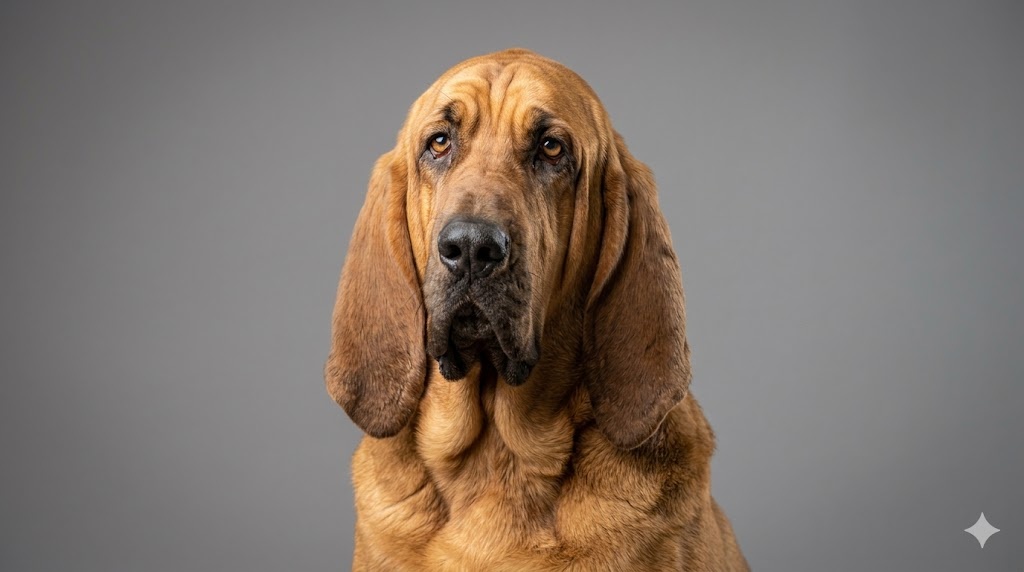
- Head: large, narrow, long, with extremely long pendulous ears, deeply wrinkled forehead and cheeks, and the famous sad, soulful expression.
- Ears: must hang in graceful folds, set low, and reach well past the nose when stretched.
- Tail: long, tapering, carried up like a sabre.
The defining feature is the nose. A Bloodhound has approximately 230 million scent receptors - versus 5 million in humans and 200 million in most other dogs. The long ears help sweep scent toward the nose; the wrinkles trap and concentrate scent.
Temperament & Character
Gentle, easygoing, and stubborn. Bloodhounds are famously tolerant - patient with children, friendly with strangers, sociable with other dogs (they are pack animals by design). The breed is the opposite of a guard dog; most would happily lead a burglar to the valuables.
The nose drives the dog. A Bloodhound on a scent is uncontrollable - they tune out their handler, the environment, even food. Recall is famously aspirational.
The breed bays loudly - a deep musical hound voice that carries over long distances. Apartment owners are rare for good reason.
Care
Coat & Grooming
The short coat is easy: weekly brush with a rubber curry, baths every 6-8 weeks. Sheds steadily; on a large dog the volume adds up.
The wrinkles and long ears require diligent care. Clean facial folds 2-3 times weekly with a dry cloth or canine wipe; dry thoroughly. Clean ears weekly - long heavy ears trap moisture and infect quickly. Some Bloodhounds need ear cleaning every 2-3 days.
Drool is heavy - keep towels in every room. Clean lips daily; food and water drip from the heavy upper lips. Trim nails every 3 weeks. Brush teeth several times weekly.
Exercise & Activity Needs
Moderate. Adults need 45-60 minutes of daily exercise - long sniff walks, scent games, tracking. The breed is not built for hard running but enjoys exploring with the nose.
Off-leash freedom is unsafe in unfenced areas. A Bloodhound that picks up a scent will follow it for kilometres, oblivious to roads, dangers, or owners.
Health & Lifespan
Average lifespan is 8-11 years - short for a non-giant breed.
Common concerns:
- Bloat (GDV) - very high risk; the deep chest is a major factor.
- Hip and elbow dysplasia.
- Eye conditions - entropion, ectropion (the droopy lower lid), cherry eye.
- Ear infections.
- Skin fold dermatitis.
- Cancer - particularly in older dogs.
- Hypothyroidism.
The breed has one of the highest bloat rates of any breed. Prophylactic gastropexy is widely recommended.
Feeding & Nutrition
Adults typically eat 3½-5 cups of quality large-breed food per day in two or three meals. Puppies must be on a large-breed puppy formula.
Bloat prevention is critical: multiple smaller meals, no vigorous exercise within an hour of meals, slow-feeder bowls. Most reputable breeders recommend prophylactic gastropexy at spay/neuter.
Keep the dog lean. Loose skin makes weight gain less obvious; feel ribs regularly.
Pros & Cons
Pros
- Gentle, family-oriented companion.
- Excellent with children.
- Outstanding nose; rewarding scent work partner.
- Distinctive, charming appearance.
- Sociable with other dogs.
Cons
- Short lifespan.
- Very high bloat risk.
- Stubborn; slow to train.
- Loud baying voice.
- Drools heavily; chronic ear and skin issues.
- Wanders far on scent.
Best Suited For
- Active rural families with secure fencing.
- Search-and-rescue, scent work, tracking enthusiasts.
- Multi-dog households.
- Owners tolerant of drool, baying, and skin care.
Not suited for apartment dwellers, owners on tight budgets (vet care is significant), or anyone wanting a tidy, quiet pet.
Bloodhound puppy growth chart
A typical growth curve for a giant breed like the Bloodhound, estimated from its adult weight of 41-50 kg. Puppies vary with sex, genetics and diet, so treat this as a guide - for your own puppy, use the puppy weight predictor.
| Age | Typical weight | % of adult |
|---|---|---|
| 2 mo | 7.4-9 kg | 18% |
| 3 mo | 11.5-14 kg | 28% |
| 4 mo | 15.2-18.5 kg | 37% |
| 6 mo | 21.3-26 kg | 52% |
| 9 mo | 28.7-35 kg | 70% |
| 12 mo | 34-41.5 kg | 83% |
| Adult | 41-50 kg | 100% |
Bloodhound - frequently asked questions
Why is Bloodhound tracking admissible in court?
The breed's scent capability has been studied for over a century. Properly trained Bloodhounds can follow trails several days old over varied terrain with documented accuracy. US courts have admitted Bloodhound evidence since 1896; modern protocols require certified dogs and handlers.
Are Bloodhounds good with kids?
Outstanding - patient, gentle, tolerant. Supervise; the breed's size requires care around toddlers.
Do they drool a lot?
Heavily. The loose lips trap food, water, and saliva, producing flying drool when the dog shakes its head.
How long do they live?
8-11 years on average. Bloat and cancer are the main lifespan limiters.
Are they good apartment dogs?
Almost never. The baying voice, size, drool, and need for outdoor sniffing make apartment life impractical.
🧠 Test yourself: guess the dog
Three clues from our quiz bank, each about another of our dogs. Can you name them?
Clue 1.Widely considered the most intelligent dog breed, this herder controls livestock with an intense, crouching stare known as the eye.
It's the Border Collie - read the full profile →
Clue 2.Caesar's troops reportedly noted these massive war dogs when they invaded Britain.
It's the English Mastiff - read the full profile →
Clue 3.Larger and heavier than its racing cousin, this thick-coated northern dog has a plumed tail, erect ears, and is built for strength and endurance in the cold.
It's the Alaskan Malamute - read the full profile →
💛 Adoptable Bloodhounds near you
Real dogs of this breed (and close mixes) waiting in shelters and rescues right now, live from Petfinder. We have no affiliation and earn nothing - if someone catches your eye, the link goes straight to their shelter. New to adopting? Start with our adoption guide.
Widget not loading (some ad-blockers hide it)? Search directly on petfinder.com.