Bull Terrier
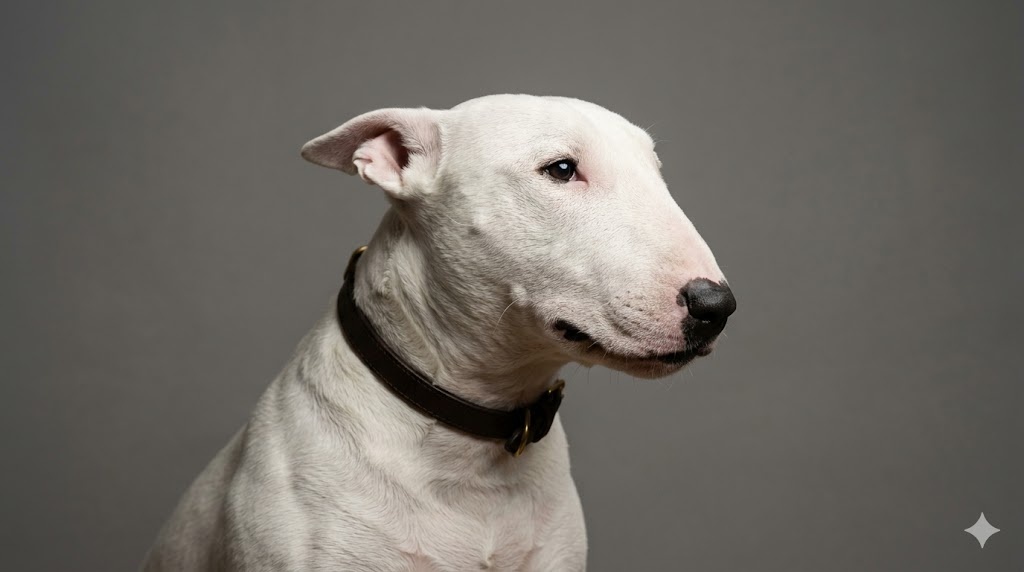
The Bull Terrier is one of the most instantly recognisable breeds in the world - a muscular, egg-headed, low-set British terrier with a goofy disposition and an enormous personality.
🗓️ Last reviewed: June 2026
Overview
The Bull Terrier is one of the most instantly recognisable breeds in the world - a muscular, egg-headed, low-set British terrier with a goofy disposition and an enormous personality. Bred in the 1800s from Bulldog and various now-extinct terriers, the breed combines bulldog tenacity with terrier energy. Despite an unfortunate cinematic reputation as a fighting dog, the modern Bull Terrier is a clownish, affectionate, family-oriented dog famous for sliding across the floor on its back, leaning on people, and generally treating life as an enthusiastic comedy.
History & Origins
James Hinks of Birmingham, England, developed the Bull Terrier in the 1850s by crossing the now-extinct White English Terrier with the Bulldog and probably the Dalmatian. The goal was a fashionable "gentleman's companion" - a dog that combined the gameness of the Bulldog with a cleaner, leggier appearance. Hinks's "White Cavalier" became wildly popular in Victorian England.
Colour was added in the early 20th century by crossing whites with Staffordshire Bull Terriers. The modern breed includes both white and coloured (brindle, black-brindle, fawn, red) varieties.
The breed's distinctive "egg-shaped" head - a continuous downward curve from skull to nose tip with no stop - was developed in the 1920s. The AKC recognised the Bull Terrier in 1885 (whites) and 1992 (coloured as a separate variety).
The breed has appeared in countless films, advertising (the Spuds MacKenzie Bud Light campaign), and as the Target stores mascot.
Appearance
Medium-sized, muscular, distinctive. Adults stand 53-56 cm (21-22 in) and weigh 23-35 kg (50-80 lb). A Miniature Bull Terrier (height under 36 cm, 11-15 kg) is a separate AKC-recognised breed.
Key features:
- Head: the unmistakable egg shape - viewed from the front it forms a smooth oval; viewed from the side a continuous downward curve from skull to nose tip with no stop.
- Coat: short, flat, harsh, glossy.
- Colour: pure white (with or without head markings) or coloured (brindle, black-brindle, red, fawn, tricolour). Coloured Bull Terriers must have more colour than white.
- Eyes: small, dark, triangular, set obliquely - the only triangular eyes in the dog world.
- Ears: small, thin, erect, set close together.
- Tail: short, set low, carried horizontally.
Temperament & Character
Affectionate, exuberant, and clownish. The Bull Terrier is one of the most playful and silly adult breeds - many remain puppy-like into old age. They are typically excellent with their own family's children, friendly with familiar people, and lively to the point of overwhelming.
The breed is famously stubborn. Bull Terriers think first, comply second. With other dogs they range from sociable to dog-aggressive, particularly toward same-sex dogs; many do best as only dogs.
The breed has high prey drive. Cats and small pets are at risk; some Bull Terriers cannot live safely with them regardless of socialisation.
A small percentage of Bull Terriers develop "Bull Terrier compulsive disorder" - obsessive tail-chasing, light-fixating, or pebble-eating. Choose a breeder who screens for this.
Care
Coat & Grooming
The short coat is very low-maintenance: weekly brush with a rubber curry, baths every 6-8 weeks. Sheds moderately year-round and more heavily twice yearly.
White Bull Terriers are prone to skin sensitivities. Watch for sunburn on white-coated dogs - the breed is one of the few that benefits from canine sunscreen.
Clean ears weekly. Trim nails every 3 weeks. Brush teeth several times weekly.
Exercise & Activity Needs
High. Adults need 60-90 minutes of vigorous daily exercise - walks, off-leash play in safe areas, structured training, weight pull. The breed is muscular and athletic; sedentary Bull Terriers become destructive and bored.
The breed excels at weight pull, agility (with patience), obedience, and earthdog at amateur level.
Health & Lifespan
Average lifespan is 11-14 years.
Common concerns:
- Deafness - significantly elevated in white Bull Terriers (up to 20% are unilaterally or bilaterally deaf). BAER testing in puppies is standard.
- Polycystic kidney disease (PKD) - DNA test available.
- Lethal acrodermatitis (LAD) - a fatal hereditary skin condition; DNA test available.
- Heart disease - mitral valve disease and other conditions.
- Patellar luxation.
- Hip dysplasia.
- Skin allergies - common in white dogs.
- Spinning/tail chasing OCD - Bull Terrier compulsive disorder.
- Hereditary nephritis - kidney disease.
Choose a breeder running the full DNA panel on both parents.
Feeding & Nutrition
Adults typically eat 2-3 cups of quality food per day in two meals. The breed gains weight easily; measure portions.
Some Bull Terriers have food sensitivities. Skin and ear issues often respond to a hydrolysed or novel-protein diet.
Pros & Cons
Pros
- Affectionate, playful, family-oriented.
- Distinctive, iconic appearance.
- Sturdy, athletic, capable of real work.
- Short coat is easy to maintain.
- Good lifespan for the size.
Cons
- Stubborn - slow to train.
- Strong, powerful - can overwhelm owners.
- Dog-on-dog reactivity common, especially same-sex.
- Strong prey drive - danger to small pets.
- Some specific genetic conditions; choose tested breeder.
- Compulsive behaviours in some lines.
- Insurance and legal restrictions in some regions.
Best Suited For
- Active families with older children.
- Experienced terrier or "bully breed" owners.
- Single-dog homes.
- Sport-oriented households (weight pull, agility, trick training).
- Secure outdoor space.
Not suited for households with cats or small pets, families with toddlers, multi-dog homes (especially same-sex), or first-time owners.
Bull Terrier puppy growth chart
A typical growth curve for a large breed like the Bull Terrier, estimated from its adult weight of 23-35 kg. Puppies vary with sex, genetics and diet, so treat this as a guide - for your own puppy, use the puppy weight predictor.
| Age | Typical weight | % of adult |
|---|---|---|
| 2 mo | 5.1-7.7 kg | 22% |
| 3 mo | 7.6-11.6 kg | 33% |
| 4 mo | 9.9-15.1 kg | 43% |
| 6 mo | 13.8-21 kg | 60% |
| 9 mo | 18.4-28 kg | 80% |
| 12 mo | 21.2-32.2 kg | 92% |
| Adult | 23-35 kg | 100% |
Bull Terrier - frequently asked questions
Are Bull Terriers good with kids?
Within their own family, often outstanding - playful, patient, sturdy. Their exuberance can overwhelm toddlers; supervise.
Are they aggressive?
Not by temperament toward humans. Dog-on-dog reactivity is real; prey drive is high. Choose a temperament-tested line and socialise carefully.
Bull Terrier vs Staffordshire Bull Terrier - what's the difference?
Different breeds. Bull Terrier is taller, leaner, with the egg-shaped head. Staffordshire Bull Terrier is shorter, stockier, with a normal canine head shape. Both descend from bull-and-terrier crosses but diverged in the late 1800s.
Why do they spin in circles?
A small percentage develop "Bull Terrier compulsive disorder" - obsessive spinning, tail-chasing, or light-chasing. Causes are partly genetic, partly stress-related. Treatment includes environmental enrichment, structured exercise, and sometimes medication.
Are they hypoallergenic?
No - they shed steadily and produce dander.
🧠 Test yourself: guess the dog
Three clues from our quiz bank, each about another of our dogs. Can you name them?
Clue 1.A robust water dog from a seafaring nation, this breed was nearly extinct before a 20th-century revival saved it.
It's the Portuguese Water Dog - read the full profile →
Clue 2.Originating in the canton of Bern, this sturdy, thick-coated working dog is famous for its sweet temperament but sadly has one of the shorter lifespans among breeds.
It's the Bernese Mountain Dog - read the full profile →
Clue 3.With long feathered ears and a docked or wagging tail, this breed once shared litters with the smaller cocker spaniel.
It's the English Springer Spaniel - read the full profile →
💛 Adoptable Bull Terriers near you
Real dogs of this breed (and close mixes) waiting in shelters and rescues right now, live from Petfinder. We have no affiliation and earn nothing - if someone catches your eye, the link goes straight to their shelter. New to adopting? Start with our adoption guide.
Widget not loading (some ad-blockers hide it)? Search directly on petfinder.com.