Bullmastiff
The Bullmastiff is a large, powerful British guardian developed in the 19th century to catch and hold poachers on country estates.
🗓️ Last reviewed: June 2026
Overview
The Bullmastiff is a large, powerful British guardian developed in the 19th century to catch and hold poachers on country estates. The breed combines the size and steadiness of the English Mastiff with the courage and agility of the English Bulldog - producing a calm, dignified, intensely loyal companion that requires careful ownership. The modern Bullmastiff is gentle with family and naturally protective, with a presence that deters intruders without needing aggression.
History & Origins
British gamekeepers in the early 1800s faced a serious poaching problem. Poachers were often armed, and gamekeepers needed dogs that could pursue, knock down, and hold an intruder without killing - a working balance hard to achieve.
The solution emerged around 1860 with a deliberate cross: 60% Mastiff for size and steadiness, 40% Bulldog for tenacity and agility. The result was the "Gamekeeper's Night Dog" - large enough to hold a man, biddable enough to release on command, dark enough to disappear at night. The modern Bullmastiff is descended from these working dogs.
The Kennel Club (UK) recognised the breed in 1924; the AKC in 1933. Modern Bullmastiffs are companions and family guardians.
Appearance
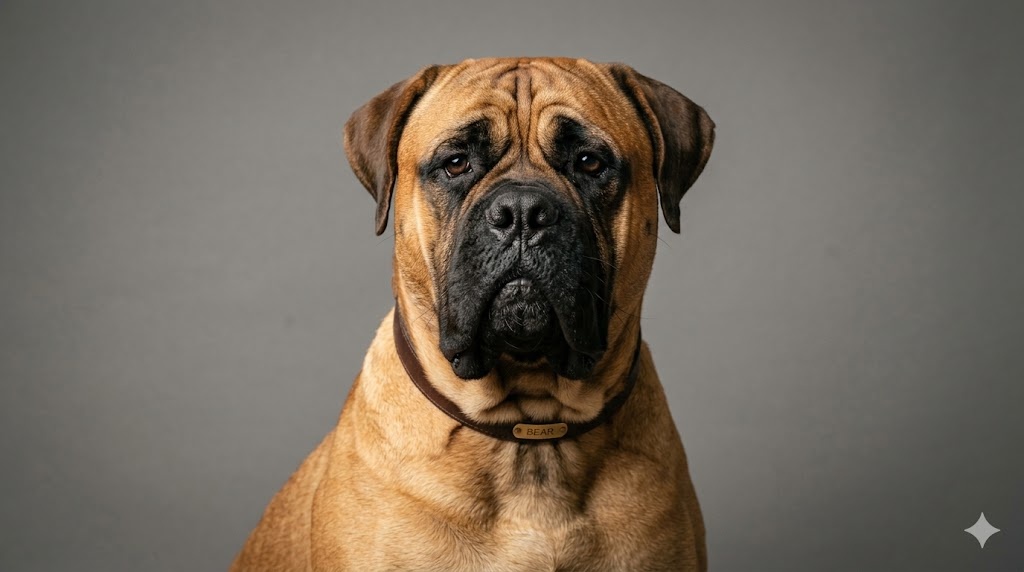
Large, powerful, slightly shorter than the Mastiff. Males stand 64-69 cm (25-27 in) and weigh 50-59 kg (110-130 lb); females are smaller. The build is compact and muscular - solid throughout.
Key features:
- Coat: short, dense, weather-resistant.
- Colour: fawn, red, or brindle, always with a black mask on the muzzle. White on the chest acceptable but small.
- Head: large, broad, square, with a moderately short muzzle (less extreme than the Mastiff or Bulldog).
- Ears: medium-sized, V-shaped, set high.
- Tail: long, set high, carried low or straight.
- Expression: alert, dignified, intelligent.
Temperament & Character
Calm, confident, and deeply bonded to family. The Bullmastiff is a natural guardian without the aggression of some protection breeds - it watches, assesses, and acts deliberately. Most are gentle with children, polite with strangers when properly introduced, and protective when truly needed.
The breed is intelligent and biddable but independent. Bullmastiffs are not soft like retrievers; they expect respect rather than indulgence. They tend to be quiet - rarely barking, but snoring and grunting frequently.
Adult Bullmastiffs sleep most of the day and exercise in short bursts. The breed is calm at home and surprisingly cat-like in its love of comfortable resting spots.
Care
Coat & Grooming
The short coat is low-maintenance: weekly brush with a rubber curry, baths every 6-8 weeks. Sheds steadily; in a large dog the volume adds up.
Wipe facial wrinkles 2-3 times weekly. Drooling is moderate - heavier after meals or in heat. Clean ears weekly. Trim nails every 3 weeks. Brush teeth several times weekly.
Exercise & Activity Needs
Modest. Adults need 30-60 minutes of daily exercise - calm walks, gentle play. The breed is built for short bursts of power, not endurance.
Puppies require strictly controlled exercise. No forced running, no jumping, controlled stair use until 18 months. Fast growth and giant size make joint disease easy to trigger.
Heat tolerance is limited. The moderately short muzzle and dense coat make hot weather genuinely difficult. Provide air conditioning, avoid midday summer activity.
Health & Lifespan
Average lifespan is 8-10 years.
Common concerns:
- Hip and elbow dysplasia - common.
- Bloat (GDV) - high risk.
- Cancer - particularly lymphoma, mast cell tumours, osteosarcoma. Cancer is the leading cause of death.
- Heart conditions - subaortic stenosis, dilated cardiomyopathy.
- Hypothyroidism.
- Eyelid problems (entropion, ectropion).
- Skin allergies.
- Cystinuria - DNA test available.
Feeding & Nutrition
Adults typically eat 4-6 cups of quality large-breed food per day in two or three meals. Puppies must be on a large-breed puppy formula to control growth.
Bloat prevention: multiple smaller meals, no vigorous exercise within an hour of meals, slow-feeder bowls. Discuss prophylactic gastropexy at spay/neuter.
Keep the dog lean - extra weight devastates joints, heart, and lifespan in giant breeds.
Pros & Cons
Pros
- Calm, devoted family companion.
- Naturally watchful without aggression training.
- Excellent with children when properly raised.
- Short coat is easy to maintain.
- Quiet at home.
Cons
- Short lifespan (8-10 years).
- Significant cancer and orthopaedic risk.
- Heat-intolerant.
- Drools and snores.
- Expensive - food, vet, beds.
- Insurance and legal restrictions in some regions.
Best Suited For
- Experienced large-breed owners.
- Calm households with secure outdoor space.
- Families with older children.
- Mild climates.
- Owners who want a serious natural guardian.
Not suited for first-time owners, sedentary households, hot climates, apartment dwellers, or anyone unable to afford giant-breed care.
Bullmastiff puppy growth chart
A typical growth curve for a giant breed like the Bullmastiff, estimated from its adult weight of 50-59 kg. Puppies vary with sex, genetics and diet, so treat this as a guide - for your own puppy, use the puppy weight predictor.
| Age | Typical weight | % of adult |
|---|---|---|
| 2 mo | 9-10.6 kg | 18% |
| 3 mo | 14-16.5 kg | 28% |
| 4 mo | 18.5-21.8 kg | 37% |
| 6 mo | 26-30.7 kg | 52% |
| 9 mo | 35-41.3 kg | 70% |
| 12 mo | 41.5-49 kg | 83% |
| Adult | 50-59 kg | 100% |
Bullmastiff - frequently asked questions
Are Bullmastiffs dangerous?
A well-bred and well-raised Bullmastiff is calm, controllable, and devoted. A poorly bred or mishandled one is genuinely dangerous due to size and natural guardian drive. Buy from a temperament-tested breeder.
Are they good with kids?
Generally outstanding with their own family. Their size requires supervision around toddlers.
Bullmastiff vs Mastiff - what's the difference?
Bullmastiff is smaller, more agile, more active, and bred specifically for guardian work. Mastiff is larger, calmer, and bred more as a passive deterrent companion. Both are gentle giants with families.
Do they drool a lot?
Moderately - heavier after meals or in heat. Less than the Mastiff or Saint Bernard, more than retrievers.
How long do they live?
8-10 years on average. Lean weight, cardiac screening, and cancer awareness push the upper end.
🧠 Test yourself: guess the dog
Three clues from our quiz bank, each about another of our dogs. Can you name them?
Clue 1.Developed along the hilly frontier between two British nations, this tireless sheepdog needs constant mental and physical work or it grows destructive.
It's the Border Collie - read the full profile →
Clue 2.Named for its original job of flushing a long-billed game bird, this floppy-eared gun dog is the smallest of the flushing sporting breeds.
It's the Cocker Spaniel (American) - read the full profile →
Clue 3.This tawny African hound is identified by a strip of backward-growing hair forming a ridge along its spine.
It's the Rhodesian Ridgeback - read the full profile →
💛 Adoptable Bullmastiffs near you
Real dogs of this breed (and close mixes) waiting in shelters and rescues right now, live from Petfinder. We have no affiliation and earn nothing - if someone catches your eye, the link goes straight to their shelter. New to adopting? Start with our adoption guide.
Widget not loading (some ad-blockers hide it)? Search directly on petfinder.com.