Collie (Rough)
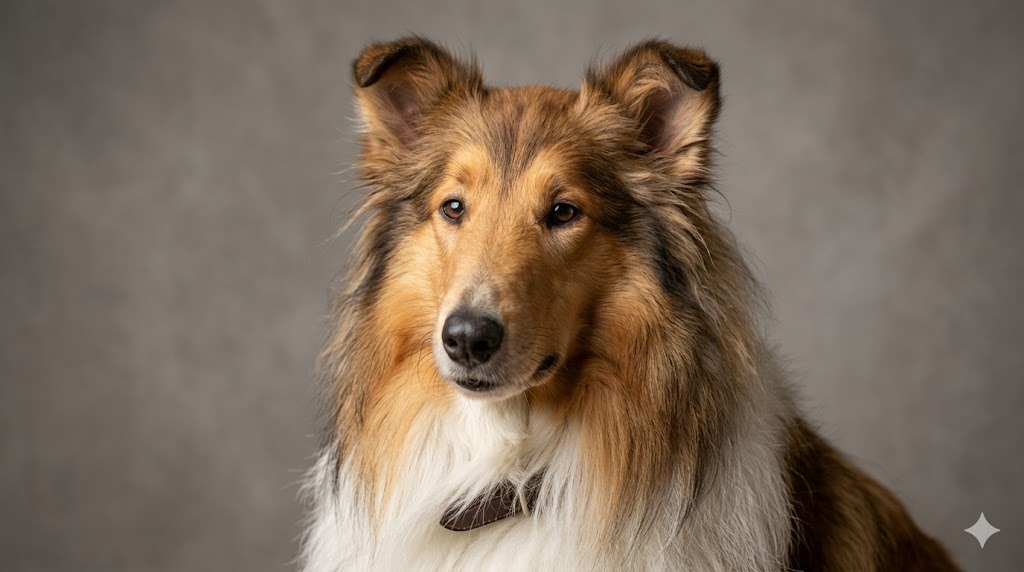
The Rough Collie - the breed forever associated with "Lassie" - is a large, long-coated Scottish herding dog famous for its elegant appearance, gentle temperament, and remarkable intelligence.
🗓️ Last reviewed: June 2026
Overview
The Rough Collie - the breed forever associated with "Lassie" - is a large, long-coated Scottish herding dog famous for its elegant appearance, gentle temperament, and remarkable intelligence. Once a working sheepdog in the Scottish Highlands, the modern Collie has become a beloved family companion that retains the breed's defining qualities: devoted attachment, sensitivity, sharp herding intelligence, and a gentle dignified manner. A Smooth Collie variant (same dog, short coat) is a separate breed in many registries.
History & Origins
"Collie" is the old Scottish word for "useful," applied broadly to working sheepdogs of the Scottish Highlands. The modern Rough Collie was developed in the 1800s by selecting larger, more refined herding dogs and crossing in Borzoi for elegance and a longer head. Queen Victoria fell in love with the breed during a visit to Balmoral in 1860; her enthusiasm transformed the Collie from working dog to fashionable companion almost overnight.
The fictional Lassie - created by Eric Knight in his 1940 novel and immortalised in the 1943 film - turned the Rough Collie into an international family-dog icon. Through the 1950s and 60s the breed was among the most popular dogs in the United States. Modern numbers have declined but quality has improved as the breed shifted from mass production back to dedicated breeders.
The AKC recognised the Collie in 1885.
Appearance
Large, elegant, well-balanced. Males stand 61-66 cm (24-26 in) and weigh 27-34 kg (60-75 lb); females are smaller. The build is athletic but refined - never coarse.
Key features:
- Coat: Rough Collie has a long, harsh, weather-resistant outer coat with a soft thick undercoat. Heavy mane and frill around the neck and chest, feathering on legs and tail. The Smooth Collie has the same structure with a short coat.
- Colour: sable-and-white (the iconic Lassie pattern), tricolour, blue merle, white (predominately white with sable, tri, or merle markings).
- Head: long, refined, wedge-shaped - the famous "Collie head" with a flat skull and tapering muzzle.
- Eyes: medium, almond, dark - except in merles, where one or both eyes may be blue.
- Ears: small, semi-erect with tipped-over tops.
- Tail: moderately long, carried low.
Temperament & Character
Gentle, sensitive, and devoted. The Collie is one of the most family-oriented large breeds - affectionate with its own people, friendly with strangers when introduced calmly, and famously gentle with children. The breed bonds intensely and dislikes being left alone for long.
Collies are intelligent and biddable. The breed retains herding drive - many will gently herd children and pets - but it is rarely intense or problematic.
Vocalisation is moderate. Collies alarm-bark but are not chronic barkers. Most are quiet at home.
Care
Coat & Grooming
The Rough coat is significant work. Brush 2-3 times weekly with a slicker, pin brush, and metal comb, paying attention to feathering, the mane, and the breeches. Daily during the twice-yearly heavy shed.
Smooth Collies need only weekly brushing.
Bathe every 6-8 weeks. Never shave the double coat - it regulates temperature in both heat and cold. Trim hair between paw pads.
Clean ears weekly. Trim nails every 3 weeks. Brush teeth several times weekly.
Exercise & Activity Needs
Moderate to high. Adults need 60-90 minutes of daily exercise - walks, off-leash running in safe areas, training, and play. The breed enjoys agility, herding, obedience, rally, tracking, and scent work.
Collies are athletic but not extreme. They do not need the industrial-scale work that Border Collies or Malinois demand.
Health & Lifespan
Average lifespan is 12-14 years.
Common concerns:
- Collie eye anomaly (CEA) - a hereditary eye condition affecting many Collies; DNA test available. All breeding dogs should be screened.
- Progressive retinal atrophy.
- MDR1 (multidrug sensitivity) mutation - very common in Collies. Affected dogs react severely to ivermectin, loperamide, certain chemotherapy agents. DNA test essential; results on file with the vet.
- Hip dysplasia - moderate.
- Dermatomyositis - skin and muscle inflammatory condition.
- Bloat (GDV) - moderate risk.
- Epilepsy.
- Hypothyroidism.
Double-merle puppies have high rates of congenital deafness and blindness. Avoid merle × merle breeding.
Feeding & Nutrition
Adults typically eat 2½-3½ cups of quality food per day in two meals. The breed maintains lean condition naturally when exercised.
Avoid heavy exercise within an hour of meals (bloat risk). Many Collies are sensitive to dietary changes; transition foods slowly.
Pros & Cons
Pros
- Gentle, devoted family companion.
- Excellent with children of all ages.
- Highly trainable.
- Beautiful, instantly recognisable appearance.
- Long-lived for a large breed.
Cons
- Heavy double-coat shedding (Rough).
- Sensitive - not for chaotic households.
- High grooming demands for the Rough variety.
- Prone to separation anxiety.
- Multiple genetic conditions; choose a tested breeder.
Best Suited For
- Families with children of any age.
- Households where someone is home most of the day.
- Sport homes (agility, obedience, herding, tracking).
- Therapy and service programmes.
- Suburban and rural homes.
Not suited for chaotic households, full-time-office homes without coverage, owners unwilling to manage shedding, or those wanting a high-drive working partner.
Collie (Rough) puppy growth chart
A typical growth curve for a large breed like the Collie (Rough), estimated from its adult weight of 27-34 kg. Puppies vary with sex, genetics and diet, so treat this as a guide - for your own puppy, use the puppy weight predictor.
| Age | Typical weight | % of adult |
|---|---|---|
| 2 mo | 5.9-7.5 kg | 22% |
| 3 mo | 8.9-11.2 kg | 33% |
| 4 mo | 11.6-14.6 kg | 43% |
| 6 mo | 16.2-20.4 kg | 60% |
| 9 mo | 21.6-27.2 kg | 80% |
| 12 mo | 24.8-31.3 kg | 92% |
| Adult | 27-34 kg | 100% |
Collie (Rough) - frequently asked questions
Rough vs Smooth Collie - what's the difference?
Same dog, different coat. Rough has the long flowing coat; Smooth has a short dense coat. Personality, size, health are essentially identical.
Is Lassie a Rough Collie?
Yes - every Lassie since 1943 has been a sable-and-white Rough Collie, played by descendants of the original Pal who starred in the 1943 film.
Are Collies good with kids?
Outstanding - gentle, patient, devoted. Among the best large breeds for families.
Do they need a lot of exercise?
Moderate - 60-90 minutes daily. Athletic but not extreme. Adaptable to suburban family life.
Are Collies smart?
Very. Among the most trainable breeds. The reputation for intelligence was earned, not invented by Lassie's writers.
🧠 Test yourself: guess the dog
Three clues from our quiz bank, each about another of our dogs. Can you name them?
Clue 1.Bred as an all-purpose hunter that can track, point, and retrieve on land or water, this athletic dog needs intense daily exercise.
It's the German Shorthaired Pointer - read the full profile →
Clue 2.Bred to pull light loads over vast frozen distances, this Arctic working breed often has striking blue eyes and a thick double coat.
It's the Siberian Husky - read the full profile →
Clue 3.Bred to herd, guard, and hunt vermin on Irish farms, this breed greets people with an enthusiastic jump nicknamed its trademark 'leap'.
It's the Soft Coated Wheaten Terrier - read the full profile →
💛 Adoptable Collie (Rough)s near you
Real dogs of this breed (and close mixes) waiting in shelters and rescues right now, live from Petfinder. We have no affiliation and earn nothing - if someone catches your eye, the link goes straight to their shelter. New to adopting? Start with our adoption guide.
Widget not loading (some ad-blockers hide it)? Search directly on petfinder.com.