Dachshund
The Dachshund - known in German as "Dackel" or "Teckel," in English as "the sausage dog" - is one of the most instantly recognisable breeds in the world.
🗓️ Last reviewed: July 2026
Overview
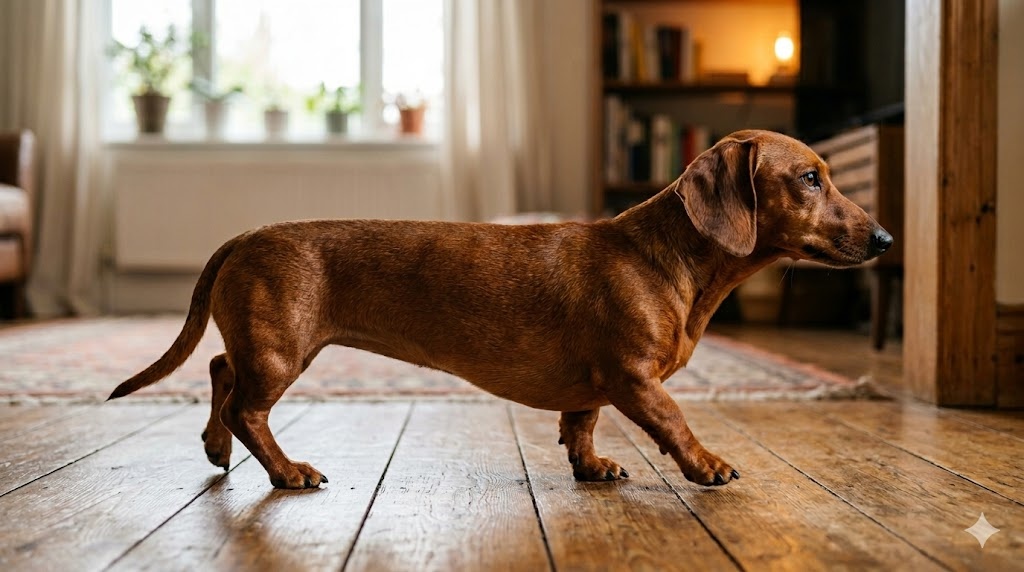
The Dachshund - known in German as "Dackel" or "Teckel," in English as "the sausage dog" - is one of the most instantly recognisable breeds in the world. Long body, short legs, bold attitude. Beneath the comic silhouette is a serious, courageous earth-dog originally bred to pursue badgers underground. The breed comes in two sizes (Standard and Miniature) and three coat types (smooth, longhaired, wirehaired), each with subtly different personalities, but all carrying the unmistakable Dachshund mix of stubbornness, intelligence, and devotion.
History & Origins
"Dachshund" translates literally as "badger dog" - and that was the job. By the 1600s, German foresters had developed long-bodied, short-legged hounds that could follow badgers, foxes, and rabbits into their burrows, bay at them, and pull them out. The exaggerated proportions are not cosmetic: they evolved for going to ground in tight spaces.
The original Dachshund was a serious working dog of around 16 kg (35 lb). Miniaturisation began in the late 1800s when smaller dogs were wanted for rabbit hunting. Wirehaired coats were developed by crossing in terrier blood for tougher coat texture and gameness; longhaired coats by adding spaniel ancestry. By 1888 the Deutscher Teckelklub had been founded; the AKC recognised the breed in 1885.
Dachshunds were widely popular in Europe, fell out of favour during the World Wars due to their German associations, and rebounded strongly afterwards. Today they are one of the most popular small breeds globally.
Appearance
Long, low, muscular. Two size classes (with some regional variation):
- Standard: chest circumference >35 cm, typically 7-14 kg (16-32 lb).
- Miniature: chest circumference <35 cm, typically 4-5 kg (under 11 lb).
- (Some regions also recognise a "rabbit" or "kaninchen" size, even smaller.)
Three coat varieties:
- Smooth: short, shiny, close coat.
- Longhaired: soft, slightly wavy coat with feathering on ears, legs, tail.
- Wirehaired: dense harsh coat with bushy eyebrows and a beard.
Colours include red (most common), black-and-tan, chocolate-and-tan, cream, dapple (merle), brindle, piebald. Double dapples can be lethal genetically - responsible breeders avoid this combination.
The head is long and tapering; the chest is keel-shaped (deep and prominent); the back is long and straight; the tail is carried in line with the spine, never curled over the back.
Temperament & Character
Dachshunds are bold, lively, and famously stubborn. They were bred to think for themselves underground, beyond a hunter's voice or hand, and the breed has never forgotten this independence. A Dachshund decides whether your command is worth following.
They are deeply attached to family - often more bonded to one person - and reserved or watchful with strangers. As alarm dogs they are excellent; as quiet apartment dogs they require training. The breed barks readily and persistently.
Coat-type generalisations: smooths tend to be most one-person, longhaireds the softest and most companionable, wirehaireds the cheekiest and most terrier-like.
Care
Coat & Grooming
- Smooth: weekly rub-down; minimal work.
- Longhaired: brush 2-3 times weekly to prevent mats; trim feathering occasionally.
- Wirehaired: brush weekly; the coat is "stripped" (hand-plucked) twice yearly by a groomer or owner - clipping ruins texture and colour.
All coats: weekly ear cleaning, monthly nail trims, several teeth brushings per week. Dental disease is very common in this breed.
Exercise & Activity Needs
Modest but real. Adults need 45-60 minutes of daily exercise - walks, sniffing time, light play. Wirehaireds tend to be the most active.
Avoid jumping (on/off furniture, up stairs), excessive stair climbing, and high-impact play. The long spine is vulnerable. Use ramps to furniture and the car. Carry small Dachshunds up and down stairs until they are fully grown; even afterwards, limit stair use.
Swimming is excellent low-impact exercise. Many Dachshunds love water; supervise - short legs and long bodies are not natural swimmers.
Health & Lifespan
Average lifespan is 12-16 years.
The defining health concern is intervertebral disc disease (IVDD): up to 25% of Dachshunds experience disc problems at some point, ranging from back pain to paralysis. Prevention: lean body weight, no jumping, ramp use, gentle daily exercise, regular swimming if possible. The X-ray-based "DachsLife" screening programme in Europe identifies genetic risk.
Other common issues:
- Obesity - Dachshunds gain weight easily and obesity directly worsens IVDD.
- Patellar luxation.
- Progressive retinal atrophy and cataracts.
- Dental disease.
- Cushing's disease in older dogs.
- Double dapple syndrome - congenital deafness/blindness from merle × merle breeding.
Feeding & Nutrition
Standards typically eat 3/4 to 1½ cups per day; Miniatures 1/3 to 3/4 cup. Two meals daily. Measure portions precisely.
A lean Dachshund - ribs easily felt, visible waist from above - lives longer and avoids back trouble. Even one extra kilogram is significant on a 5 kg dog. Treats should be tiny and counted into daily calories.
Pros & Cons
Pros
- Distinctive, charming appearance.
- Bold, courageous personality in a small body.
- Long-lived.
- Good apartment size; adapts to many homes.
- Excellent alarm dog.
Cons
- Serious spinal disease risk.
- Stubborn; slow to house-train.
- Barks readily - not for noise-sensitive neighbours.
- Reserved with strangers; needs careful socialisation.
- Can be possessive about food, toys, owner.
Best Suited For
- Singles or couples wanting a devoted small companion.
- Patient owners who appreciate strong personality.
- Apartment dwellers who don't mind some barking.
- Families with older children who respect the dog's back.
- Owners willing to use ramps and prevent jumping.
Not suited for households with toddlers (handling injuries the dog or the child), owners wanting an easy obedience dog, or families that allow jumping on/off furniture.
Dachshund puppy growth chart
A typical growth curve for a medium breed like the Dachshund, estimated from its adult weight of 7-14 kg. Puppies vary with sex, genetics and diet, so treat this as a guide - for your own puppy, use the puppy weight predictor.
| Age | Typical weight | % of adult |
|---|---|---|
| 2 mo | 1.9-3.8 kg | 27% |
| 3 mo | 2.8-5.6 kg | 40% |
| 4 mo | 3.5-7 kg | 50% |
| 6 mo | 4.8-9.5 kg | 68% |
| 9 mo | 6-11.9 kg | 85% |
| 12 mo | 6.8-13.6 kg | 97% |
| Adult | 7-14 kg | 100% |
Dachshund - frequently asked questions
Why are Dachshunds so stubborn?
They were bred to work alone underground, beyond the hunter's control. Independent decision-making is genetic. Reward-based training works around this; pressure does not.
Are Dachshunds good with kids?
With respectful older children, yes. With toddlers, supervise closely - small kids fall on long-backed dogs and the dog may snap. Many Dachshunds prefer adult company.
Smooth, long, or wire - which is best?
Smooth: lowest grooming, most one-person tendency. Long: softest temperament, more grooming. Wire: cheekiest personality, intermediate grooming. Choose by personality preference; coat is the easiest factor to live with.
Can Dachshunds use stairs?
Carefully. Build a habit of carrying small Dachshunds up and down stairs until at least a year old, and limit stair use throughout life. Ramps help.
Are they hypoallergenic?
No - all three coat types shed, though wirehaireds shed least.
🧠 Test yourself: guess the dog
Three clues from our quiz bank, each about another of our dogs. Can you name them?
Clue 1.A toy breed famed for sitting on royal laps, its tricolor and ruby coats come in four named patterns.
It's the Cavalier King Charles Spaniel - read the full profile →
Clue 2.Known for an emphatic high-pitched scream when displeased, this spirited spitz is famously catlike and clean.
It's the Shiba Inu - read the full profile →
Clue 3.A lean, short-coated pointing breed from Hungary prized for both pointing and retrieving game, with a self-colored nose blending into its coat.
It's the Vizsla - read the full profile →
💛 Adoptable Dachshunds near you
Real dogs of this breed (and close mixes) waiting in shelters and rescues right now, live from Petfinder. We have no affiliation and earn nothing - if someone catches your eye, the link goes straight to their shelter. New to adopting? Start with our adoption guide.
Widget not loading (some ad-blockers hide it)? Search directly on petfinder.com.