English Mastiff
The English Mastiff - usually just called Mastiff - is one of the largest dog breeds in the world.
🗓️ Last reviewed: June 2026
Overview
The English Mastiff - usually just called Mastiff - is one of the largest dog breeds in the world. Massive, dignified, and surprisingly gentle, the Mastiff has been a guardian, war dog, and noble companion in Britain for at least two thousand years. Despite the intimidating size, the modern Mastiff is famously placid - a slow-moving, deeply affectionate giant that wants nothing more than to lean against its people and sleep on whichever piece of furniture it has chosen.
History & Origins
Mastiff-type dogs have existed in Britain since pre-Roman times. Julius Caesar's accounts describe huge fighting dogs encountered during his invasions in 55 and 54 BC, and the Romans exported these dogs to fight in arenas across the empire. Mediaeval mastiffs guarded estates, hunted boar, and accompanied knights to war.
By the late 1800s the breed had nearly disappeared. The First and Second World Wars almost finished it - at one point only about 14 breeding-quality Mastiffs remained, mostly in North America. The modern breed was reconstructed from these survivors, with some outcrossing to other mastiff-type breeds to broaden the gene pool. The AKC recognised the breed in 1885; today the Mastiff is one of the most popular giant breeds globally.
Appearance
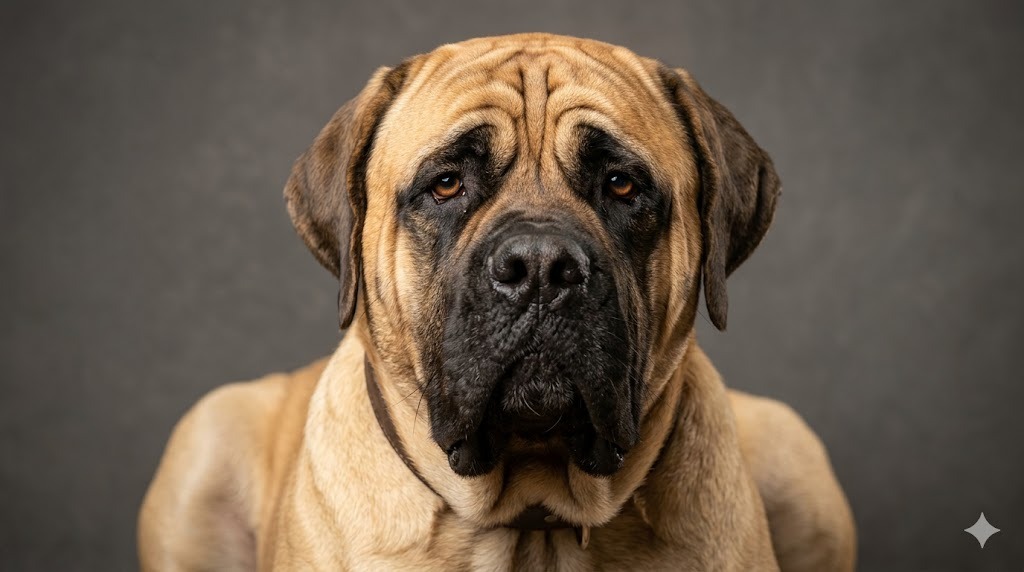
Enormous, heavy, dignified. Males stand at least 76 cm (30 in) and weigh 70-100+ kg (150-230+ lb); some exceptional dogs exceed 110 kg. Females are smaller but still massive.
Key features:
- Coat: short, dense, weather-resistant double coat.
- Colour: fawn, apricot, or brindle; always with a black mask, black ears, and black around the eyes. Solid black is not recognised.
- Head: massive, broad, square, with a relatively short broad muzzle (moderately brachycephalic, but not flat).
- Ears: medium-sized, set high, V-shaped, drop.
- Tail: long, set high, carried low.
- Expression: dignified, calm, soulful.
Temperament & Character
Calm, affectionate, and naturally watchful. Mastiffs bond deeply with family and are typically wonderful with children - patient, gentle, and protective without being aggressive. Strangers receive a calm assessment rather than excitement. The breed's size alone deters most threats; actual protection drive is more reserve than aggression.
Mastiffs are placid by nature. Adult Mastiffs sleep 14-18 hours a day. They are not interested in hard exercise or sport. They want company, comfortable resting spots, and quiet routine.
The breed matures very slowly - many Mastiffs are still puppyish at age 3-4.
Care
Coat & Grooming
The short coat is low-maintenance: weekly brush with a rubber curry, baths every 6-8 weeks. Sheds steadily, heavier twice yearly.
Wipe facial wrinkles and the heavy upper lips daily; trapped moisture and food debris cause infections quickly. Drooling is heavy - keep towels in every room. Clean ears weekly. Trim nails every 3 weeks (heavy nails). Brush teeth several times weekly.
Exercise & Activity Needs
Modest. Adults need 30-45 minutes of daily exercise - calm walks, gentle play. Hard exercise damages joints. Avoid running, jumping, and stairs in puppies under 18 months; many breeders limit stair use throughout life.
Heat tolerance is poor - the heavy build, dense coat, and moderately short muzzle make hot weather genuinely dangerous. Provide air conditioning, avoid midday summer activity, and watch for overheating.
Health & Lifespan
Average lifespan is 6-10 years - among the shortest of any breed. Owning a giant breed means accepting this.
Common concerns:
- Hip and elbow dysplasia - very common.
- Bloat (GDV) - extremely high risk; the deep chest and giant size make Mastiffs one of the most at-risk breeds. Many owners pursue prophylactic gastropexy at spay/neuter.
- Cardiomyopathy.
- Eyelid problems (entropion, ectropion, cherry eye).
- Cancer - particularly osteosarcoma and lymphoma.
- Cystinuria - a hereditary kidney/bladder condition; DNA test available.
- Pyometra in unspayed females.
- Spondylosis in older dogs.
Feeding & Nutrition
Adults typically eat 6-10 cups of quality large-breed food per day in two or three meals. Puppies must be on a large-breed puppy formula to control growth - fast-growing Mastiffs develop joint disease.
Bloat prevention is critical: multiple smaller meals, no vigorous exercise within an hour of meals, slow-feeder bowls if needed. Many owners pursue prophylactic gastropexy (surgical stomach tacking) at spay/neuter to prevent twisting.
Keep the dog lean despite the giant size. Visible waist and easily felt ribs. Overweight Mastiffs develop joint disease early and die sooner.
Pros & Cons
Pros
- Calm, affectionate, family-devoted companion.
- Naturally watchful guardian without training to be aggressive.
- Excellent with children.
- Low exercise demands.
- Short coat is easy to maintain.
Cons
- Very short lifespan.
- Significant inherited health issues; high vet bills.
- Drools heavily.
- Heat-intolerant.
- Slow to mature; long puppyhood with enormous puppies.
- Strong, expensive to feed and medicate.
Best Suited For
- Calm households with secure outdoor space.
- Owners emotionally and financially prepared for a short, intense relationship.
- Families with older children and the time to invest in training a giant breed.
- Cold or mild climates.
- Households tolerant of drool.
Not suited for apartment dwellers, hot climates, owners wanting an active sport dog, or anyone unable to afford specialist veterinary care.
English Mastiff puppy growth chart
A typical growth curve for a giant breed like the English Mastiff, estimated from its adult weight of 70-100 kg. Puppies vary with sex, genetics and diet, so treat this as a guide - for your own puppy, use the puppy weight predictor.
| Age | Typical weight | % of adult |
|---|---|---|
| 2 mo | 12.6-18 kg | 18% |
| 3 mo | 19.6-28 kg | 28% |
| 4 mo | 25.9-37 kg | 37% |
| 6 mo | 36.4-52 kg | 52% |
| 9 mo | 49-70 kg | 70% |
| 12 mo | 58.1-83 kg | 83% |
| Adult | 70-100 kg | 100% |
English Mastiff - frequently asked questions
How big do Mastiffs get?
Males commonly 70-100 kg; some exceed 110 kg. Among the largest breeds in the world, comparable to Saint Bernards and Great Danes.
Are Mastiffs good with kids?
Outstanding. Patient, gentle, and protective. Their size requires supervision around toddlers - accidental knockdowns happen.
Do they drool a lot?
Yes. Heavy drooling, particularly after eating, drinking, or in heat. Keep towels in every room.
How long do they live?
6-10 years on average. Some reach 11-12. The short lifespan is the breed's biggest emotional cost.
Mastiff vs Saint Bernard - which is calmer?
Both are giant, gentle, family-oriented breeds. Saint Bernard is generally more playful and slightly more energetic; Mastiff is more dignified and lower-energy. Both drool, both have short lifespans, both excel as gentle family companions.
🧠 Test yourself: guess the dog
Three clues from our quiz bank, each about another of our dogs. Can you name them?
Clue 1.A cheerful, hypoallergenic-friendly lapdog that looks like a small white powder puff, it is playful and bonds closely with its family.
It's the Bichon Frise - read the full profile →
Clue 2.A 19th-century cross of bulldog and terrier stock, this stocky dog has a famously stubborn, clownish personality.
It's the Bull Terrier - read the full profile →
Clue 3.Despite weighing only a few pounds, this fine-boned companion is a tireless, athletic dog that excels at agility courses.
It's the Papillon - read the full profile →
💛 Adoptable English Mastiffs near you
Real dogs of this breed (and close mixes) waiting in shelters and rescues right now, live from Petfinder. We have no affiliation and earn nothing - if someone catches your eye, the link goes straight to their shelter. New to adopting? Start with our adoption guide.
Widget not loading (some ad-blockers hide it)? Search directly on petfinder.com.