Great Dane
The Great Dane is the "Apollo of dogs" - a towering, elegant giant that ranks among the tallest breeds in the world.
🗓️ Last reviewed: June 2026
Overview
The Great Dane is the "Apollo of dogs" - a towering, elegant giant that ranks among the tallest breeds in the world. Despite the imposing size, the modern Dane is calm, affectionate, and famously gentle, often called a "gentle giant" with good reason. The breed served as a working hound and noble companion in Germany for centuries before settling into modern family life as one of the most striking and easygoing giants of the dog world. Like all giant breeds, the Dane pays for its size with a tragically short lifespan.
History & Origins
Despite the name, the Great Dane is a German breed, not Danish. Large mastiff-type hounds were used in Germany from at least the Middle Ages for hunting wild boar - large game requiring large dogs. By the 1600s German nobility had refined the breed for both hunting and palace guard work. The breed was originally called the Deutsche Dogge (German Mastiff) and remains so in continental Europe. English speakers adopted the misleading "Great Dane" in the 1800s.
The modern breed was standardised at a German breeders' conference in 1880. The AKC recognised the breed in 1887. Through the 20th century the Great Dane shifted entirely from hunting to companionship.
Appearance
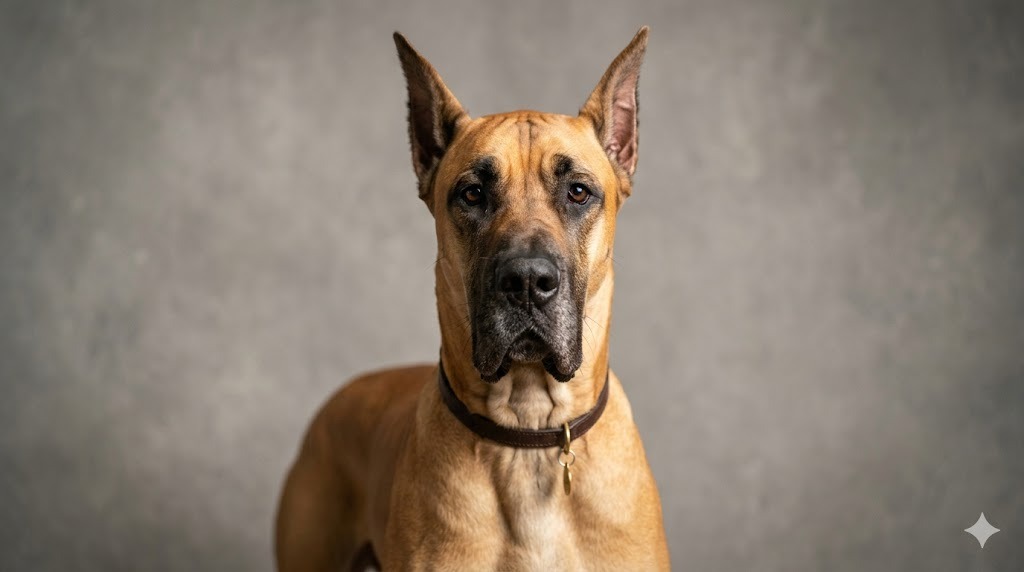
Enormous, tall, elegant. Males stand at least 76 cm (30 in) at the shoulder and typically 80-90 cm (32-35 in); weight 60-90 kg (130-200 lb). Females are smaller. Some Danes exceed 100 cm (40 in) at the shoulder. The current world's tallest dog records are all held by Great Danes.
Key features:
- Coat: short, smooth, glossy.
- Colour: seven officially recognised colours - fawn, brindle, blue, black, harlequin, mantle, merle. (Merle was officially added in 2018.)
- Head: long, narrow, rectangular when viewed from above.
- Ears: historically cropped to stand erect; natural drop ears increasingly common.
- Tail: long, set high, carried low at rest.
Temperament & Character
Calm, affectionate, and gentle. The Great Dane is famously laid-back - adults sleep 14-18 hours a day. Around family they are deeply bonded, often comically convinced they are lap dogs (and acting accordingly). With strangers most are polite or reserved; the breed's size deters intruders without aggression.
Around children, well-bred Danes are patient and gentle. Around small pets they vary - most are fine, but some retain prey drive from hunting ancestry.
The breed matures slowly. Mental adulthood is 3 years; emotional maturity often later.
Care
Coat & Grooming
The short coat is low-maintenance: weekly brush with a rubber curry, baths every 6-8 weeks. Sheds steadily; in such a large dog the volume adds up.
Drool varies by line - some lines drool heavily, others minimally. Wipe lips and chin after meals. Clean ears weekly. Trim nails every 3 weeks. Brush teeth several times weekly.
Exercise & Activity Needs
Modest. Adults need 45-60 minutes of daily exercise - long calm walks, gentle play. The breed is not built for hard running or sport.
Puppies require strictly controlled exercise. No forced running, no jumping, no stairs until joints close (around 18 months). Fast growth and giant size make joint disease easy to trigger. Breeders typically provide an exercise schedule for the first year-and-a-half.
Health & Lifespan
Average lifespan is 7-10 years - among the shortest of any breed.
Common concerns:
- Bloat (GDV) - the single highest-risk breed. Approximately 40% of Danes will experience bloat in their lifetime. Many breeders and vets recommend prophylactic gastropexy (surgical stomach tacking) at spay/neuter.
- Dilated cardiomyopathy (DCM) - common; the breed's leading cause of death. Annual cardiac screening from age 2.
- Hip dysplasia - moderate.
- Wobbler syndrome (cervical spondylomyelopathy).
- Osteosarcoma (bone cancer) - elevated rates.
- Hypothyroidism.
- Eyelid problems - entropion, ectropion, cherry eye.
- Demodex.
Choose a breeder with documented heart and joint screening across multiple generations.
Feeding & Nutrition
Adults typically eat 6-10 cups of quality large-breed food per day in two or three meals. Puppies must be on a large-breed puppy formula to control growth rate.
Bloat prevention is paramount: multiple smaller meals, no vigorous exercise within an hour of meals, slow-feeder bowls. Discuss prophylactic gastropexy with the breeder and vet - increasingly standard practice in this breed.
Avoid grain-free, legume-heavy diets - associated with diet-related DCM in giant breeds. Most cardiologists now recommend traditional grain-inclusive diets from established manufacturers.
Keep the dog lean. A visible waist and easily felt ribs. Excess weight devastates joints, heart, and lifespan in giant breeds.
Pros & Cons
Pros
- Calm, gentle, family-devoted companion.
- Naturally watchful - size alone deters.
- Excellent with children when properly socialised.
- Striking, instantly recognisable appearance.
- Short coat is easy to maintain.
Cons
- Very short lifespan.
- High bloat and cardiac risk.
- Expensive - food, vet bills, beds, transport all scale with size.
- Drools moderately.
- Limited tolerance for jumping, hard exercise, stairs.
- Demanding space and household tolerance.
Best Suited For
- Families with secure outdoor space and tall doorways.
- Owners emotionally and financially prepared for short, expensive ownership.
- Calm households with children old enough to be safe around a giant dog.
- Mild climates.
Not suited for apartment dwellers (technically possible but rare in practice), hot climates, owners on a tight budget, or anyone seeking an athletic running partner.
Great Dane puppy growth chart
A typical growth curve for a giant breed like the Great Dane, estimated from its adult weight of 60-90 kg. Puppies vary with sex, genetics and diet, so treat this as a guide - for your own puppy, use the puppy weight predictor.
| Age | Typical weight | % of adult |
|---|---|---|
| 2 mo | 10.8-16.2 kg | 18% |
| 3 mo | 16.8-25.2 kg | 28% |
| 4 mo | 22.2-33.3 kg | 37% |
| 6 mo | 31.2-46.8 kg | 52% |
| 9 mo | 42-63 kg | 70% |
| 12 mo | 49.8-74.7 kg | 83% |
| Adult | 60-90 kg | 100% |
Great Dane - frequently asked questions
How tall do Great Danes get?
Males commonly 80-90 cm at the shoulder; some exceed 100 cm. On hind legs they easily reach 2 metres tall.
How long do they live?
7-10 years on average. Some reach 11-12 with luck, lean weight, gastropexy, and cardiac screening.
Are they good with children?
Yes, with their own family - gentle, patient, and protective. Their size makes them dangerous around toddlers by accident, not aggression.
Do they need a big house?
Surprisingly, no - they need space to lie down (a lot of it) but they don't run laps around the house. Many Danes do well in modest homes with a tolerant household and daily walks.
Why is bloat such a big issue?
The deep narrow chest and giant size create ideal conditions for gastric dilatation-volvulus (twisted stomach). Without immediate surgery, bloat kills within hours. Prevention (small meals, no exercise around food, prophylactic gastropexy) is the difference between life and death for many Danes.
🧠 Test yourself: guess the dog
Three clues from our quiz bank, each about another of our dogs. Can you name them?
Clue 1.A favorite of Greek and Roman nobles, this tiny companion has dark eyes, a black nose, and barely sheds.
It's the Maltese - read the full profile →
Clue 2.This powerful black-and-tan guardian was once used by Roman armies to drive and protect herds of cattle.
It's the Rottweiler - read the full profile →
Clue 3.Bred in England to hunt rabbits in packs, this compact tricolor hound has a loud, distinctive bay and an unstoppable nose-to-the-ground drive.
It's the Beagle - read the full profile →
💛 Adoptable Great Danes near you
Real dogs of this breed (and close mixes) waiting in shelters and rescues right now, live from Petfinder. We have no affiliation and earn nothing - if someone catches your eye, the link goes straight to their shelter. New to adopting? Start with our adoption guide.
Widget not loading (some ad-blockers hide it)? Search directly on petfinder.com.