Pug
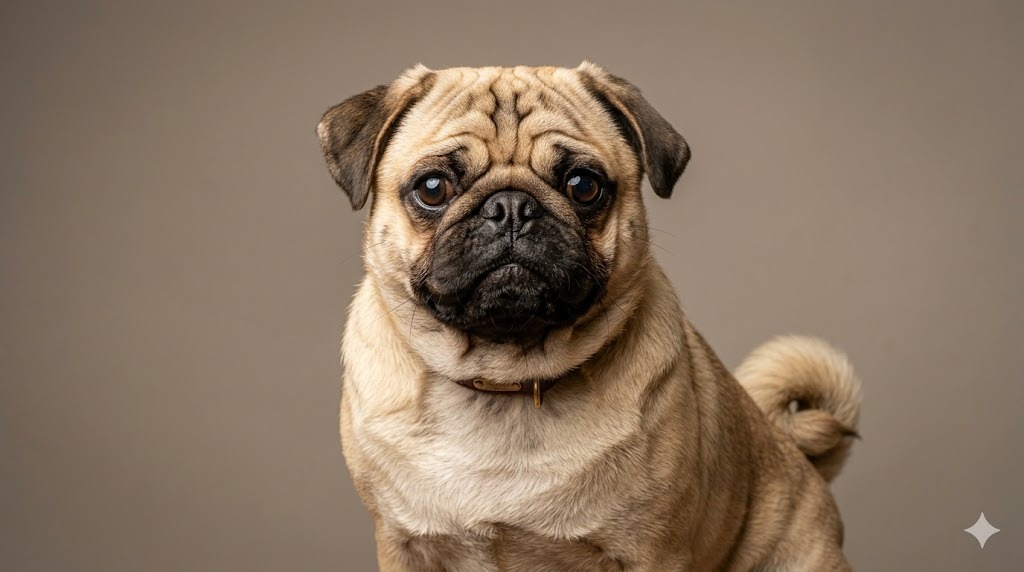
The Pug is a small, flat-faced, wrinkle-headed companion dog with an ancient pedigree and a personality wildly disproportionate to its size.
🗓️ Last reviewed: June 2026
Overview
The Pug is a small, flat-faced, wrinkle-headed companion dog with an ancient pedigree and a personality wildly disproportionate to its size. Bred in China at least two thousand years ago as a lap dog for emperors, the Pug has been a court favourite in Tibet, Holland, and Britain across the centuries. The breed's motto, "multum in parvo" - "much in little" - captures the Pug perfectly: small body, big eyes, enormous personality, and unfortunately enormous health issues that have made the modern Pug a textbook example of the consequences of extreme conformation.
History & Origins
Pugs were bred in ancient China specifically as companion dogs for the imperial court - emperors kept them in luxury, with servants assigned to each dog. Tibetan Buddhist monasteries also kept Pugs as gifts from China. The breed reached Europe in the 16th century through Dutch traders.
In 1572 a Pug reportedly saved the life of William the Silent, Prince of Orange, by alerting him to Spanish assassins. The breed became the official dog of the House of Orange and travelled to England with William III in 1688. Queen Victoria kept many Pugs and helped fix the breed's modern form. By the late 1800s the Pug had become a fashionable lap dog throughout Europe and North America. The AKC recognised the breed in 1885.
Modern Pugs have been bred for increasingly flat faces, wider heads, and tighter wrinkles than their historical ancestors. The result is a sweet companion with significant health challenges.
Appearance
Small, compact, square. Adults stand 25-33 cm (10-13 in) and weigh 6-9 kg (14-20 lb).
Key features:
- Coat: short, smooth, glossy double coat.
- Colour: fawn (with a black face mask), black, silver, or apricot. Most familiar is fawn with a black mask.
- Head: very large in proportion to the body, with deep wrinkles, a flat face, and enormous round dark eyes.
- Ears: small, soft, "rose" or "button" ears, set high.
- Tail: curled tightly over the back; double-curled is preferred in shows.
Temperament & Character
Friendly, playful, and devoted. Pugs are typically excellent with children, friendly with strangers and other dogs, and tolerant in multi-pet homes. They are not natural alarm dogs and bark less than most small breeds.
The breed is famously food-motivated - a Pug will do anything for a treat, including spectacularly bad decisions. They are also notoriously stubborn; intelligence is high but compliance is selective.
Pugs are companions. They want to be on the sofa, in the bed, on the lap, or following their human at all times. They do not tolerate being alone for long. The breed snores, snorts, grunts, and makes a continuous vocabulary of strange noises throughout the day.
Care
Coat & Grooming
The short coat sheds remarkably for the size - Pugs leave hair on every surface. Brush 2-3 times weekly with a rubber curry; daily during the twice-yearly heavy shed.
Bathe every 4-6 weeks. The facial wrinkles must be cleaned 2-3 times weekly with a dry cloth or canine wipe and dried thoroughly - trapped moisture causes painful skin infections quickly. Some Pugs need daily wrinkle cleaning. Wipe around eyes daily.
Clean ears weekly. Trim nails every 3 weeks. Brush teeth daily - dental disease is universal.
Exercise & Activity Needs
Modest. Adults need 30-45 minutes of daily exercise split across the day - multiple short walks, indoor play, light training. The breed is playful but tires quickly.
The flat face severely limits heat and exercise tolerance. Never walk a Pug in midday summer sun. Never leave one in a parked car. Stop at the first sign of heavy breathing or distress. Most cannot swim safely - top-heavy bodies and flat faces don't combine well with water.
Health & Lifespan
Average lifespan is 12-15 years, though many Pugs face significant health challenges throughout life.
Common concerns:
- Brachycephalic Obstructive Airway Syndrome (BOAS) - affects the majority of modern Pugs to some degree. Many require surgical airway correction.
- Heat intolerance.
- Eye conditions - the prominent eyes are vulnerable to corneal ulcers, dry eye, entropion, proptosis (eye popping out of the socket from injury or even rough handling).
- Pug Dog Encephalitis (PDE) - a fatal inflammatory brain disease specific to this breed. Affects roughly 1.2% of all Pugs.
- Hip dysplasia and patellar luxation.
- Hemivertebrae - spinal deformity related to the screw tail.
- Obesity - universal risk; Pugs eat enormously and exercise modestly.
- Skin fold dermatitis.
- Dental disease.
- Demodex.
The Pug has become a focus of welfare concern in several European countries. The Netherlands and Norway have proposed or implemented breeding restrictions to favour healthier conformation.
Feeding & Nutrition
Adults typically eat 1/2 to 1 cup of quality small-breed food per day in two meals. The breed gains weight effortlessly and any excess severely worsens breathing, joint, and lifespan outcomes. Measure portions; limit treats to 10% of calories; ignore the begging eyes.
A lean Pug - ribs easily felt - moves better, breathes better, and lives longer. Many Pug owners feed 10-20% less than the bag instructs.
Pros & Cons
Pros
- Friendly with everyone - kids, strangers, dogs.
- Apartment-friendly with modest exercise needs.
- Affectionate and entertaining.
- Low grooming demands beyond wrinkles.
- Adaptable to many lifestyles.
Cons
- Significant brachycephalic health issues; reduced quality of life in many.
- Heat-intolerant; severe summer risk.
- Prone to obesity and food allergies.
- Sheds heavily despite short coat.
- Specific catastrophic risks (PDE, eye proptosis).
- Snores, snorts, drools.
Best Suited For
- Calm households with someone home most of the day.
- Apartment dwellers in mild climates.
- Families with older children.
- Retirees wanting a constant lap companion.
- Owners who can budget seriously for veterinary care.
Not suited for hot-climate outdoor lifestyles, active runners or hikers wanting a companion, full-time-office homes, or first-time owners unprepared for ongoing health management.
Pug puppy growth chart
A typical growth curve for a toy breed like the Pug, estimated from its adult weight of 6-9 kg. Puppies vary with sex, genetics and diet, so treat this as a guide - for your own puppy, use the puppy weight predictor.
| Age | Typical weight | % of adult |
|---|---|---|
| 2 mo | 2-3 kg | 33% |
| 3 mo | 2.7-4.1 kg | 45% |
| 4 mo | 3.3-5 kg | 55% |
| 6 mo | 4.5-6.8 kg | 75% |
| 9 mo | 5.7-8.5 kg | 95% |
| 12 mo | 6-9 kg | 100% |
| Adult | 6-9 kg | 100% |
Pug - frequently asked questions
Are Pugs healthy?
Many Pugs are not. Brachycephalic breathing, eye problems, and a range of inherited issues affect most modern Pugs to some degree. Choosing a breeder who outcrosses to healthier lines (e.g., the Retro Pug or Continental Pug) or pursuing a healthy mixed Pug can improve outcomes significantly.
Do Pugs shed a lot?
Yes - heavily for their size, especially fawn Pugs. Daily brushing during shed seasons is essential.
Are they good with kids?
Generally excellent - patient, gentle, and tolerant. Supervise toddlers; the prominent eyes are vulnerable.
Can Pugs swim?
Most cannot safely. Top-heavy bodies and flat faces make swimming dangerous. Use a life vest near water.
Why do their eyes pop out?
The shallow eye sockets cannot retain the prominent eyes under significant impact. Common triggers include rough handling, fights with other dogs, or even violent sneezing. Veterinary emergency in all cases.
🧠 Test yourself: guess the dog
Three clues from our quiz bank, each about another of our dogs. Can you name them?
Clue 1.Unmistakable for its egg-shaped head and tiny triangular eyes, this muscular breed was once a long-running beer mascot.
It's the Bull Terrier - read the full profile →
Clue 2.Bred to dig into setts and burrows after badgers, this dog's name literally means 'badger dog' in German.
It's the Dachshund - read the full profile →
Clue 3.Bred for a flat chest to fit down burrows, this tenacious dog comes in smooth, broken, and rough coats.
It's the Jack Russell Terrier - read the full profile →
💛 Adoptable Pugs near you
Real dogs of this breed (and close mixes) waiting in shelters and rescues right now, live from Petfinder. We have no affiliation and earn nothing - if someone catches your eye, the link goes straight to their shelter. New to adopting? Start with our adoption guide.
Widget not loading (some ad-blockers hide it)? Search directly on petfinder.com.