Rottweiler
The Rottweiler is a powerful, calm, and confident working dog with roots stretching back to the Roman legions.
🗓️ Last reviewed: July 2026
Overview
The Rottweiler is a powerful, calm, and confident working dog with roots stretching back to the Roman legions. Despite a reputation built by careless owners and dramatic media coverage, a well-bred and well-raised Rottweiler is steady, affectionate with family, and superb at virtually every working role asked of it - herding, drafting, police, protection, search-and-rescue, and service. The breed is not aggressive by nature; it is serious, observant, and physically capable, which makes good ownership both a privilege and a responsibility.
History & Origins
The breed's ancestors were Roman drover dogs - large, mastiff-type herders that travelled with the legions across the Alps. When the Romans settled in what is now southern Germany, around the town later called Rottweil, these dogs stayed. For centuries the "Rottweiler Metzgerhund" (butcher's dog of Rottweil) drove cattle to market, guarded the herd and the cash, and pulled small carts of meat.
When rail transport replaced cattle drives in the late 1800s, the breed almost disappeared. It was rescued by early 20th-century enthusiasts who recognised its working potential. By the First World War, Rottweilers were serving as police and military dogs. The German Rottweiler Club (ADRK), founded in 1921, set a strict working-temperament standard that remains influential today.
The Rottweiler became one of the most popular breeds in North America during the 1980s and 90s, then suffered the inevitable backlash of irresponsible breeding and bad publicity. Numbers stabilised; quality breeders remain focused on temperament, working ability, and health.
Appearance
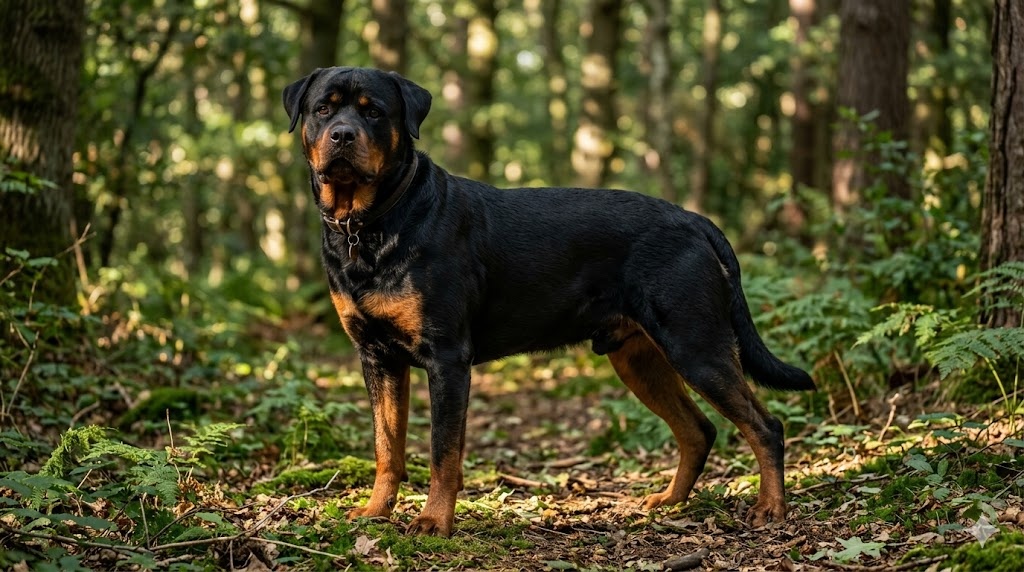
A robust, powerful, medium-large dog. Males stand 61-69 cm (24-27 in) and weigh 50-60 kg (110-130 lb); females are noticeably smaller and lighter. The build is balanced, never fat or coarse - a working dog, not a giant breed.
Key features:
- Coat: short, dense, slightly harsh outer coat with an undercoat on the neck and thighs.
- Colour: always black with clearly defined mahogany or rust markings on the cheeks, muzzle, chest, legs, and over the eyes. Other colours are non-standard.
- Head: broad with a moderate stop, strong muzzle, and small triangular ears carried forward.
- Tail: historically docked; today natural in many countries (long, carried level or slightly raised).
- Expression: calm, confident, alert.
Temperament & Character
The breed standard calls for "self-assured, steady, fearless" temperament. A proper Rottweiler is calm at home, reserved with strangers, and protective only when truly necessary. The dog is observant rather than reactive - it watches, weighs, and acts deliberately.
Rottweilers are deeply affectionate with their own people. The "leaning" gesture - pressing the whole body against your leg - is a breed signature. Many are reported to think of themselves as small dogs and try to sit in laps.
They are not "friendly to everyone." A correct adult is polite but selective with strangers. Excessive friendliness or fearful sharpness are both faults.
Care
Coat & Grooming
Short, easy-care double coat. Brush 1-2 times weekly with a rubber curry or de-shedding mitt; daily during the twice-yearly shed. Bathe every 6-8 weeks.
Clean ears weekly, trim nails every 2-3 weeks (Rotts have heavy nails that don't wear down on pavement alone), brush teeth several times weekly.
Exercise & Activity Needs
A serious working dog. Adults need at least 60-90 minutes of substantial exercise daily, ideally combining walking, jogging, structured training, drafting, or sport work. The breed excels at IGP/Schutzhund, obedience, tracking, herding, carting, and dock diving.
Mental work is critical. A Rottweiler without a job becomes pushy, frustrated, and sometimes destructive. Daily training sessions, problem-solving games, and consistent rules keep the dog balanced.
Avoid heavy exercise in puppies under 12-14 months - joints are still developing. No forced running on hard surfaces, no jumping from height, controlled growth.
Health & Lifespan
Average lifespan is 9-11 years. Common issues:
- Hip and elbow dysplasia - historic problem in the breed. Both parents must be screened.
- Osteosarcoma (bone cancer) - significantly elevated risk; spaying/neutering before maturity has been linked to higher rates in females.
- Aortic stenosis and other heart conditions.
- Bloat (GDV) - moderate to high risk.
- Hypothyroidism.
- Eye conditions (entropion, ectropion, PRA).
Delayed spay/neuter (after 18-24 months) is increasingly recommended in this breed to reduce cancer and joint risks. Discuss timing with a vet familiar with large-breed research.
Feeding & Nutrition
Adults usually need 4-6 cups of quality large-breed food per day, in two or three meals. Puppies should be fed a large-breed puppy formula to control growth rate - fast-growing Rottweilers develop joint disease.
Bloat risk is real: feed multiple smaller meals, avoid vigorous exercise within an hour of meals, consider a slow-feeder if your dog inhales food. Joint-support diets with glucosamine and EPA/DHA are reasonable from middle age.
Keep the dog lean. Visible fat shortens lives in this breed dramatically.
Pros & Cons
Pros
- Calm, confident, family-devoted companion.
- Versatile in working and sport roles.
- Short coat is easy to maintain.
- Natural protector - without training to be aggressive.
- Sturdy, athletic, capable of carrying real workload.
Cons
- Powerful and serious - requires experienced, committed ownership.
- Significant cancer risk; shorter lifespan than ideal.
- Sheds steadily; "blows" coat twice yearly.
- Insurance and legal restrictions in some regions.
- Strong jaws and pulling power require leash mastery.
Best Suited For
- Experienced owners committed to training and structure.
- Active households with secure outdoor space.
- Sport homes (IGP, obedience, tracking, herding, carting).
- Working roles: police, security, search-and-rescue.
- Families with older, dog-savvy children.
Not suited for first-time owners, sedentary households, full-time-office homes without coverage, or anyone uncomfortable with a powerful dog.
Rottweiler puppy growth chart
A typical growth curve for a giant breed like the Rottweiler, estimated from its adult weight of 50-60 kg. Puppies vary with sex, genetics and diet, so treat this as a guide - for your own puppy, use the puppy weight predictor.
| Age | Typical weight | % of adult |
|---|---|---|
| 2 mo | 9-10.8 kg | 18% |
| 3 mo | 14-16.8 kg | 28% |
| 4 mo | 18.5-22.2 kg | 37% |
| 6 mo | 26-31.2 kg | 52% |
| 9 mo | 35-42 kg | 70% |
| 12 mo | 41.5-49.8 kg | 83% |
| Adult | 50-60 kg | 100% |
Rottweiler - frequently asked questions
Are Rottweilers dangerous?
A well-bred, well-raised Rottweiler is stable, controllable, and safe. A neglected or badly bred one is genuinely dangerous - they are large, powerful dogs. Choose a temperament-tested line and train from day one.
Are Rottweilers good with kids?
Generally yes with their own family. Supervise - their size makes accidents easy. Socialise carefully with neighbour children.
Do Rottweilers drool a lot?
Less than mastiffs but more than most short-coated breeds, particularly after eating or drinking.
How long do Rottweilers live?
9-11 years on average. Lean weight, cancer awareness, and good genetics push the upper end.
Are they hypoallergenic?
No - they shed and produce dander.
🧠 Test yourself: guess the dog
Three clues from our quiz bank, each about another of our dogs. Can you name them?
Clue 1.A distinctive ghostly-grey pointer whose breeding was once tightly controlled by an exclusive German club to protect its quality.
It's the Weimaraner - read the full profile →
Clue 2.This gentle giant is sweet and patient with families despite its enormous frame, but sadly has a short lifespan.
It's the Great Dane - read the full profile →
Clue 3.Despite its glamorous lap-dog image, this small English breed retains a bold terrier temperament from its vermin-hunting origins.
It's the Yorkshire Terrier - read the full profile →
💛 Adoptable Rottweilers near you
Real dogs of this breed (and close mixes) waiting in shelters and rescues right now, live from Petfinder. We have no affiliation and earn nothing - if someone catches your eye, the link goes straight to their shelter. New to adopting? Start with our adoption guide.
Widget not loading (some ad-blockers hide it)? Search directly on petfinder.com.