Shetland Sheepdog
The Shetland Sheepdog - universally called the "Sheltie" - is a small herding dog from the remote Shetland Islands north of Scotland.
🗓️ Last reviewed: June 2026
Overview
The Shetland Sheepdog - universally called the "Sheltie" - is a small herding dog from the remote Shetland Islands north of Scotland. Brilliant, sensitive, and uncannily attuned to its family, the Sheltie looks like a miniature Rough Collie but is a distinct, older breed with its own working heritage. Among the most intelligent and trainable breeds in the world, the Sheltie is also one of the most demanding emotionally - a sensitive, vocal, devoted dog that requires patient ownership.
History & Origins
The Shetland Islands lie on the same latitude as southern Greenland - windswept, treeless, and poor in pasture. Small farms could not support large dogs or large livestock; everything that lived there had to be efficient. The Sheltie was developed from local Spitz-type herders crossed with Scottish working collies brought to the islands. The breed's job was to herd small sheep, ponies, and poultry over rough ground.
By the late 19th century the original "Shetland Collie" was nearly lost as crossbreeding with imported Rough Collies and Pomeranians blurred the breed. The modern Sheltie was reconstructed in the early 1900s, with the breed standard finalised in the 1920s. The AKC recognised the breed in 1911.
The modern Sheltie is closer in temperament to a miniature working collie than to the Spitz dogs in its background. It is not, despite the resemblance, a miniature Rough Collie.
Appearance
Small to medium, balanced, with a flowing double coat. Adults stand 33-41 cm (13-16 in) and weigh 7-11 kg (15-25 lb).
Key features:
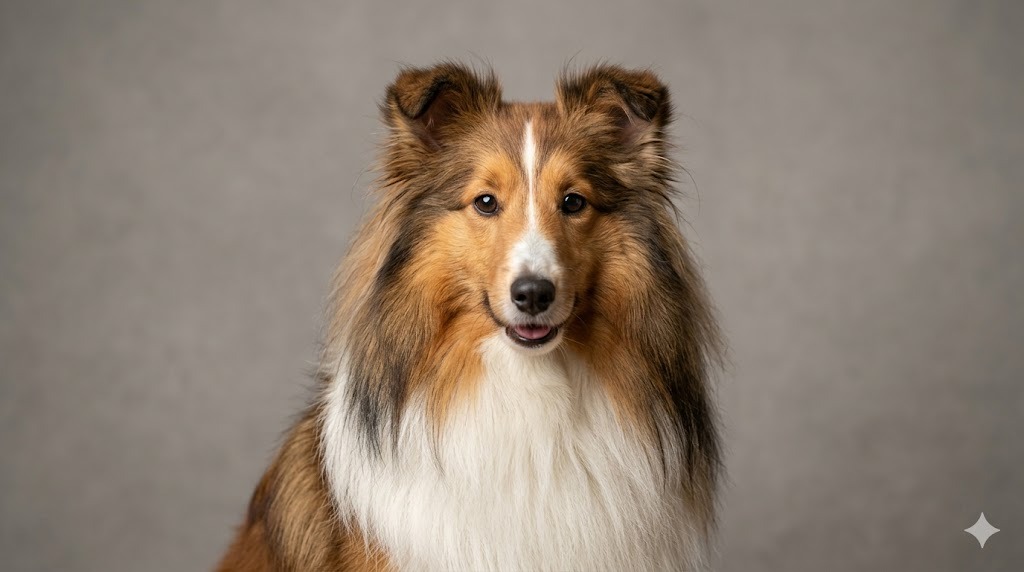
- Coat: dense double coat with a long, straight outer coat and soft thick undercoat. Mane around the neck, feathering on legs and tail.
- Colour: sable (most common), tricolour (black with white and tan), blue merle (with white and tan), bi-black (black-and-white), bi-blue (blue merle without tan). Double merles must not be bred.
- Head: refined wedge with small semi-erect ears, almond-shaped dark eyes (blue eyes accepted in merles), and a soft expression.
- Tail: carried low, never above the topline.
Temperament & Character
Brilliant, sensitive, alert, and intensely loyal. Shelties bond very closely with family and tend to be reserved or aloof with strangers - not aggressive, just cautious. They form one or two strongest bonds within the family.
The breed is vocal - Shelties bark at the doorbell, the postman, suspicious sounds, and minor changes in routine. Training reduces but rarely eliminates this.
Sensitivity defines the breed. Shelties read emotional tone like few other dogs. Stressful households, harsh corrections, or chaotic environments produce anxious, shut-down adults. Calm consistency produces brilliant, devoted companions.
Care
Coat & Grooming
The double coat is significant work. Brush 2-3 times weekly with a slicker followed by a pin brush and metal comb. Daily during the heavy spring and autumn coat blow when the undercoat falls out in handfuls.
Bathe every 6-8 weeks. Trim feathering on feet and sanitary area. Never shave a Sheltie - the double coat regulates temperature in both heat and cold, and shaving damages regrowth.
Clean ears weekly. Trim nails every 3 weeks. Brush teeth several times weekly.
Exercise & Activity Needs
Higher than the size suggests. Adults need 60-90 minutes of varied daily exercise combining walks, off-leash play in safe areas, and training. The breed excels at agility (often dominant in small classes), obedience, herding, flyball, rally, and scent work.
Mental work is essential. The Sheltie's brain works constantly - bored Shelties bark obsessively, develop compulsions (shadow chasing, light fixations), and become anxious. Daily training, puzzle toys, and a structured routine keep the breed balanced.
Health & Lifespan
Average lifespan is 12-14 years.
Common concerns:
- Collie eye anomaly (CEA) - a hereditary eye condition; DNA test available. All breeding dogs should be screened.
- Hip dysplasia.
- Progressive retinal atrophy.
- Dermatomyositis - a skin and muscle inflammatory condition specific to Collies and Shelties.
- MDR1 (multidrug sensitivity) gene mutation - common in this breed. Affected dogs react severely to ivermectin and certain other drugs. DNA test essential.
- Hypothyroidism.
- Von Willebrand's disease - a clotting disorder; DNA test available.
- Epilepsy.
Double-merle puppies (merle × merle breeding) have very high rates of deafness and blindness. Avoid breeders who pair two merles.
Feeding & Nutrition
Adults typically eat 3/4 to 1½ cups of quality food per day in two meals. The breed gains weight easily; measure portions.
The double coat hides weight gain - a Sheltie can be obese before it looks fat. Feel ribs and waist regularly. Joint-support diets with EPA/DHA are reasonable from middle age.
Pros & Cons
Pros
- Brilliantly intelligent and trainable.
- Devoted, family-oriented companion.
- Excellent at every dog sport.
- Beautiful, expressive appearance.
- Long-lived for a medium breed.
Cons
- Heavy double-coat shedding.
- Vocal - barking is a breed trait.
- Reserved with strangers; can develop fear or reactivity.
- Sensitive - not for chaotic households.
- Tendency to chase moving objects.
Best Suited For
- Active families willing to commit time to training.
- Sport homes (agility, obedience, herding).
- Service and therapy programmes.
- Households tolerant of barking.
- Owners experienced with sensitive breeds.
Not suited for chaotic households, harsh handlers, full-time-office homes without coverage, or owners wanting a calm low-maintenance pet.
Shetland Sheepdog puppy growth chart
A typical growth curve for a medium breed like the Shetland Sheepdog, estimated from its adult weight of 7-11 kg. Puppies vary with sex, genetics and diet, so treat this as a guide - for your own puppy, use the puppy weight predictor.
| Age | Typical weight | % of adult |
|---|---|---|
| 2 mo | 1.9-3 kg | 27% |
| 3 mo | 2.8-4.4 kg | 40% |
| 4 mo | 3.5-5.5 kg | 50% |
| 6 mo | 4.8-7.5 kg | 68% |
| 9 mo | 6-9.4 kg | 85% |
| 12 mo | 6.8-10.7 kg | 97% |
| Adult | 7-11 kg | 100% |
Shetland Sheepdog - frequently asked questions
Sheltie vs Rough Collie - what's the difference?
Despite the resemblance, they are separate breeds. The Sheltie is smaller (7-11 kg vs 25-34 kg), more reserved, and from the Shetland Islands. The Collie is larger, more outgoing, and from mainland Scotland. They share herding ancestry but diverged centuries ago.
Are Shelties good with kids?
With respectful older children, yes. The breed's sensitivity makes very young children stressful for them. Many Shelties prefer adult company.
Do they shed a lot?
Yes - moderate year-round, heavy twice a year. Daily brushing during shed seasons is essential.
Why are they so vocal?
The breed was developed to bark at intruders and to control livestock. Vocalisation is hardwired. Training reduces unwanted barking but does not eliminate it.
Are they hypoallergenic?
No - heavy shedders.
🧠 Test yourself: guess the dog
Three clues from our quiz bank, each about another of our dogs. Can you name them?
Clue 1.This Irish farm terrier is named for the warm grain-like color of its uniquely silky single coat.
It's the Soft Coated Wheaten Terrier - read the full profile →
Clue 2.One of the oldest Arctic sled dogs, this powerful freighting breed was developed by an Inuit people to haul heavy loads over long distances, not to race for speed.
It's the Alaskan Malamute - read the full profile →
Clue 3.A German tax collector developed this sleek guard dog in the 1890s to protect him on his rounds.
It's the Doberman Pinscher - read the full profile →
💛 Adoptable Shetland Sheepdogs near you
Real dogs of this breed (and close mixes) waiting in shelters and rescues right now, live from Petfinder. We have no affiliation and earn nothing - if someone catches your eye, the link goes straight to their shelter. New to adopting? Start with our adoption guide.
Widget not loading (some ad-blockers hide it)? Search directly on petfinder.com.