Madagascar Hissing Cockroach
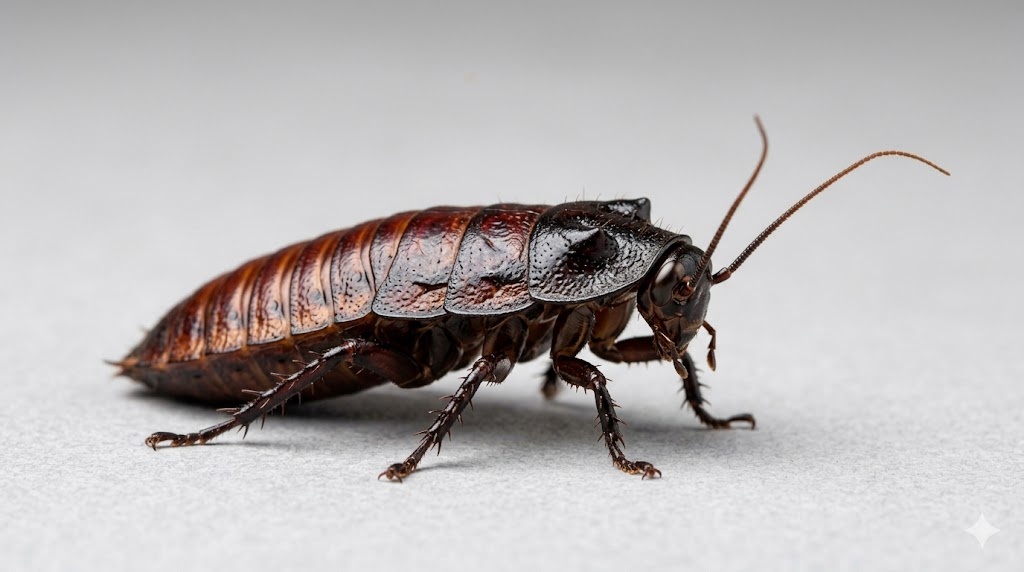
The Madagascar Hissing Cockroach (Gromphadorhina portentosa) is a large wingless cockroach native to Madagascar, famous for the audible hiss produced by forcing air through breathing holes.
🗓️ Last reviewed: June 2026
Overview
The Madagascar Hissing Cockroach (Gromphadorhina portentosa) is a large wingless cockroach native to Madagascar, famous for the audible hiss produced by forcing air through breathing holes. Popular as an educational pet - slow-moving, hardy, and one of the few invertebrates that can be safely handled by children.
Natural History
Native to Madagascar. Lives in rainforest leaf litter. Slow-moving and incapable of flight. Hisses for defence, communication, and mating.
Appearance
Adults 5-7.5 cm length. Glossy dark brown. Males have prominent horns on the pronotum; females are unhorned.
Temperament & Handling
Slow, calm, easily handled. Among the most child-friendly invertebrates. Don't bite or sting. Can stick to vertical surfaces with claws - be careful around carpets and curtains.
Enclosure
Plastic storage bin or aquarium 40 × 30 × 30 cm for a colony of 10-20.
Provide:
- Egg crate / cardboard for hiding.
- Substrate of coco fibre.
- Shallow water (with pebbles to prevent drowning).
- Escape-proof lid - they climb glass.
Apply petroleum jelly or fluon to the top 5 cm of enclosure to prevent climbing escapes.
Heating, Humidity, Lighting
- Temperature: 24-29°C.
- Humidity: 60-70%.
Diet
Omnivore: fresh vegetables, fruit, dog food (high-protein), oats, leaf litter. Provide water source.
Health & Lifespan
2-5 years.
Generally robust.
Pros & Cons
Pros: safe and easy to handle, child-friendly, low cost, educational. Cons: illegal/restricted in some US states; potential escape concern; not for cockroach-phobic households.
Madagascar Hissing Cockroach - frequently asked questions
Are they legal?
Banned in some US states (Florida, Louisiana, others) due to agricultural concerns. Check local regulations.
Do they fly?
No - flightless.
Can they reproduce?
Yes - single-sex groups prevent unwanted breeding. Females produce live young.
Are they good for kids?
Excellent educational pets - calm, safe, easily handled.
Are they really sushi-friendly in Madagascar?
Local diets do include them; not relevant to pet keeping.
🧠 Test yourself: guess the exotic
Three clues from our quiz bank, each about another of our exotic. Can you name them?
Clue 1.One of the world's largest land mollusks, this shelled creature can grow as long as an adult's hand and is a serious invasive pest.
It's the Giant African Land Snail - read the full profile →
Clue 2.This crustacean has a soft, spiraled abdomen and must borrow an empty snail shell to protect its body.
It's the Hermit Crab - read the full profile →
Clue 3.A heavy-bodied arachnid kept as a pet, the females of which can live for decades, far longer than the short-lived males.
It's the Tarantula - read the full profile →