Tarantula
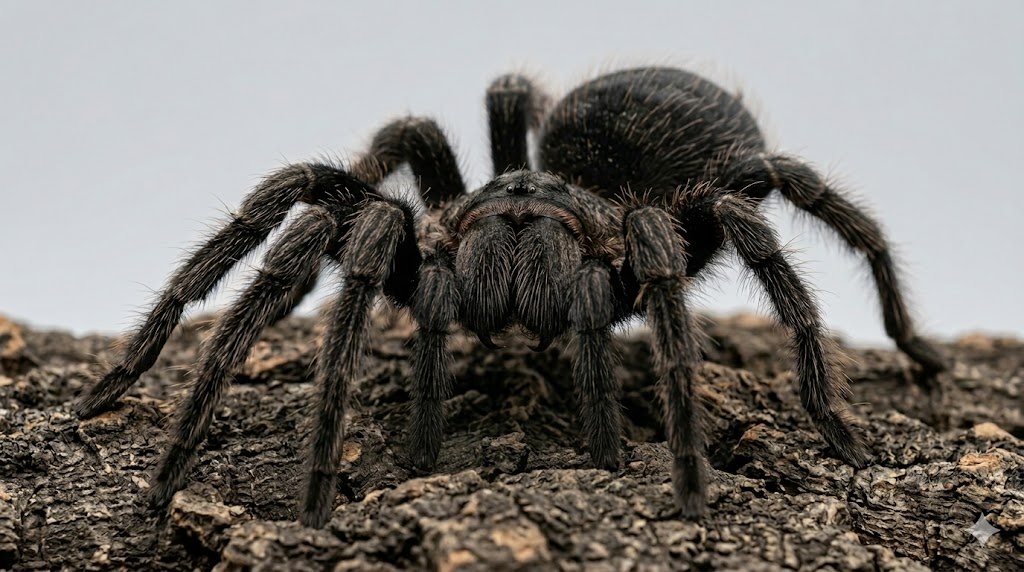
Tarantulas are large, hairy spiders kept as exotic pets.
🗓️ Last reviewed: June 2026
Overview
Tarantulas are large, hairy spiders kept as exotic pets. Despite the menacing appearance, most pet species are docile, long-lived (some over 30 years), and require minimal daily care. The hobby distinguishes between "Old World" (more aggressive, more potent venom) and "New World" (calmer, weaker venom, urticating hairs) species.
Common Pet Species
- Chilean Rose Hair (Grammostola rosea) - most popular beginner species.
- Mexican Red Knee (Brachypelma hamorii) - striking colours.
- Pink Toe (Avicularia avicularia) - arboreal.
- Mexican Red Rump (Tliltocatl vagans).
- Brazilian Black (Grammostola pulchra).
- Greenbottle Blue (Chromatopelma cyaneopubescens).
Appearance
Body 5-10 cm; legspan 12-25 cm. Many colours and patterns by species.
Temperament & Handling
Best as observation pets. Handling is generally discouraged in modern keeping - risk to spider (falls are fatal) outweighs benefits.
If handled: New World species have urticating hairs that cause skin irritation. Old World species have potent venom and faster reflexes; never handle.
Enclosure
Terrestrial species: 30 × 30 × 30 cm sufficient for most. Larger isn't always better - large spaces stress some species.
Arboreal species: vertical enclosures with branches.
Substrate: coco fibre or peat 8-10 cm deep for burrowing species. Hide cave. Shallow water dish.
Heating, Humidity, Lighting
- Temperature: 22-28°C (species-specific).
- Humidity: 60-80% (species-specific; desert species drier).
- Low/no UV needed.
Diet
Live insects: crickets, dubia roaches, mealworms. Adults eat 1-2 prey items per 1-2 weeks. Some species fast for months without harm.
Health & Lifespan
Females: 15-30+ years (some over 40). Males: 3-7 years (die after maturity).
Common concerns:
- Falls - fatal from heights as low as 30 cm in heavy species.
- Dehydration.
- Moulting issues.
- Parasitic mites.
Pros & Cons
Pros: very long-lived (females), low maintenance, quiet, take little space. Cons: observation-only, falls are fatal, some species are unsafe.
Tarantula - frequently asked questions
Are they dangerous?
Most pet species have venom roughly equivalent to a bee sting. Old World species (Asian, African) have more potent venom and aren't beginner pets.
Can you handle them?
Possible with calm species (Chilean Rose, Mexican Red Knee). Discouraged - falls injure or kill the spider. Modern keeping favours observation only.
How long do they live?
Females: 15-30+ years. Males: 3-7 years.
Are they good for kids?
For observation, older children only. Never for handling.
Best beginner species?
Chilean Rose Hair (Grammostola rosea) - docile, hardy, slow-moving.
🧠 Test yourself: guess the exotic
Three clues from our quiz bank, each about another of our exotic. Can you name them?
Clue 1.Sold cheaply at beach shops, this pet has one oversized claw used to seal the entrance of its home.
It's the Hermit Crab - read the full profile →
Clue 2.One of the world's largest land mollusks, this shelled creature can grow as long as an adult's hand and is a serious invasive pest.
It's the Giant African Land Snail - read the full profile →
Clue 3.This ambush hunter has a single ear on its underside, tuned to detect the echolocation of hunting bats.
It's the Praying Mantis - read the full profile →