Cardinal Tetra
The Cardinal Tetra (Paracheirodon axelrodi) is the more brilliantly coloured cousin of the Neon Tetra.
Updated: October 2026
Overview
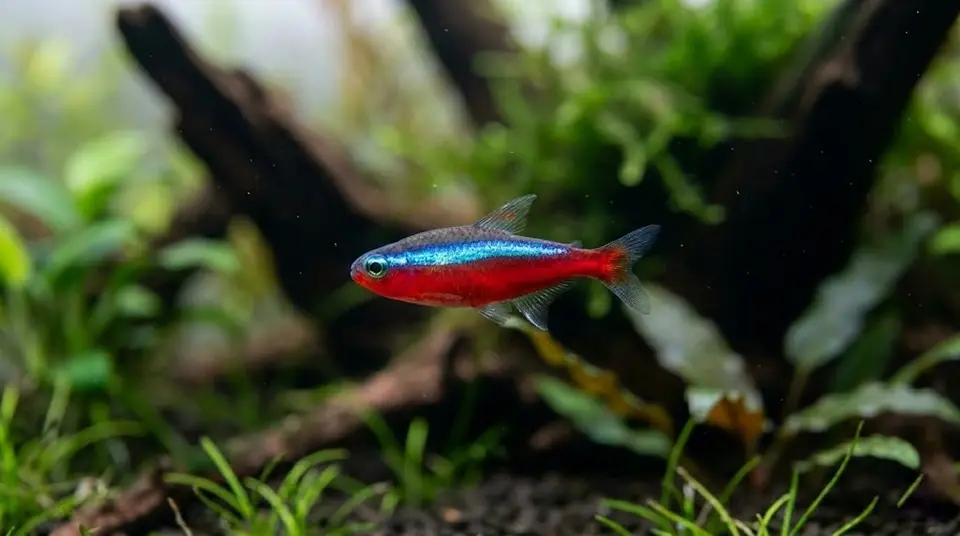
The Cardinal Tetra (Paracheirodon axelrodi) is the more brilliantly coloured cousin of the Neon Tetra. The species displays the same electric blue and red stripes - but the red extends the full length of the body rather than only the rear half. Cardinals are often considered the "prestige" version of Neons.
Natural History
Native to the upper Orinoco and Negro river basins of South America. Blackwater fish - soft, acidic, tannin-stained water.
Appearance
About 3 cm in total length (Wikipedia); FishBase gives a maximum of 3.0 cm standard length, and cardinals appear to grow larger in captivity than in the wild (Wikipedia). Brilliant blue dorsal stripe, full-length red lower stripe.
Temperament & Tankmates
Peaceful shoaling fish of the middle water layers. FishBase advises groups of five or more (FishBase), and the RSPCA keeps shoaling fish in groups of six or more so they do not feel stressed.
Excellent community fish. Like Neons, avoid large predators.
Tank Size & Setup
An aquarium at least 60 cm long, by FishBase. The RSPCA's guideline for tropical fish is 1.5-2 litres of water per 1 cm of fish length, tails excluded (RSPCA).
Soft acidic water, gentle flow, planted, dim lighting, blackwater conditions ideal.
Water Parameters
- Temperature: 23-27°C (FishBase).
- pH: 4.0-6.0 (acidic).
- Hardness: dH 5-12 (FishBase).
Diet
Mostly predatory: in the wild it picks tiny animals off plants, roots and leaf litter, mainly midge larvae and microcrustaceans such as water fleas and copepods (Wikipedia). In the tank, small flakes or micro pellets supplemented with thawed frozen daphnia or brine shrimp, which the RSPCA calls an excellent supplement for tropical fish; two or three feeds a day, each only as much as the fish eat in two to five minutes.
Health & Lifespan
Several years in captivity; in nature it may effectively be an annual, living about one year (Wikipedia).
Common concerns are the same as for the Neon.
Pros & Cons
Pros: more red than Neons, peaceful in a shoal, from a wild fishery that supports local people on the Rio Negro (Wikipedia). Cons: needs acidic water; most fish in the trade are wild-caught, as breeding in captivity is difficult (FishBase).
Everyday gear for aquariums
Links go to Amazon or a partner brand's own store and may earn us a commission at no extra cost to you. As an Amazon Associate we earn from qualifying purchases. An Amazon link leads to a type of gear and you choose the exact product; a card that names a store leads to that partner's own shop.
Cardinal Tetra - frequently asked questions
Cardinal vs Neon - which?
Cardinals carry red along the whole lower body, neons only on the rear half (Wikipedia). Cardinals need more acidic water (pH 4.0-6.0 by FishBase), while Wikipedia gives neons an ideal aquarium pH of 7.0; neons are more widespread, as cardinals were long hard to breed in captivity.
How long do they live?
Several years in captivity; in nature possibly only about a year (Wikipedia).
How do I care for a cardinal tetra?
Keep a group of five or more (FishBase), or six or more by the RSPCA's rule for shoaling fish, in a heated aquarium at least 60 cm long at 23-27°C, pH 4.0-6.0 and hardness dH 5-12 (FishBase). Feed small foods two or three times a day, only as much as they eat in two to five minutes (RSPCA).
Beginner fish?
With cycled tank and soft water, yes.
Sources
Sources this profile draws on, as linked in the text:
Test yourself: guess the fish
Three clues from our quiz bank, each about another of our fish. Can you name them?
Clue 1.Nicknamed the 'king of the aquarium,' this round, flat Amazonian cichlid feeds its fry on mucus from its own skin.
It's the Discus - read the full profile →
Clue 2.Domesticated from a dull carp over a thousand years ago in China, this orange fish is one of the oldest kept pets.
It's the Goldfish - read the full profile →
Clue 3.Keepers love this diverse group for bold personalities but warn that many dig substrate and fiercely defend a chosen territory.
It's the Cichlid (Overview) - read the full profile →