Guppy
The Guppy (Poecilia reticulata) is one of the most popular and easiest tropical freshwater fish - colourful, hardy, peaceful, and famously prolific.
Updated: October 2026
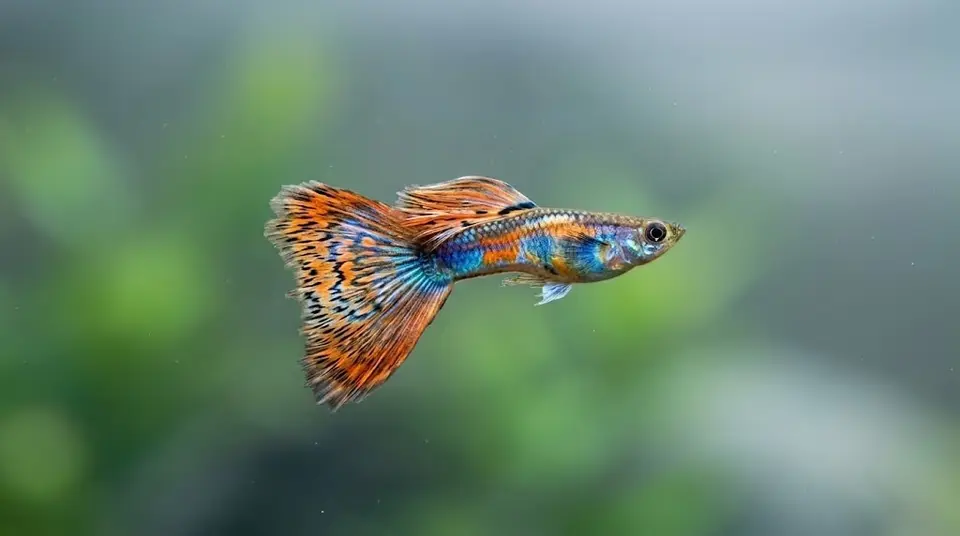
Overview
The Guppy (Poecilia reticulata) is one of the most popular and easiest tropical freshwater fish - colourful, hardy, peaceful, and famously prolific. Often the first fish for new aquarium keepers and a staple of community tanks.
Natural History
Native to South America (Trinidad, Venezuela, Guyana, Brazil). Livebearing - produces live young instead of eggs. Established invasive populations worldwide.
Appearance
Adults: females 4-6 cm, males 3-4 cm. Males have brilliant colours and long flowing tails; females are larger but plainer.
Hundreds of strain types: cobra, snakeskin, mosaic, tuxedo, half-black, albino, and many more.
Temperament & Tankmates
Peaceful. Excellent in community tanks with other small peaceful fish. Avoid:
- Fin-nippers (tiger barbs, some tetras).
- Large predators.
Mix with: small tetras, corydoras, otocinclus, peaceful livebearers (platy, molly).
Tank Size & Setup
Minimum: 40 L (10 gallon) for a group of 5-7. Larger preferred.
Keep at least 3 - guppies are schooling/grouping fish.
If breeding is not desired, keep all-male or all-female groups. Mixed-sex groups produce non-stop fry - females can store sperm and produce multiple broods from one mating.
Water Parameters
- Temperature: 22-28°C.
- pH: 6.8-7.8 (tolerates wide range).
- Hardness: moderate to hard.
Diet
Omnivore. Wild guppies feed on algal remains, diatoms, invertebrates, zooplankton, detritus, plant fragments and aquatic insect larvae (Wikipedia). In the tank, give a tropical fish flake or micro pellet as the staple and add other foods for balance and enrichment, as the RSPCA advises.
| Give | Avoid |
|---|---|
| Tropical fish flakes or micro pellets as the staple | Goldfish flakes: their nutrient levels are different (RSPCA) |
| Frozen daphnia or brine shrimp, fully thawed, which the RSPCA calls an excellent supplement for tropical fish | Holiday feeding blocks: they release a lot of food quickly and most of it may rot (RSPCA) |
| Crumbled boiled egg yolk or some lettuce leaf, which the RSPCA suggests trying, depending on the species | More food than the fish eat in two to five minutes |
Feed two or three times a day, as much as the fish eat within two to five minutes. Underfeeding is safer than overfeeding, because fish suffer more from poor water quality than from a lack of food (RSPCA).
Health & Lifespan
1.5-3 years.
Common concerns:
- Inbreeding decline - modern Guppy strains often weak; quality from reputable breeders fares better.
- Ich.
- Fin rot.
- Tuberculosis (rare).
- Dropsy.
Pros & Cons
Pros: brilliant colours, peaceful, easy to keep, breed easily, ideal for beginners. Cons: short lifespan, fry production constant in mixed-sex tanks, weak inbred strains.
Everyday gear for aquariums
Links go to Amazon or a partner brand's own store and may earn us a commission at no extra cost to you. As an Amazon Associate we earn from qualifying purchases. An Amazon link leads to a type of gear and you choose the exact product; a card that names a store leads to that partner's own shop.
Guppy - frequently asked questions
What do guppies eat?
In the wild, algal remains, small invertebrates, zooplankton and insect larvae (Wikipedia). In the tank, tropical flakes or micro pellets as the staple, with thawed frozen daphnia or brine shrimp as a supplement, two or three times a day and only as much as they eat in two to five minutes (RSPCA).
Do they really breed easily?
Yes: the guppy is also known as the millionfish. Its gestation varies from 20 to 60 days at 25-27.8°C, and brood size is extremely variable (Wikipedia).
Can I keep just males?
Yes, recommended for non-breeding setups. All-male groups can have minor fin-nipping; provide enough space.
How long do they live?
The typical lifespan of the Guppy is 1.5-3 years.
Beginner fish?
Yes - among the easiest. Choose from reputable breeders rather than mass-market stock.
Sources
Sources this profile draws on, as linked in the text:
Test yourself: guess the fish
Three clues from our quiz bank, each about another of our fish. Can you name them?
Clue 1.Famous for multiplying fast, these fish carry developing fry internally until the babies emerge swimming.
It's the Molly / Platy / Swordtail (Livebearers) - read the full profile →
Clue 2.Some species of this small, brilliantly colored fish lay eggs that survive dried mud until rains return.
It's the Killifish - read the full profile →
Clue 3.Fancy varieties of this fish include bubble-eye and telescope-eye types bred for unusual looks.
It's the Goldfish - read the full profile →