Bearded Dragon
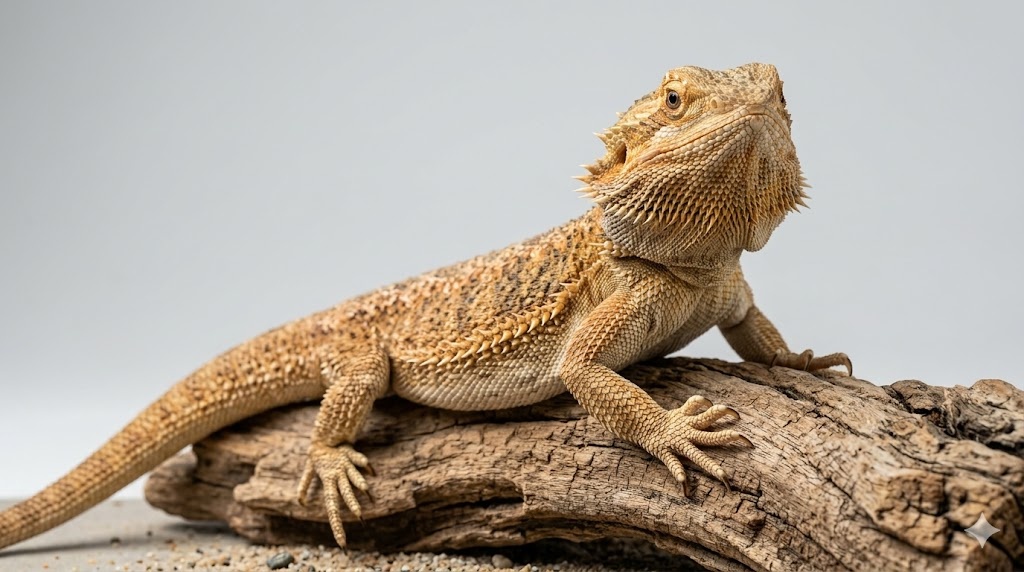
The Bearded Dragon (Pogona vitticeps) is one of the most popular pet lizards in the world - a medium-sized Australian agamid known for its docile temperament, expressive "beard" display, and interactive personality.
🗓️ Last reviewed: June 2026
Overview
The Bearded Dragon (Pogona vitticeps) is one of the most popular pet lizards in the world - a medium-sized Australian agamid known for its docile temperament, expressive "beard" display, and interactive personality. "Beardies" are diurnal, tolerate handling well, and recognise their owners.
Natural History
Native to arid woodlands and deserts of central Australia. Lives semi-arboreally on branches and rocks. Diurnal - active during the day, basking heavily.
Appearance
Adults 40-60 cm length, 350-600 g.
Wild colour: tan/brown with darker bars. Many morphs: hypo, citrus, red, leucistic, silkback (welfare-controversial), and others.
Distinctive "beard" - extensible spiny throat - flared and blackened when threatened, courting, or excited.
Temperament & Handling
Docile and friendly. Bearded Dragons typically tolerate daily handling, recognise owners, and many "wave" (a submissive arm motion) at humans or their reflection.
Enclosure
Minimum: 120 × 60 × 60 cm for one adult. Larger preferred. PVC or wood preferred over glass (better heat retention).
Provide:
- Basking branch / rock under hot spot.
- Hide on cool side.
- Live or artificial plants.
- Shallow water dish.
- Substrate: tile, reptile carpet, or paper. Loose substrate (sand) is debated - impaction risk vs natural behaviour.
Heating & Lighting
- Basking spot: 38-42°C surface temperature.
- Warm side ambient: 32-35°C.
- Cool side: 24-28°C.
- Night: can drop to 18-22°C.
- UVB essential - high-output UVB (Arcadia 12% or Reptisun 10.0) replaced every 6-12 months. Without UVB, metabolic bone disease is rapid and fatal.
Humidity
30-40%. Dry environment.
Diet
Omnivore. Diet shifts with age:
- Juveniles: 70% insects, 30% vegetables.
- Adults: 30% insects, 70% vegetables.
Insects: crickets, dubia roaches, black soldier fly larvae, hornworms. Avoid mealworms as staple (high chitin).
Vegetables: leafy greens (collard, mustard, turnip, dandelion), bell pepper, squash, sweet potato.
Avoid: spinach (oxalates), iceberg, avocado, citrus, rhubarb, lightning bugs (toxic).
Calcium + D3 supplement 3-5 times weekly.
Health & Lifespan
8-14 years.
Common concerns:
- Metabolic bone disease from inadequate UVB or calcium.
- Impaction from sand or large prey.
- Atadenovirus (also called "ADV") - common, often subclinical.
- Parasites (coccidia, pinworms).
- Yellow fungus disease.
- Egg binding in females.
- Obesity.
Pros & Cons
Pros:
- Docile and interactive.
- Tolerates handling well.
- Diurnal - active when humans are.
- Recognises owners.
Cons:
- Expensive setup (UVB, heat, large enclosure).
- 8-14 year commitment.
- Live insect feeding.
- High UVB requirements.
Best Suited For
- First-time reptile owners willing to invest in proper setup.
- Families with older children.
Not suited for squeamish owners (insect feeding) or those unable to afford proper UVB.
Bearded Dragon - frequently asked questions
Why do they "wave"?
A submissive social signal - they wave at other Bearded Dragons, owners, and reflections. Adorable but means "I see you, no threat."
Why does the beard turn black?
Stress, courting, basking. Not always a problem; context matters.
How long do they live?
8-14 years; some reach 15+.
Are they good for kids?
Yes - among the most child-friendly reptiles for older children with supervision.
Do they need UVB?
Absolutely. Without UVB, metabolic bone disease develops rapidly.
🧠 Test yourself: guess the reptile
Three clues from our quiz bank, each about another of our reptiles. Can you name them?
Clue 1.Native to the grasslands of west and central Africa, this constrictor is a favorite of breeders who have produced hundreds of color and pattern morphs.
It's the Ball Python - read the full profile →
Clue 2.This nocturnal climber has no eyelids, so it licks its own eyeballs clean with its tongue.
It's the Crested Gecko - read the full profile →
Clue 3.This large arboreal lizard has a third 'eye' on top of its head that senses light and shadow from above.
It's the Green Iguana - read the full profile →