Corn Snake
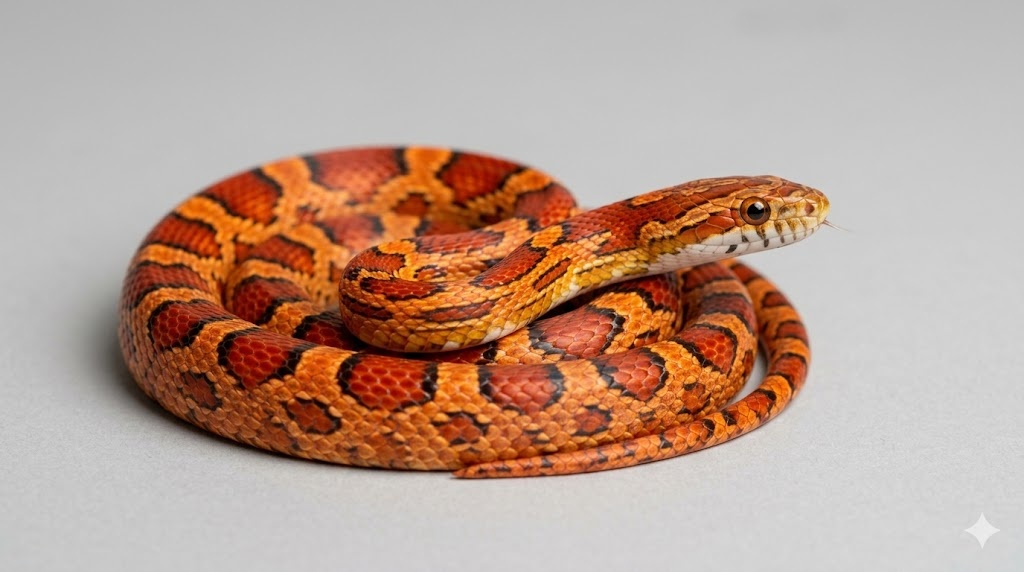
The Corn Snake (Pantherophis guttatus) is one of the most popular pet snakes and frequently recommended as the ideal beginner snake.
🗓️ Last reviewed: June 2026
Overview
The Corn Snake (Pantherophis guttatus) is one of the most popular pet snakes and frequently recommended as the ideal beginner snake. Native to the southeastern United States, the species is small, docile, hardy, and eats reliably - the opposite of the Ball Python's notorious food refusal habits.
Natural History
Native to fields and woodlands of the southeastern US. Semi-arboreal - climbs occasionally. Crepuscular. Constrictor - kills prey by squeezing.
Appearance
Adults 1-1.5 m length, slim build, 200-500 g.
Wild colour: orange-red with red blotches outlined in black. Hundreds of morphs: amelanistic, snow, anery, lavender, hypo, motley, stripe, and many combinations.
Temperament & Handling
Docile, easy to handle, reliable feeder. Among the friendliest snake species - most accept handling well from juvenile stage. Active and curious during handling.
Enclosure
Minimum: 1.2 × 0.4 × 0.4 m for one adult. Larger acceptable.
Provide:
- Hide on warm and cool side.
- Climbing branches.
- Water bowl.
- Substrate: aspen, cypress, coconut husk.
- Secure lid - corn snakes are escape artists.
Heating & Lighting
- Warm side: 27-30°C surface; 25-28°C ambient.
- Cool side: 22-25°C.
- Night: can drop to 20-23°C.
- UVB: beneficial but not strictly required (older keeping).
Humidity
40-60%. Increase to 60-70% during shed.
Diet
Carnivorous. Frozen-thawed mice:
- Hatchlings: pinky every 5-7 days.
- Juveniles: fuzzy/hopper every 7 days.
- Adults: adult mouse every 10-14 days.
Eat reliably - among the easiest snakes to feed.
Health & Lifespan
15-20 years (some 23+).
Common concerns:
- Mites.
- Respiratory infections.
- Scale rot.
- Cryptosporidiosis (rare).
- Inclusion body disease.
Pros & Cons
Pros:
- Reliable feeders.
- Docile and easy to handle.
- Small manageable size.
- Hundreds of morphs.
- Excellent first snake.
Cons:
- 15-20+ year commitment.
- Escape artists - secure cage essential.
- Frozen rodent feeding.
Best Suited For
- First-time snake keepers.
- Owners wanting reliable easy snake.
- Older children with adult supervision.
Corn Snake - frequently asked questions
Corn snake vs Ball python - which is better for beginners?
Both are excellent. Corn snake eats reliably and is more active/curious. Ball python is more docile but more prone to food refusal. Personal preference.
Are they good for kids?
Yes - among the most child-friendly snakes for older children with supervision.
How long do they live?
15-20 years.
Do they bite?
Rarely. Bites are mild and usually defensive.
Why are they called "corn" snakes?
The belly pattern resembles maize/Indian corn. Also, the species was historically found in grain stores hunting mice.
🧠 Test yourself: guess the reptile
Three clues from our quiz bank, each about another of our reptiles. Can you name them?
Clue 1.Named for the dark rosettes hatchlings wear over bands, this nocturnal pet licks its eyes to keep them clean.
It's the Leopard Gecko - read the full profile →
Clue 2.A popular small pet tortoise from arid Asia, this round-shelled grazer rarely exceeds eight inches long.
It's the Russian Tortoise - read the full profile →
Clue 3.This nocturnal climber has no eyelids, so it licks its own eyeballs clean with its tongue.
It's the Crested Gecko - read the full profile →