Gerbil
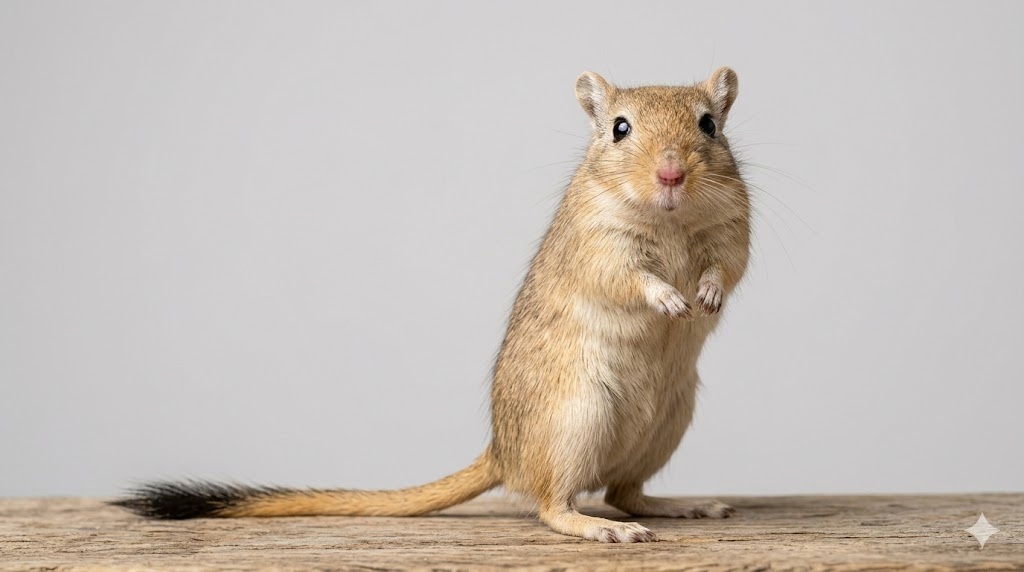
The gerbil - typically the Mongolian gerbil (Meriones unguiculatus) - is an active, social, nearly odourless small rodent originally native to the Mongolian steppes.
🗓️ Last reviewed: June 2026
Overview
The gerbil - typically the Mongolian gerbil (Meriones unguiculatus) - is an active, social, nearly odourless small rodent originally native to the Mongolian steppes. Gerbils combine desert-adapted hardiness with friendly social behaviour, making them one of the most rewarding small mammals for active observation.
Natural History & Origin
Mongolian gerbils inhabit semi-arid grasslands in Mongolia, northern China, and southern Russia. They live in extended family groups in elaborate burrow systems. The pet population began with about 20 wild-caught pairs brought to the US in 1954.
Appearance
Adults weigh 70-110 g, body length 10-13 cm plus tufted tail of similar length.
Colour varieties: agouti (wild), black, white, lilac, dove, argente, schimmel, and many others.
Temperament & Handling
Curious, active, friendly. Gerbils explore continuously and rarely sleep for long. They are easier to handle than hamsters - friendlier and less likely to bite.
Never pick up by the tail - gerbil tails are fragile and the skin sleeve can slough off, exposing bone. Pick up by cupping the body in both hands.
Housing
Minimum enclosure: 70 × 40 cm floor space, larger preferred. Tall enclosures (60+ cm high) for deep burrowing.
The defining requirement: very deep bedding (30+ cm). Gerbils dig elaborate tunnel systems and this is non-negotiable enrichment. Hamster cages are typically too shallow; aquariums (40-gallon and up) work well.
Provide:
- Deep paper or hemp bedding (no pine/cedar).
- Solid wheel (20+ cm).
- Wooden chew items (gerbil teeth grow continuously).
- Sand bath.
- Ceramic food bowl.
- Water bottle.
- Multiple hiding spots.
Diet
- Gerbil dry mix with grains, seeds, dried vegetables.
- Small portion of fresh vegetables every 2-3 days.
- Limited fruit as rare treat.
- Sunflower seeds very limited (fattening).
Avoid: citrus, onion, dairy, chocolate, sugary treats.
Gerbils need very little water (desert adaptation) but always provide fresh water.
Health & Lifespan
3-4 years.
Common concerns:
- Tyzzer's disease - bacterial infection, often fatal.
- Epilepsy - some genetic lines prone to seizures.
- Tail injuries from improper handling.
- Scent gland tumours (mid-belly) in older gerbils.
- Dental disease.
- Old-age tumours.
Pros & Cons
Pros:
- Active and engaging to watch.
- Friendly and easy to handle.
- Nearly odourless.
- Cheaper to feed than larger rodents.
- 3-4 year companions.
Cons:
- Must be kept in pairs.
- Need very deep bedding (large enclosure).
- Tail injuries from rough handling.
- Adult introductions difficult.
Best Suited For
- Older children and adults.
- Families wanting an active social small pet.
- Apartment dwellers.
Not suited for young children (tail fragility), households without proper deep-bedding setup.
Gerbil - frequently asked questions
Why deep bedding?
Gerbils evolved as burrowers. Adequate burrowing depth is one of the most important enrichments and significantly reduces stress.
Can I keep one gerbil alone?
Strongly discouraged. Gerbils are social. Always keep at least two same-sex.
Are they good for kids?
Older children with supervision. Teach proper handling (never by tail) and respect the gerbil's need to rest.
How long do they live?
3-4 years on average. Some reach 5.
🧠 Test yourself: guess the small mammal
Three clues from our quiz bank, each about another of our small mammals. Can you name them?
Clue 1.This social herbivore is born fully furred with open eyes and can run within hours of birth.
It's the Guinea Pig - read the full profile →
Clue 2.A soft grey high-altitude rodent kept as a pet, it overheats easily and needs a cool room plus a dust bath.
It's the Chinchilla - read the full profile →
Clue 3.This small, long-tailed rodent is the domesticated form of a common household pest kept as a friendly pet.
It's the Fancy Mouse - read the full profile →
Social Needs
Gerbils are obligately social. Keep at least in same-sex pairs (two littermates). Lone gerbils develop depression and short lifespan.
Introducing unfamiliar adult gerbils can cause severe fighting ("declanning"). Same-litter or split-cage method for new introductions.