AirTag for Dogs 2026: Complete Guide + Best Holders, Limits & Alternatives
Complete guide to using AirTag on your dog in 2026 - how it works, the best collar holders, real limitations vs GPS trackers, and when to choose Fi or Whistle instead.
AirTag for Dogs 2026: Complete Guide + Best Holders, Limits & Alternatives
An AirTag is the cheapest way to keep tabs on a dog - about $29 plus a collar holder - but it’s a finder, not a true GPS: it only pings off nearby iPhones, so it works in cities and suburbs and falls apart in empty backcountry. For a dog that genuinely roams or escapes, a real GPS tracker like Fi or Whistle is the better tool.
Apple’s AirTag became one of the most-discussed pet products almost by accident. Designed for keys and bags, the $29 device works well enough on dog collars that millions of owners now use them as low-cost pet trackers. Apple doesn’t market them this way - and there are real limitations - but for the right use case, an AirTag is the cheapest insurance against a lost dog you can buy.
This guide covers exactly what AirTag does and doesn’t do, the best holders for dog collars, when AirTag is the right choice, and when a real GPS tracker (Fi, Whistle, Tractive) is worth the additional cost. The decision turns on one question: do you primarily need to find a dog that’s already missing, or monitor a dog that’s currently with you?
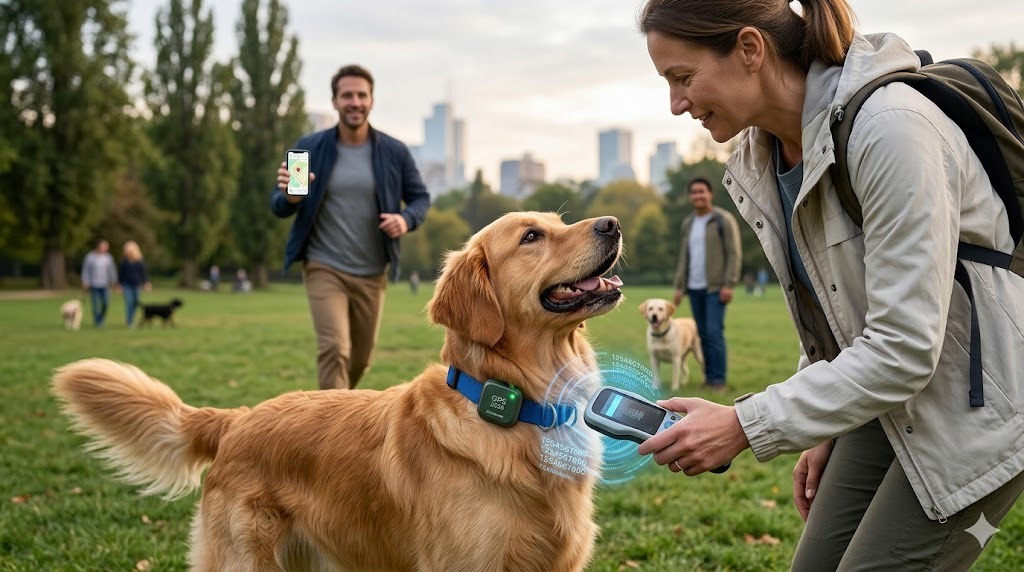
The AirTag pet-tracking premise: AirTag uses Apple’s Find My network of nearly 2 billion iPhones to anonymously relay its location whenever an iPhone passes near it. There’s no built-in GPS or cell service - the network does the work. This is brilliantly clever in cities and useless in remote areas.
At a Glance: AirTag vs Real Trackers
| Feature | AirTag | Fi GPS Collar | Whistle GO Explore | Tractive |
|---|---|---|---|---|
| Cost upfront | $29 | $149 | $130 | $50 |
| Monthly subscription | $0 | $10-15 | $10 | $7-13 |
| Live GPS tracking | No | Yes | Yes | Yes |
| Update frequency | Every iPhone passes | Every 6 seconds (active) | Every 15 seconds | Every 2-60 seconds |
| Works in remote areas | No | Yes (LTE) | Yes | Yes |
| Battery life | 1 year (replaceable coin cell) | 2+ months | 20 days | 2-7 days |
| Geofence alerts | No | Yes | Yes | Yes |
| Activity tracking | No | Yes | Yes | No |
| Compatible OS | iPhone only | iPhone + Android | iPhone + Android | iPhone + Android |
| Best for | Urban escape-runners | Adventure dogs, escape artists | Health-tracking | Budget GPS |
How AirTag Works on a Dog
The basic mechanism
AirTag broadcasts a Bluetooth signal. Any iPhone within ~30 feet that hears it relays the location (encrypted, anonymized) to Apple’s servers. You see the last known location in the Find My app.
What this means in practice
- Dense urban areas: Updates frequently (sometimes every few minutes), as iPhones constantly pass nearby
- Suburban neighborhoods: Updates every 15-60 minutes during daytime, less at night
- Rural areas: Updates only when someone with an iPhone walks or drives within 30 feet - could be hours or never
- Truly remote areas: Essentially useless
When AirTag is helpful
- Dog runs out the front door in a city or town
- Dog wanders from yard in a suburban neighborhood
- Dog escapes from a dog park
- Dog gets out at a public event (festival, parade)
- Dog goes missing from a trail near civilization
When AirTag fails
- Dog lost in remote wilderness
- Dog stolen and moved to a low-population area
- Real-time tracking of moving dog (updates are too infrequent)
- Multi-mile tracking during a chase
Best AirTag Holders for Dog Collars
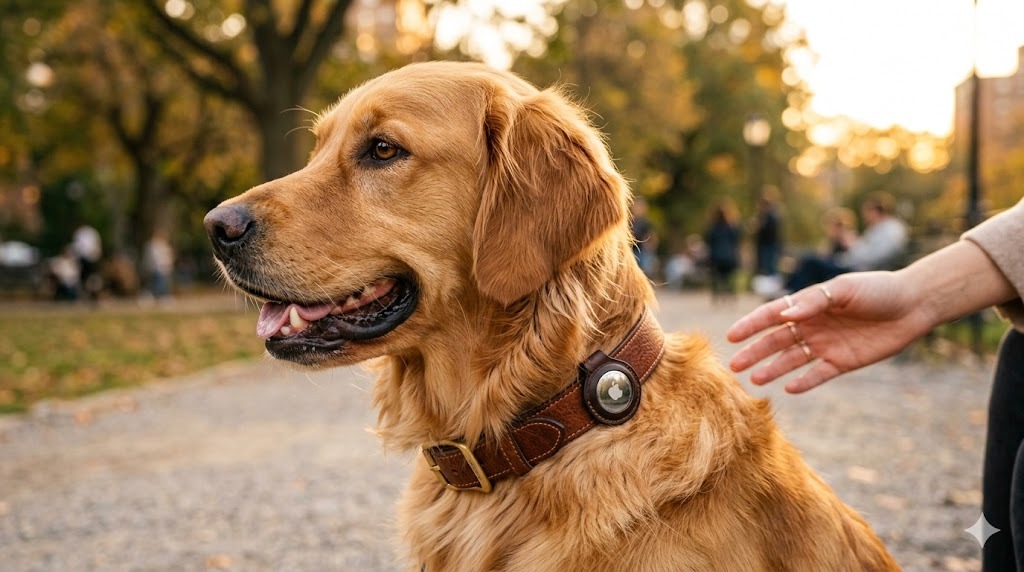
The AirTag itself doesn’t attach to a collar. You need a holder that’s durable enough for dog use.
🥇 Belkin AirTag Holder for Pets
The Belkin is the recommended default. Apple-licensed manufacturing, designed for dog use, doesn’t muffle the AirTag’s sound (important for the “find nearby” feature). Fits standard 1-inch-wide dog collars.
🥈 Heavy-Duty Silicone Holders (Various Brands)
For dogs that swim, dig, or run through brush, silicone holders with full-seal designs (no fabric) are more durable. Look for brands like ROEMOTI, Liquipel, or Catalyst. Price: $8-15.
Trade-off: Silicone holders are bulkier and may muffle the AirTag’s audio.
🥉 Slip-On Fabric Holders
The cheapest option ($5-10). The collar threads through a fabric loop with the AirTag in a pocket. Less durable but acceptable for indoor dogs that rarely escape.
What to avoid
- Cheap unbranded plastic holders - often crack within weeks
- Holders that completely seal in fabric - muffle audio, harder to verify AirTag is working
- Anything advertised as “swimming-proof” - AirTag itself is only IP67 (splash-resistant, not swim-proof)
Real Limitations You Should Know
1. Battery isn’t field-replaceable from your phone
The AirTag uses a CR2032 coin battery. You replace it manually once a year. Apple notifies you in Find My when battery gets low.
2. AirTag doesn’t survive deep water
IP67 rating handles rain and brief splashes. Sustained swimming or full submersion can damage it. If your dog swims regularly, a real GPS tracker with higher water rating is better.
3. iPhone-only setup
Android users can detect AirTags (for stalking prevention) but cannot set up or track an AirTag. If you’re on Android, this isn’t your product.
4. Anti-stalking alerts
If your AirTag travels with someone else’s phone for an extended period, Apple alerts them that an AirTag is following them. This isn’t usually an issue for dogs at home but matters if your dog hangs out with a dog walker or boarder regularly - they’ll get alerts.
5. Sound alert is mild
Compared to medical alarms or even car key fobs, the AirTag chirp is quiet. Useful for finding a dog within 30 feet; useless for hearing across a park.
6. No active tracking
You see where the AirTag was when last detected. There’s no live “currently moving toward X” display. For dogs actively running, the lag between updates can be significant.
When AirTag Is the Right Pick
You want backup, not primary tracking
The dog rarely escapes. You want something just in case. AirTag at $29 is rational insurance.
You live in a city or suburb
iPhone density is high enough for frequent location updates.
Your dog is already chipped and has visible ID
AirTag complements but doesn’t replace these. A chipped, tagged dog with an AirTag is well-covered.
You don’t want monthly subscription costs
Real GPS trackers add $7-15/month indefinitely. AirTag is one-time cost plus a $2 battery once a year.
Multiple pets
Putting an AirTag on each cat, dog, and pocket pet costs $90 for 3 pets. Three GPS trackers would cost $450 + $30/month.
When AirTag Isn’t Enough
Your dog runs miles when free
A determined escape artist heading out at full speed needs minute-by-minute tracking, not every-15-minutes updates.
You live somewhere remote
Wilderness areas don’t have iPhone density. AirTag becomes essentially useless when the nearest iPhone is miles away.
Your dog has high prey drive
Chasing wildlife into the woods, AirTag updates die quickly as the dog moves out of populated areas.
You need geofence alerts
“Tell me if my dog leaves the yard” requires real GPS with notifications. AirTag has no proactive alerts (only reactive: you check the app).
You want activity tracking
Fi and Whistle measure exercise, sleep quality, and behavior patterns. AirTag does location only.
AirTag vs GPS Trackers: The Real Cost Analysis
5-year cost comparison
| Product | Upfront | Subscription | 5-Year Total |
|---|---|---|---|
| AirTag (with replacement battery yearly) | $29 | $10 (batteries) | $39 |
| Tractive Mini | $50 | $7/month × 60 = $420 | $470 |
| Whistle GO Explore | $130 | $10/month × 60 = $600 | $730 |
| Fi Series 3 | $149 | $11/month × 60 = $660 | $809 |
AirTag is dramatically cheaper. The question is whether the difference in capability justifies the difference in price.
Honest assessment
For dogs that rarely escape and live in populated areas, AirTag offers 70-80% of the practical lost-dog protection of real GPS trackers at 5% of the cost. For dogs that frequently escape, escape into remote areas, or whose owners want geofence alerts and activity tracking, real GPS trackers are worth their cost.
Backup Strategy: Layered Protection
The best practice isn’t AirTag OR a GPS tracker - it’s layered protection.
Layer 1: Microchip
Mandatory baseline. $30-60 one-time cost. The dog gets a microchip implanted (10 minutes, no anesthesia). Any vet or shelter can scan it.
Layer 2: Visible ID tag
A tag on the collar with your phone number. Most lost dogs are returned this way - by neighbors who simply call the number.
Layer 3: AirTag or budget GPS
Adds location capability. Lost dog moving around a neighborhood becomes findable.
Layer 4: Full GPS tracker (premium households)
Live tracking, geofence alerts, activity data. Premium tier for escape-prone dogs and adventure dogs.
What dogs actually need
Indoor dog, never escapes: Microchip + visible ID. AirTag optional. Suburban dog, occasional escape: Microchip + visible ID + AirTag. Urban escape artist: Microchip + visible ID + AirTag + monitoring habits. Adventure / hunting dog: Microchip + visible ID + Fi or Whistle GPS. Multiple pets, budget-conscious: Microchips + AirTags for everyone.
Setting Up an AirTag for Your Dog
1. Initial setup
- Open Find My on your iPhone
- Pull the AirTag battery tab to activate
- iPhone detects it and offers setup
- Name it (e.g., “Buddy’s Collar”)
- Assign to “Pet” category
2. Test location updates
- Place AirTag near you, then far away from your home
- Wait 30-60 minutes
- Verify Find My shows updated location
- If never updates, your area may have low iPhone density
3. Attach to collar
- Place AirTag in chosen holder
- Snap holder onto collar
- Adjust position so it’s centered on dog’s neck (more visible to passing iPhones, less likely to be obstructed)
4. Verify dog tolerates it
- Wear collar with AirTag for one full day at home
- Check for irritation or excessive collar adjustment
- Most dogs ignore it within hours
5. Quarterly check
- Verify AirTag still updates location
- Check battery level (Find My app shows percentage)
- Replace battery when it drops below 20%
Privacy and Safety Considerations
For the dog owner
- Anti-stalking alerts will trigger for anyone walking with your dog regularly (dog walker, daycare). Notify them.
- Friends or family can briefly carry the dog without issues.
- Boarding facilities receive frequent AirTag alerts - your dog may need to be removed before boarding to prevent customer service confusion.
For lost dog scenarios
- Take your phone with you when looking for your dog.
- AirTag’s “Find Nearby” feature (precise UWB tracking within 30 feet) works only when you’re physically close to the AirTag.
- The sound alert is helpful in close range; not loud enough for cross-park use.
For dog theft
- If your dog is stolen, AirTag may track them to the thief’s location.
- Thieves familiar with AirTag may remove the collar. A backup tracker hidden in collar lining (sewn into the collar) provides additional security.
- Don’t confront thieves - call police and provide AirTag location data.
Frequently Asked Questions
Will AirTag work without iPhones around?
No. AirTag requires nearby iPhones to relay location. In areas without iPhone density (very remote, late at night), updates stop until an iPhone passes by.
How long does the battery last?
About 12 months. Apple notifies you in Find My when it’s low. The battery is a CR2032 coin cell that costs $2-4 to replace.
Is AirTag safe for dogs?
Yes. The device is encased in plastic and doesn’t pose a danger if worn properly. Risk: the AirTag could become a choking hazard if removed and chewed. Use a secure holder.
Can I track multiple dogs with one AirTag?
No. Each AirTag is unique. Use one per dog.
Does AirTag work for cats?
Yes, with caveats. Cats spend more time in remote areas (under sheds, in tall grass) where iPhones don’t reach. AirTag is more useful for indoor cats that occasionally escape than for outdoor cats.
What if my dog swims often?
AirTag is splash-resistant but not waterproof. Frequent swimmers risk damaging the device. For water-prone dogs, choose a real GPS tracker with higher water rating (Fi, Whistle).
Will neighbors know my dog has an AirTag?
Only if they spend extended time with the dog. Brief proximity (passing on the sidewalk) doesn’t trigger alerts. Sustained co-location for 8+ hours can trigger anti-stalking notifications on Android phones.
Can I disable the sound alert?
You can’t disable the AirTag’s sound permanently, but you can make it quieter using third-party holders that muffle the speaker. Note: this also reduces the usefulness of “Find Nearby.”
What’s the difference between AirTag and Tile?
AirTag uses Apple’s Find My network (2+ billion iPhones). Tile uses Tile’s own network (much smaller). In practical terms, AirTag has 50x+ more relay devices. For pet use, AirTag is dramatically more useful unless you’re an Android-only household.
Is AirTag better than a microchip?
They serve different purposes. Microchip identifies the dog if found by a vet or shelter (no location tracking). AirTag provides location when iPhones pass nearby (no identification function). Both are inexpensive - use both.
Our Final Recommendation
For most dog owners, an AirTag in a Belkin holder is the right choice as a budget tracker - $44 total upfront, no monthly fees, useful insurance against escape in populated areas. Pair with a microchip and visible ID tag for layered protection.
For owners of escape artists, hunting dogs, or outdoor adventurers, a real GPS tracker (Fi or Whistle) is worth the recurring cost - live tracking, geofence alerts, and reliable updates in remote areas justify the price.
For households with multiple pets, putting AirTags on each is the practical scalable solution - $30 each, no subscriptions, comprehensive baseline coverage.
The AirTag isn’t a substitute for a real GPS tracker. But for the dogs that don’t need real-time monitoring, it’s one of the highest-value pet purchases available.
Related Reading
- Best GPS Dog Trackers (Fi / Whistle / Tractive)
- Best No-Pull Dog Harness
- Best Pet Insurance 2026
- Best Dog Collars and ID Tags
- How to Find a Lost Dog: First 24 Hours
Last updated: May 2026.