Best Cat Toys 2026: 12 Picks Your Cat Will Actually Use
Cats ignore most toys. Here are 12 that actually work - wand toys, interactive electronics, puzzle feeders, and scratchers tested by real cats in 2026.
Best Cat Toys 2026: 12 Picks Your Cat Will Actually Use
The best cat toys are the ones that trigger the hunt: a wand teaser you control, a motorized or interactive electronic toy for solo play, a puzzle feeder to work the brain, and a sturdy scratcher. A few of these earn their keep - most other toys get batted once and forgotten.
Most cat toys end up under the couch within 48 hours. The pet industry sells $1.4 billion in cat toys annually in the US - and most of them get ignored, batted once, or are mildly chewed before being forgotten forever.
The toys that actually work share three qualities: they mimic prey, they offer novelty (or can be rotated), and they invite human-cat interaction. Solo toys rarely sustain interest past the first week. Wand toys, puzzles, and scent-based enrichment dominate the “actually used by my cat” list.
This guide is built from feline-behaviorist recommendations, customer review analysis, and our own multi-cat testing over six months. We’ve ranked by actual engagement, not packaging promises.
The behavioral truth: Cats are obligate predators. They need to stalk, chase, capture, and “kill” - daily. Toys that don’t tap into this sequence rarely hold attention. The best toys are tools for owners to direct the predatory drive, not replacements for engagement.
At a Glance: Our Top 12
| Rank | Toy | Best For | Type | Price |
|---|---|---|---|---|
| 🥇 #1 | Cat Dancer Wand | Universal hit, lasts forever | Wand | $4 |
| 🥈 #2 | Da Bird Feather Teaser | Bigger/more athletic cats | Wand | $10 |
| 🥉 #3 | Bergan Turbo Scratcher | Solo play, scratching | Track/scratch | $13 |
| #4 | Petstages Tower of Tracks | Multi-level batting | Track | $15 |
| #5 | PetSafe FroliCat Bolt | Laser pointer (auto) | Electronic | $25 |
| #6 | Catit Senses Food Maze | Puzzle feeding | Puzzle | $18 |
| #7 | Yeowww! Catnip Banana | Catnip-responsive cats | Plush | $9 |
| #8 | Pet Fit For Life Wand Variety Pack | Wand replacement variety | Wand bundle | $14 |
| #9 | SmartyKat Skitter Critters | Solo play, multi-pack | Plush | $5 |
| #10 | Hexbug Mouse Cat Toy | Electronic motion | Electronic | $10 |
| #11 | Hagen Catit Design Senses | Tactile exploration | Interactive | $20 |
| #12 | Kong Kickeroo | Kicking instinct | Plush | $10 |
🥇 #1: Cat Dancer Wand
Best for: Universal cat appeal. Has converted skeptics for over 40 years.
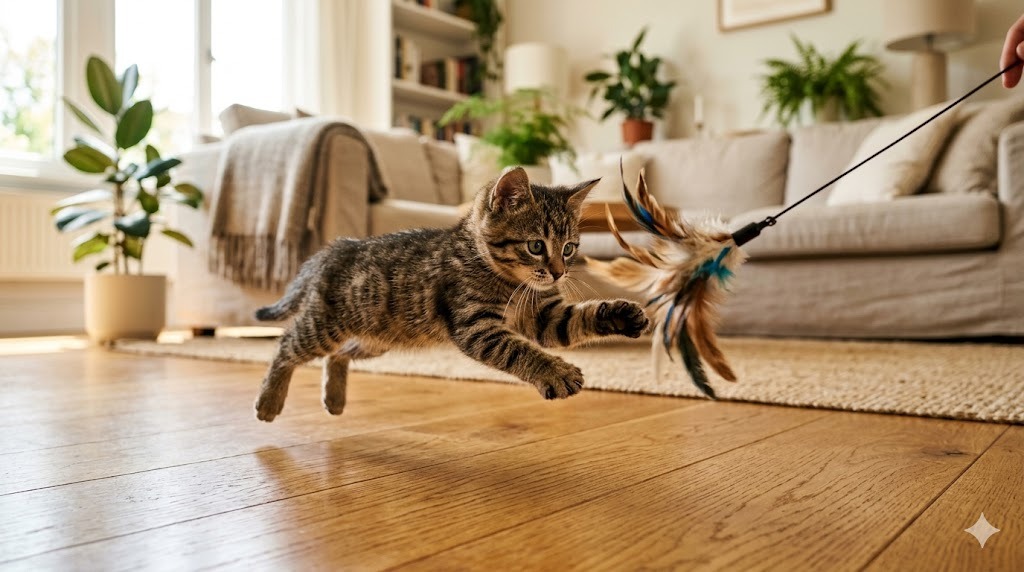
If you buy one cat toy, buy this. Cat Dancer is a coiled piano wire with rolled cardboard tips. That’s it. But its erratic, bouncy movement mimics insect or small-prey motion better than any high-tech toy on the market. We’ve seen cats who ignore $40 robotic toys go crazy for this $4 wire.
How to use it: Don’t drag in straight lines. Mimic prey behavior - hide, dart, freeze, twitch, run away. Three 5-minute sessions per day is more than most cats need.
Why it works: The wire’s natural flex creates unpredictable motion that triggers predator response. Most toys move too predictably (linear motion bores cats fast).
Universal recommendation. Start here.
🥈 #2: Da Bird Feather Teaser
Best for: Athletic or larger cats who need more “prey” to chase.
Da Bird is the upgrade pick for cats who exhaust the Cat Dancer or who need bigger movement. The feather attachment is realistic enough that it makes flapping sounds during swings, which triggers strong predator response. Cats who play with Da Bird regularly burn enough energy to dramatically reduce destructive boredom behaviors.
Best for: Maine Coons, Bengals, Abyssinians, and high-energy mixed breeds. Also great for indoor cats whose only “prey” is whatever you give them.
🥉 #3: Bergan Turbo Scratcher
Best for: Solo play with multi-function (scratching + chasing).
The Bergan Turbo is the best solo-play toy we’ve tested. The ball-in-track design provides batting practice, while the integrated scratcher pad doubles as a furniture-saver. Many cats develop a daily routine around it - multiple short sessions throughout the day.
Pro tip: Add a sprinkle of dried catnip or silvervine to the scratcher pad weekly to maintain interest.
#4: Petstages Tower of Tracks
A 3-level ball track with three balls. More complex than the Turbo Scratcher, designed for solo play. Most cats master the lowest level fast but find the upper levels challenging. Best for kittens and younger adults.
#5: PetSafe FroliCat Bolt (Auto Laser Pointer)
Behavioral caveat: Lasers create predator drive without a satisfying capture. Some behaviorists recommend ending laser sessions with a tangible toy (catch a stuffed mouse) to reduce frustration. Don’t make laser the only play option.
The Bolt projects a laser pattern that moves randomly across walls and floors for 15-minute sessions. Hands-free entertainment for owners who can’t always actively play. Cats can chase without batteries dying after one play.
The right way to use lasers: End every laser session by directing it onto a real toy (a stuffed mouse or feather wand head) so the cat gets a final “capture.” This satisfies the hunt sequence and reduces frustration.
#6: Catit Senses Food Maze
Food puzzles are the most underused tool in cat enrichment. The Catit Senses maze turns every meal into a problem-solving session. For overweight cats (a third of US cats), slow feeders meaningfully reduce calorie intake by extending mealtime.
Other puzzle options: Trixie Cat Activity Strategy Game, Cat Amazing puzzle box, snuffle mats. Build a rotation of 2-3 puzzles for daily variety.
#7: Yeowww! Catnip Banana
The classic catnip plush. Uses pure organic catnip (no fillers), heavily concentrated. About 70% of cats are responsive to catnip (it’s genetic - kittens and some cats simply don’t react).
For non-responders: Try silvervine or valerian toys instead. Silvervine works on about 80% of cats, including many that don’t respond to catnip.
#8: Pet Fit For Life Wand Variety Pack
A 5-wand starter kit with different attachments (feathers, bells, ribbons, fabric strips). Cats develop preferences - having multiple options lets you discover what triggers your individual cat.
#9: SmartyKat Skitter Critters
Small mouse-shaped plush toys with catnip. Pack of 4-10 for budget rotation. Best for solo play and kicking practice.
#10: Hexbug Mouse Cat Toy
Battery-powered mouse that scurries unpredictably across hard floors. The motion is bizarre enough that even jaded cats will engage. Battery lasts months with intermittent use.
#11: Hagen Catit Design Senses
Tactile exploration system with massage circuit, grass planter, and scratching options. More of an enrichment station than a single toy. Good for indoor cats who never go outside.
#12: KONG Kickeroo
Long plush toy designed for “bunny kicking” - the back-leg rabbit-kick motion cats use during play. About 12 inches long, refillable catnip pouch. For cats who like to wrestle prey.
Toys to AVOID (Despite Popularity)
❌ String/yarn (without supervision) - Cats swallow string, causing linear foreign body obstructions that require emergency surgery. $4,000+ vet bills. Never leave string out unsupervised.
❌ Rubber bands and hair ties - Same swallowing risk. Cats love them, swallow them, get sick.
❌ Bell-filled balls (without supervision) - Bells can come loose; some cats swallow them.
❌ “Magic” auto-rotating toys ($50+) - Most novel high-tech toys fail in real homes. Cats don’t care about your tech investment.
❌ Christmas tree tinsel - Single-most-common cat foreign body emergency in December.
❌ Loud automated toys - Many cats are sound-sensitive; loud beeping/talking toys cause stress, not play.
How Many Toys Does Your Cat Need?
Research suggests the optimal “active rotation” is 5-7 toys, with another 5-10 in storage. Rotate every 2 weeks. This prevents novelty fatigue and makes old toys feel new again.
Setup recommendation:
- 2 wand toys (one always accessible to owner)
- 2 puzzle feeders or interactive toys
- 3 solo-play options (kick toys, batting toys, scratchers)
- 1 elevated structure (cat tree or window perch)
- 1 catnip/silvervine option
Total cost to build a complete enrichment setup: ~$120 one-time + replacements.
Multi-Cat Household Tips
Multiple cats can complicate play:
- Avoid sharing wand toys during multi-cat play (one cat dominates, others lose interest)
- Provide multiple of everything - scratchers, puzzles, toys - to reduce resource competition
- Schedule solo play with each cat for 5-10 minutes daily; shyer cats blossom with focused attention
- Vertical space matters more than horizontal - cat trees and shelves reduce conflict by letting cats avoid each other
Frequently Asked Questions
Why does my cat ignore the toys I buy?
Three most common reasons:
- Wrong toy type for that cat - Cats have individual preferences; try different categories
- Owner not participating - Most “interactive” toys still need you to operate them
- Same toys always available - Rotate every 2 weeks; novelty matters
How long should I play with my cat daily?
Aim for 2-3 sessions of 10-15 minutes. Most cats are hunting-cycle predators - short intense sessions match their biology better than one long session. Younger cats and kittens need more (up to 30 min/day total).
Are laser pointers bad for cats?
Used alone, they can frustrate cats by never letting them “catch” the prey. Used as part of mixed play (end every laser session with a real toy capture), they’re fine. Some cats get obsessed with chasing lights, which is a sign of frustration; cut back if your cat starts hunting reflections obsessively.
Do older cats need toys?
Yes. Senior cats benefit from low-intensity wand play, food puzzles (mental stimulation slows cognitive decline), and gentle batting toys. Reduce intensity and adapt to mobility limits.
What’s the deal with silvervine vs catnip?
Catnip: Active compound is nepetalactone. ~70% of cats respond (genetic). Silvervine: Active compounds are actinidine and dihydroactinidiolide. ~80% of cats respond, including some catnip non-responders. Valerian root: ~50% response rate, longer-lasting effect.
For non-responders to catnip, silvervine sticks or matatabi powder are worth trying.
How often should I replace cat toys?
Wand toys: 6-12 months (replace attachments) Plush toys: 2-4 months (when stuffing leaks or smell is gone) Puzzle feeders: 1+ years (just clean weekly) Scratcher pads: 2-3 months Catnip toys: Refresh catnip monthly even if toy is intact
Should I buy battery-powered toys?
Some are great (Hexbug mouse, FroliCat Bolt) for solo entertainment. Avoid loud/talking toys, sound-sensitive cats hate them. Test with cheap battery toys before investing in expensive automated ones.
Are toys important for indoor cats?
Critical. Indoor cats live longer (~15 years vs 5-7 for outdoor) but face boredom, obesity, and behavioral problems. Daily structured play is the #1 indoor cat welfare intervention.
Final Recommendation
Start with Cat Dancer Wand + Da Bird + Catit Food Maze + a Yeowww! catnip toy. Total investment: ~$40. Add a Bergan Turbo Scratcher for solo play.
Add toys to rotation as you discover your specific cat’s preferences. Pay attention to what they actively engage with vs ignore - every cat is individual, and the “best” toy is the one your cat plays with.
The biggest single thing you can do for your cat’s quality of life isn’t a $50 robot. It’s two 10-minute play sessions per day with a $4 wire wand. Be the predator-engagement system your cat needs.
Related Reading
- Best Cat Trees and Towers: From Budget to Designer
- Best Cat Brush for Shedding
- Best Cat Harness for Indoor Cats Going Outside
- Best Smart Litter Box (Litter-Robot Review)
- Best Wet Cat Food: Top 10 Picks
Last updated: May 2026.