Best Indoor Dog Gates 2026: Pressure-Mount, Hardware-Mount & Extra-Wide Picks
Honest reviews of the best indoor dog gates in 2026 - Carlson, Regalo, Cumbor, Richell. Pressure vs hardware mount, sizing for doorways and stairs, escape-proof picks for chewers.
Best Indoor Dog Gates 2026: Pressure-Mount, Hardware-Mount & Extra-Wide Picks
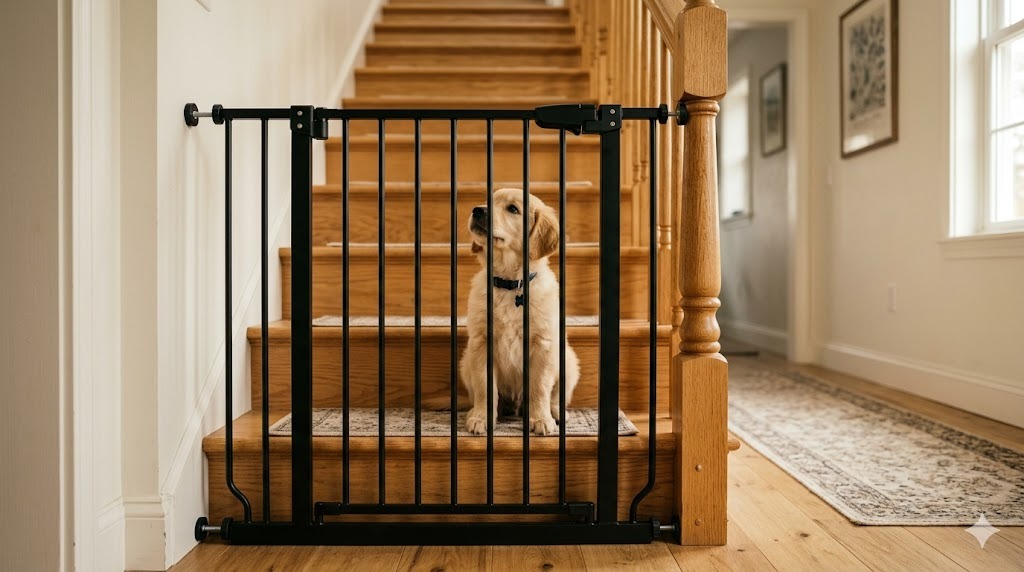
The best indoor dog gate is a pressure-mounted gate for doorways you can’t drill (Carlson, Cumbor), a hardware-mounted gate for the top of stairs and for chewers (Regalo), and an extra-wide model for open spaces. Match the mount to the spot - pressure for convenience, hardware for anywhere a fall or escape would be dangerous.
An indoor dog gate solves more problems than almost any other piece of pet equipment. It contains puppies during house training, keeps senior dogs off slippery stairs, separates incompatible pets, blocks access to the kitchen during cooking, protects guests who are nervous around dogs, and gives reactive dogs a managed space to decompress.
The challenge is that “dog gate” is the wrong search term. Most pet gates are actually rebranded baby gates - designed for toddlers, not for dogs that can jump, climb, and chew. The right gate depends on the dog’s size, the location, and whether the dog is a planner or a reactor. This guide covers what works for which scenario, plus the structural difference between pressure-mount and hardware-mount that matters more than the marketing suggests.
Critical safety note: Never use a pressure-mount gate at the top of stairs. The fall hazard is real - every year, dogs and children are injured when pressure gates give way. At the top of any staircase, only use hardware-mount gates screwed into wall studs.
At a Glance: Top Picks
| Rank | Gate | Type | Width | Best For |
|---|---|---|---|---|
| 🥇 #1 | Carlson Extra Tall Pet Gate | Pressure-mount | 29-44” | Tall dogs, doorways |
| 🥈 #2 | Regalo Easy Step Walk-Through | Pressure-mount | 29-39” | Most households, value |
| 🥉 #3 | Cumbor Auto-Close Hardware-Mount | Hardware-mount | 29-46” | Top of stairs, safety |
| #4 | Richell Wood Freestanding | Freestanding | up to 62” | No-install rooms, design |
| #5 | Carlson Extra Wide Walk-Through | Pressure-mount | 38-61” | Wide openings, archways |
| #6 | MidWest Wire Mesh Pet Gate | Pressure-mount | 39-62” | Chewers, escape-prone |
| #7 | PawHut Retractable Mesh | Hardware-mount | up to 55” | Discreet, occasional use |
🥇 #1: Carlson Extra Tall Pet Gate
The Carlson Extra Tall is the default recommendation for households with medium-to-large dogs that jump. At 36 inches, the gate blocks anything short of a determined athletic jumper - Labs, Golden Retrievers, mid-size mixed breeds, almost any dog that hasn’t been specifically trained to scale fences.
The small pet door at the base is genuinely useful. Cat households use it constantly. With dog access to one zone (living room) and cats to another (kitchen, where food is), the gate solves the multi-species conflict in one purchase.
Real-world durability: Owners report 5-8 years of daily use. The steel doesn’t bend, the latch keeps working, the pressure-mount stays tight when re-tightened occasionally.
Best for: Households with medium-to-large dogs and a separate cat, dogs that jump standard 30” gates, daily-use placements in main thoroughfares.
🥈 #2: Regalo Easy Step Walk-Through
The Regalo is the go-to mid-budget pick for most households. If your dog isn’t a jumper and you don’t need extra height or a cat door, this is the right level of quality without paying premium. Easy to install in five minutes, easy to walk through, easy to remove when not needed.
Best for: Small-to-medium dogs (under 40 lb) that don’t jump, standard doorway widths, owners wanting reliability without overspending.
🥉 #3: Cumbor Auto-Close Hardware-Mount
If the gate is going at the top of stairs, this is the only category to consider. Hardware-mount gates screw directly into wall studs and cannot fall under any normal pressure. The Cumbor adds an auto-close feature that solves the most common failure point with any gate - humans forgetting to close it.
Best for: Top-of-stairs placements, mandatory for senior dogs with mobility issues, owners who frequently walk through and might forget to latch.
#4: Richell Wood Freestanding Pet Gate
A freestanding accordion-style gate that requires no installation. Beautiful natural wood finish that fits in formal living spaces. Best for blocking off rooms without doorways or for households that don’t want to modify walls.
The trade-off: a determined dog can push it over. Best for calm dogs that respect boundaries rather than aggressive escape artists.
Best for: Open archways without door frames, design-conscious owners, rentals where drilling isn’t allowed, small-to-medium calm dogs.
#5: Carlson Extra Wide Walk-Through
The wider version of the Carlson Extra Tall, designed for openings up to 61 inches. The frame loses a little rigidity at full extension but remains strong enough for medium dogs. Essential for wide archways, double-doorway openings, and oddly-sized spaces.
Best for: Wide architectural openings, doorways wider than 39 inches, partial room divisions.
#6: MidWest Wire Mesh Pet Gate
The pick for chewers and escape artists. Vertical steel bars set close enough that dogs can’t get teeth around them properly. Heavier and more institutional in appearance than fabric or wood gates, but the only gate that genuinely survives chewing.
Best for: Determined chewers, dogs that destroy soft-edge gates, breeds known for crating destruction (Bulldogs, Boxers, Pit mixes during teething or anxiety phases).
#7: PawHut Retractable Mesh Pet Gate
A discreet option - when not in use, the gate rolls back into a wall-mounted housing. Mesh fabric, not solid bars. Works well for occasional barriers (during meals, when guests arrive) but won’t contain a determined dog.
Best for: Occasional-use scenarios, design-conscious homes, families with calm dogs that respect boundaries.
Pressure-Mount vs Hardware-Mount: The Critical Choice
This is the single most important decision when buying a dog gate.
Pressure-Mount
The gate uses tension between two walls, frames, or door jambs to stay in place. Four rubber pads press against the surfaces.
Pros:
- No drilling, no permanent installation
- Portable - move to different locations
- Cheaper
- Renter-friendly
Cons:
- Can fail under sustained pressure (dog pushing repeatedly)
- Loosens over time, requires re-tightening
- Never safe at top of stairs
- Requires solid mounting surfaces (drywall-only mounting often fails)
Hardware-Mount
The gate screws directly into wall studs or door jamb framing.
Pros:
- Cannot fail under normal force
- Safe at top of stairs (the only acceptable type for this location)
- Permanent solid mount
- Holds up to large determined dogs
Cons:
- Requires drilling
- Leaves holes when removed
- Not portable
- More expensive
When pressure-mount is fine
- Doorways and openings on a single floor
- Containing puppies for house training
- Separating areas during meals or guest visits
- Households without stairs
When hardware-mount is required
- Top of any staircase
- Containing large dogs (over 50 lb) that lean or push
- Long-term placements that won’t move
- Whenever there’s any doubt about safety
Sizing: Width and Height
Width
Measure the opening at three points (top, middle, bottom) - frames are often not square. Use the widest measurement to determine the gate width range you need.
| Opening Width | Gate Type |
|---|---|
| 29-39” | Standard pet gate |
| 38-61” | Extra-wide gate |
| 62-79” | Extra-wide with extensions |
| 80”+ | Multi-panel freestanding |
Height
Match height to the dog’s jumping ability, not just standing height.
| Dog Size / Type | Minimum Gate Height |
|---|---|
| Small dogs, non-jumpers | 24” |
| Standard medium dogs | 30” |
| Larger dogs, mild jumpers | 36” |
| Athletic/agility-trained dogs | 41-42” |
| Determined climbers | Not solvable with a gate - use a closed door |
The rule: A dog can jump roughly twice its shoulder height when motivated. Goldens, Labs, GSDs jump 30” gates from a standing position. Border Collies and Australian Shepherds can clear 40” gates.
What Each Material Means
Steel
Strongest. Doesn’t bend. Doesn’t chew. Default for daily-use gates.
Plastic
Lightweight. Cheap. Suitable only for very small dogs and short-term use. Chewers destroy plastic gates in days.
Wood
Attractive. Suitable for calm dogs only. Can be scratched and chewed at corners.
Wire Mesh
Indestructible to chewing. Less attractive. Best for escape artists.
Fabric Mesh
Lightweight, retractable, discreet. Useless against any dog willing to push or chew.
Common Placement Scenarios
House training a puppy
What you need: 30” pressure-mount in the kitchen or hallway. Creates a controlled potty-training zone with hard floors.
Separating dog from baby
What you need: Either a tall pressure-mount (Carlson 36”) or a hardware-mount. The dog needs to be visibly contained - peek-through helps reduce anxiety.
Multi-dog household, incompatible pairs
What you need: A solid gate, not mesh. Dogs see each other less = lower reactivity. Consider a half-height gate plus a closed door technique alternately.
Cat in the kitchen, dog in the living room
What you need: A gate with a small pet door at the base. Carlson Extra Tall is the standard pick.
Senior dog and slippery stairs
What you need: Hardware-mount at the top of the stairs. This is medical necessity, not convenience - senior dog falls cause life-threatening injuries.
Reactive dog when guests arrive
What you need: A solid, opaque gate at the entryway. The dog can see and hear but not see new people directly. Reduces over-arousal.
Introducing a Gate
For dogs new to gates, the introduction matters more than people think.
Day 1-3: Familiarization
- Set up the gate with the door open
- Let the dog walk back and forth freely
- Toss treats on both sides
- Don’t close it
Day 4-7: Closed door, you stay
- Close the gate with you on the same side
- Reward calm behavior
- Build up to 10 minutes
- Open and walk through together regularly
Week 2: Brief separations
- Close the gate with you on the opposite side
- Stay visible
- Build from 30 seconds to 5 minutes
- Reward quiet behavior
Week 3: Normal use
- Most dogs accept the gate as routine
- Continue rewarding calm behavior
- Reactive dogs may need 4-6 weeks total
For reactive or anxiety-prone dogs: Consider crate training in parallel. The gate is environmental management; the crate is teaching tolerance for being apart.
Frequently Asked Questions
Can a dog gate replace a crate?
For house training, no - crates teach the dog to hold their bladder while a gated room does not. For separation and management, gates can replace crates for many adult dogs that are reliable in defined spaces.
My dog destroys gates. What do I do?
Move to wire mesh (MidWest) or hardware-mount steel. If destruction continues, the problem is anxiety or boredom, not the gate. Address the underlying behavior with training and enrichment, not by buying stronger gates indefinitely.
Are pressure-mount gates safe?
Yes - except at the top of stairs. For ground-floor doorways, hallways, and openings between rooms, pressure-mount gates are perfectly safe when correctly installed and maintained. Re-tighten every few months.
Will a 30-inch gate stop a Lab?
Usually yes, but only because most Labs respect the boundary. A motivated Lab can clear it. If your Lab has ever jumped over a couch or counter, choose 36” or taller.
How wide can dog gates extend?
Standard gates: up to 44”. Extra-wide: up to 62”. Beyond that, you need multiple gates joined or a custom freestanding system. Some manufacturers (Richell, Carlson) sell extension panels.
Can I install a gate in a doorway without a frame?
Difficult. Pressure-mount needs surface contact on both sides; hardware-mount needs studs. For unframed openings, freestanding gates are the practical choice.
Are mesh fabric gates strong enough?
For small calm dogs only. Anything else can chew or push through.
How long do dog gates last?
- Premium steel (Carlson, Cumbor): 5-10 years
- Mid-tier (Regalo): 3-5 years
- Budget: 1-2 years
- Wood/freestanding: depends entirely on chewing - calm dogs, 10+ years; chewers, weeks
Can dogs learn to open gates?
Some learn to lift latches, particularly Border Collies, Poodles, and other intelligent breeds. Choose gates with double-action latches (squeeze and lift) for these dogs.
Will a gate stress my dog?
Briefly, during the first introduction. After the first week, most dogs treat gates as normal furniture. If the gate causes persistent anxiety, the issue is usually separation anxiety, not the gate itself.
Our Final Recommendation
For most households with medium-to-large dogs, the Carlson Extra Tall Pet Gate is the right pick. The 36” height handles jumpers, the small pet door solves the cat-and-dog conflict, and the steel construction lasts a decade.
For top-of-stairs placement, the Cumbor Auto-Close Hardware-Mount is the right answer - no exceptions. Pressure-mount gates do not belong at the top of stairs, regardless of brand quality.
For owners wanting reliable mid-budget protection, the Regalo Easy Step Walk-Through is the value pick.
A dog gate is a simple, cheap purchase that solves complex problems - multi-pet conflicts, mobility safety, house training, reactive dog management, peace of mind during cooking. The right one quietly does its job for years.
Related Reading
- Best Dog Crates: Wire, Plastic & Wooden Reviewed
- Best Dog Playpens for Puppies and Adults
- How to House Train a Puppy in 21 Days
- Best Calming Donut Dog Beds for Anxiety
- How to Stop Dog Barking: Training and Products That Work
Last updated: May 2026.