Best Cat Trees & Towers 2026: Designer, Large-Cat & Apartment Picks
Honest reviews of the best cat trees and towers in 2026 - Mau Pets, Frisco, Tuft + Paw, Hidden Hollow. From budget Amazon picks to designer modern furniture, sized for every cat.
Best Cat Trees & Towers 2026: Designer, Large-Cat & Apartment Picks
The best cat tree is a tall, rock-solid one with several perches and sisal scratching posts - Frisco for budget value, Tuft + Paw or Mau Pets for designer looks, and a wide-based model for big cats. Stability and height matter most: a wobbly tower goes unused, no matter how it looks.
Cat trees are not optional furniture. For indoor cats, vertical space is the single most important environmental feature after the litter box. A cat that can climb, perch, and observe from height shows measurably lower stress, fewer behavior problems, and better physical condition than a cat confined to floor level. Veterinarians and feline behaviorists agree on almost nothing - they agree on this.
The market splits into three rough categories: cheap carpeted multi-platform towers from Amazon ($40-$120), designer modern cat furniture that looks like real furniture ($200-$800), and middle-ground branded picks (Frisco, Go Pet Club) that balance quality and price. This guide covers what works for each cat type, size, and household. We focus on real durability, real cat preference, and how to choose without overspending on the wrong style.
Why cats need vertical space: Cats evolved as both predator and prey. Height provides safety from threats, hunting visibility, and territorial confidence. A cat without vertical access in the home shows the same stress markers as a cat confined to a small cage. This is true even for older, less active cats.
At a Glance: Top Picks
| Rank | Cat Tree | Height | Capacity | Best For |
|---|---|---|---|---|
| 🥇 #1 | Frisco 72-inch Cat Tree | 72” | 25 lb per platform | Best overall value |
| 🥈 #2 | Tuft + Paw Capsule Tower | 60” | Designer modern | Stylish homes |
| 🥉 #3 | Mau Pets Hidden Hollow | 70” | Large cats | Maine Coons, Ragdolls |
| #4 | Vesper V-High Base by Catit | 67” | Modern minimal | Apartment design |
| #5 | Go Pet Club 62-inch | 62” | Budget reliable | Multi-cat, value |
| #6 | Yaheetech 54-inch with Sisal | 54” | Compact | Small apartments |
| #7 | PetFusion Modern Cat Tree | 51” | Replaceable scratching posts | Long-term durability |
🥇 #1: Frisco 72-inch Cat Tree
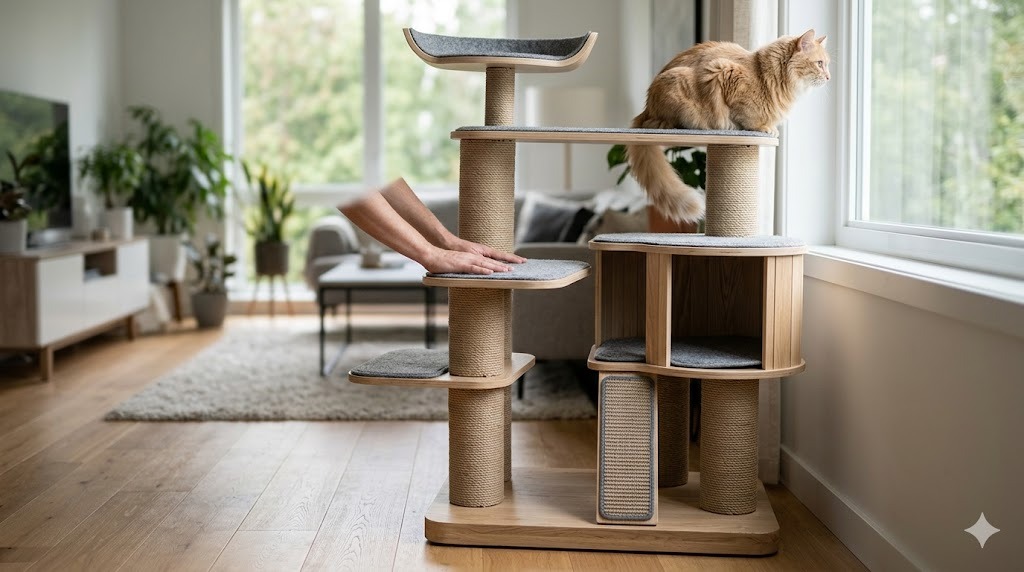
The Frisco 72-inch is the safe default recommendation. Six feet of height covers everything a healthy adult cat wants - high observation perches, mid-level hideaway, low scratch posts. The construction is heavier than the Amazon equivalents in the same price range, with a wider base that doesn’t wobble when cats jump up at speed.
Cats consistently choose this tree over taller cheaper alternatives. Height matters less than perch stability and platform comfort, and the Frisco delivers both.
Real-world durability: Owners report 4-6 years of regular use. Carpet wears but doesn’t fall apart. Sisal needs replacement every 18-24 months on the most-used post.
Best for: Single-cat or two-cat households, owners wanting reliability without overspending, the default purchase if you’re not sure what your cat will use.
🥈 #2: Tuft + Paw Capsule Tower
For households where the cat tree has to look like something other than a cat tree, Tuft + Paw is the strongest pick. The materials are genuinely good - real wood, real felt, real sisal - and the design language fits modern interiors without compromising on the structural features cats actually want (stable platforms, climbable scratch posts, an enclosed hide).
The replaceable component design is the unusual feature here. When the sisal wears or the cushion stains, you replace that part rather than the whole tree. Total lifetime cost over 8-10 years drops below cheap alternatives that get discarded every 2-3 years.
Best for: Owners who want design-conscious furniture, larger cats that need stronger platforms, long-term thinking on cost-of-ownership.
🥉 #3: Mau Pets Hidden Hollow Cat Tree
Most cat trees are designed for 8-12 lb cats. Maine Coons, Ragdolls, Norwegian Forest Cats, and large male tabbies routinely hit 18-25 lb. On standard trees, these cats bend platforms, snap posts, and tip the base. The Mau Pets is the strongest option engineered for genuinely large cats - wide platforms, reinforced internal posts, a wide stable base.
Best for: Maine Coons, Ragdolls, large Norwegian Forest Cats, Siberian cats, any household with cats consistently over 15 lb.
#4: Vesper V-High Base by Catit
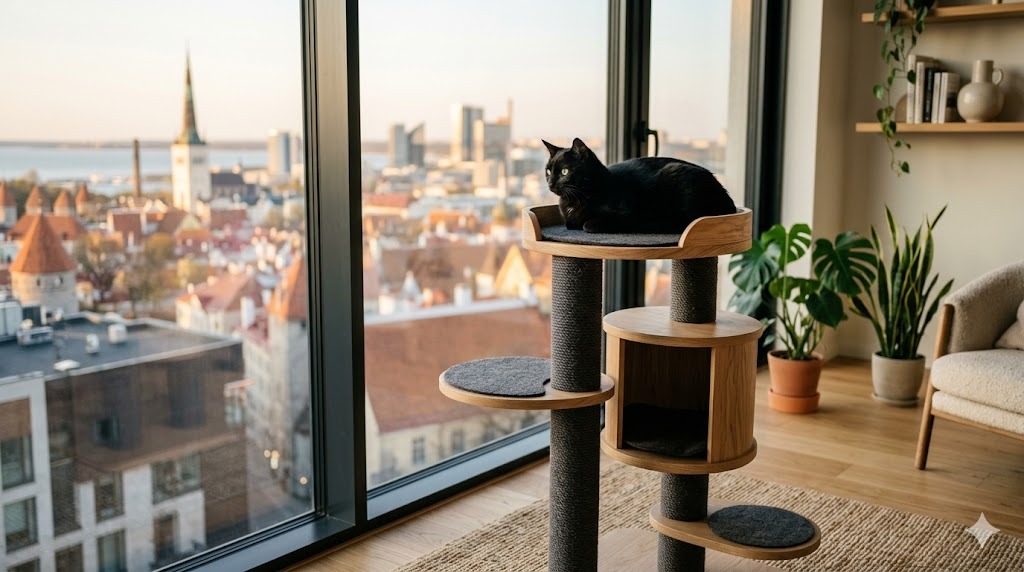
A clean, minimal cat tower in dark walnut wood with felt cushions. Looks like a piece of design furniture rather than carpeted pet equipment. Stable, attractive, suited to modern apartments where a six-foot carpeted tower feels visually out of place.
Best for: Design-conscious apartment dwellers, smaller cats (under 12 lb), owners who want a single attractive piece rather than maximum cat features.
#5: Go Pet Club 62-inch Cat Tree
The reliable budget pick. Tall enough, plenty of perches, basic carpeted construction. Fewer features and lower-grade materials than the Frisco but acceptable durability for the price.
Best for: Multi-cat households on a budget, secondary trees for upper floors, testing whether your cat will use a tall tree before investing more.
#6: Yaheetech 54-inch with Sisal
A compact mid-budget tower for small apartments. Doesn’t dominate a room. Lower platform count than taller trees but covers the basics - scratching, climbing, perching.
Best for: Studio apartments, single cats with limited space, kittens who don’t need maximum height.
#7: PetFusion Modern Cat Tree
A modern design with replaceable scratching posts and platforms. Less furniture-grade than Tuft + Paw but better materials than mass-market Amazon options. Strong middle-ground pick for owners who want longevity without designer pricing.
Best for: Mid-budget owners thinking about replacement parts, modern home aesthetics without paying $500+.
What Cats Actually Use a Cat Tree For
Most owners imagine cats spending the day climbing. Reality is different.
Sleeping (60-70% of tree use)
The single biggest function. Cats sleep on cat tree platforms because elevated, semi-enclosed spaces feel safe. The hide on the tree is often the cat’s primary sleep location.
Observation (20%)
Watching outdoors through a window, watching the household, watching other pets. The highest perch is usually the territorial-confidence spot.
Scratching (5-10%)
Sisal posts handle most scratching. A good tree dramatically reduces couch and door-frame scratching, but cats also need at least one horizontal scratcher elsewhere.
Active play (5%)
Less than expected. Cats use the tree as a launch point for short bursts but don’t climb continuously.
Refuge from other pets or guests
Heavily used during stressful events - vacuum noise, new people, dog visits, fireworks. The tree is the cat’s emotional safety zone.
Sizing: Match the Tree to the Cat
Small cats (under 10 lb)
Most standard trees work. Focus on multiple platforms, sisal coverage, and a hide. Minimum 48” height for adult cats.
Medium cats (10-15 lb)
Standard market - the Frisco 72” is the perfect range. Look for platform width at least 10” and stable base.
Large cats (15-22 lb)
Mau Pets, Tuft + Paw, or specifically-rated large-cat trees only. Standard trees flex and break. Look for wide platforms (12”+) and reinforced posts.
Giant cats (Maine Coons over 22 lb)
Very few off-the-shelf trees handle these cats. Mau Pets is the standard pick. Custom-built trees may be necessary.
Multi-cat households
Buy taller, with multiple perches at different heights. Cats resolve hierarchy via height - the dominant cat takes the top, others take lower levels. A tree with only one top perch causes conflict.
Tall vs Wide: Which Matters More
If you have to choose between a tall narrow tree and a shorter wider tree, the answer depends on the cat.
Choose tall and narrow if:
- You have one or two cats
- The cat is athletic and young
- You want maximum vertical territory
- Floor space is limited
Choose shorter and wider if:
- You have a senior cat or one with mobility issues
- Cats over 15 lb who can’t safely jump from height
- Multi-cat household needing multiple platforms at similar heights
- You want a piece of furniture rather than a climbing structure
Materials and What They Mean
Carpet covering
Standard plush carpet: Comfortable, cleans easily. Cats prefer it for sleeping platforms. Faux fur: Softer but harder to keep clean. Felt: Modern designer choice. Less comfortable than carpet for sleeping. Wood (uncovered): Hard, cool surface. Some cats prefer it in summer.
Posts
Sisal rope: Standard, replaceable, lasts 18-36 months on the most-used post. Sisal fabric: Alternative wrap. Less satisfying for clawing, longer lasting. Cardboard: Used on cheaper trees. Wears in months. Carpet-wrapped: Cats confuse it with floor carpet - encourages couch scratching. Avoid if possible.
Frame
Solid wood: Best, expensive, found on designer brands. Engineered wood / particle board: Standard. Acceptable strength. Cardboard tubing wrapped in carpet: Budget. Avoid for cats over 12 lb.
Base
Wide and heavy: Required for stability. Test by pushing the top of the tree - minimal wobble is normal, significant movement is dangerous.
Where to Place a Cat Tree
Placement matters more than people realize.
Near a window
The single best location. Cats spend hours observing birds, people, weather. Place the highest perch at a window if possible.
In the main living area
Cats want to be with their humans. A tree in a back bedroom often goes unused. The living room or family room sees real daily use.
Away from doors and high-traffic paths
Cats need to feel safe on the tree. A tree directly next to a door slammed regularly causes the cat to avoid it.
Multi-tree households
For larger homes, multiple smaller trees distributed across rooms beat a single mega-tree. Cats use the nearest one.
What to avoid
- Direct sun all day (overheats)
- Next to a noisy appliance
- In a basement or rarely-used room
- Where the dog can easily reach it
Introducing a New Cat Tree
Cats can be cautious about new furniture.
Day 1
Place the tree, walk away. Don’t force interaction. Most cats investigate within an hour.
Day 2-7
Sprinkle dried catnip on the highest platform. Place a favorite blanket in the hide. Treats on every level once daily.
Week 2
The cat should be using the tree daily. If not, try moving it to a different location (often near a window solves the problem).
When introduction fails
Common reasons: tree wobbles (cats sense instability and avoid), too far from family activity, scared by assembly process. Solutions: stabilize the base with weights underneath, move to active rooms, give the tree a week of “settling” before pressuring use.
Maintenance
Weekly
- Vacuum carpet platforms and base
- Check post wear
Monthly
- Tighten any loose bolts
- Inspect for chewed or worn sisal
- Clean stains on carpet with mild pet-safe cleaner
Replace components
- Sisal rope: every 18-36 months on heavily-used posts
- Platform cushions: every 2-3 years
- Whole tree: most last 4-8 years before structural failure
Frequently Asked Questions
Why won’t my cat use the cat tree?
The most common reasons: wrong location (move it near a window), tree wobbles (stabilize the base), too tall and the cat is intimidated (start with lower trees), or the cat prefers furniture (it does). Try catnip on platforms, treats at each level, and place a familiar-smelling blanket in the hide.
How many cat trees do I need?
For one cat in an average apartment, one tall tree placed well. For two cats, two trees (in different rooms) or one mega-tree with multiple high perches. The rule is “one tree per cat plus one extra” for households of three or more.
Are designer cat trees worth the money?
For long-term ownership in a stylish home, yes. The materials genuinely last longer, replacement parts mean you don’t discard the whole structure, and the design fits in your living space. For students or owners who move frequently, mid-range branded trees (Frisco, Go Pet Club) are the better value.
What height do cats actually want?
Cats use trees from 48-84 inches. Above 84 inches stops adding value - most cats don’t climb that high once habituated. Tall trees signal abundance, but the perch the cat actually sleeps on is rarely the tallest.
Can older cats use cat trees?
Yes, but choose shorter trees with wider platforms and accessible lower perches. Many senior cats stop using upper levels at age 12+. A 4-foot tree with a wide low hide is more useful for seniors than a 6-foot tree.
Will my dog destroy a cat tree?
Sturdy trees survive normal dog activity, but cats need vertical safety. Place the tree in a room with a dog gate or in a location the dog can’t reach. The point of the tree is to be a dog-free zone.
How do I clean a cat tree?
Vacuum weekly with the upholstery attachment. Spot-clean with mild pet-safe cleaner. For heavy stains, white vinegar and water (1:3) works. Most carpet covers are not removable for full washing.
Are sisal posts safe for cats?
Yes - sisal is the standard scratching material, well-tolerated by cats. Watch for fraying as posts wear, since loose strands can catch claws. Replace sisal when significantly worn.
Where should the cat tree go in a small apartment?
Living room, near a window with bird activity. Even in a small space, a tall narrow tree provides the most useful territory. Avoid bedrooms unless that’s where you spend significant daytime hours.
How tall should a cat tree be for a Maine Coon?
70 inches minimum, with wide reinforced platforms. Standard cat trees often fail under Maine Coons. The Mau Pets Hidden Hollow is the standard pick for cats this size.
Our Final Recommendation
For most cat owners, the Frisco 72-inch Cat Tree is the right pick. Six feet of well-built vertical territory, multiple perches and hides, replaceable parts, and a price that doesn’t punish first-time buyers. It’s the safe default.
For households with cats over 15 lb, the Mau Pets Hidden Hollow is the only pick worth considering - standard trees flex and fail with large cats.
For design-conscious owners willing to invest, the Tuft + Paw Capsule Tower combines genuinely good materials with furniture-grade aesthetics and replaceable components for decade-long use.
A cat tree is one of the few purchases that meaningfully improves a cat’s daily life. Indoor cats spend years in your apartment - give them three-dimensional territory.
Related Reading
- Best Cat Toys for Indoor Enrichment
- Best Cat Brush by Coat Type
- Best Wet Cat Food
- Best Smart Litter Box: Litter-Robot Review
- Best Pet Insurance for Cats 2026
Last updated: May 2026.