American Eskimo Dog
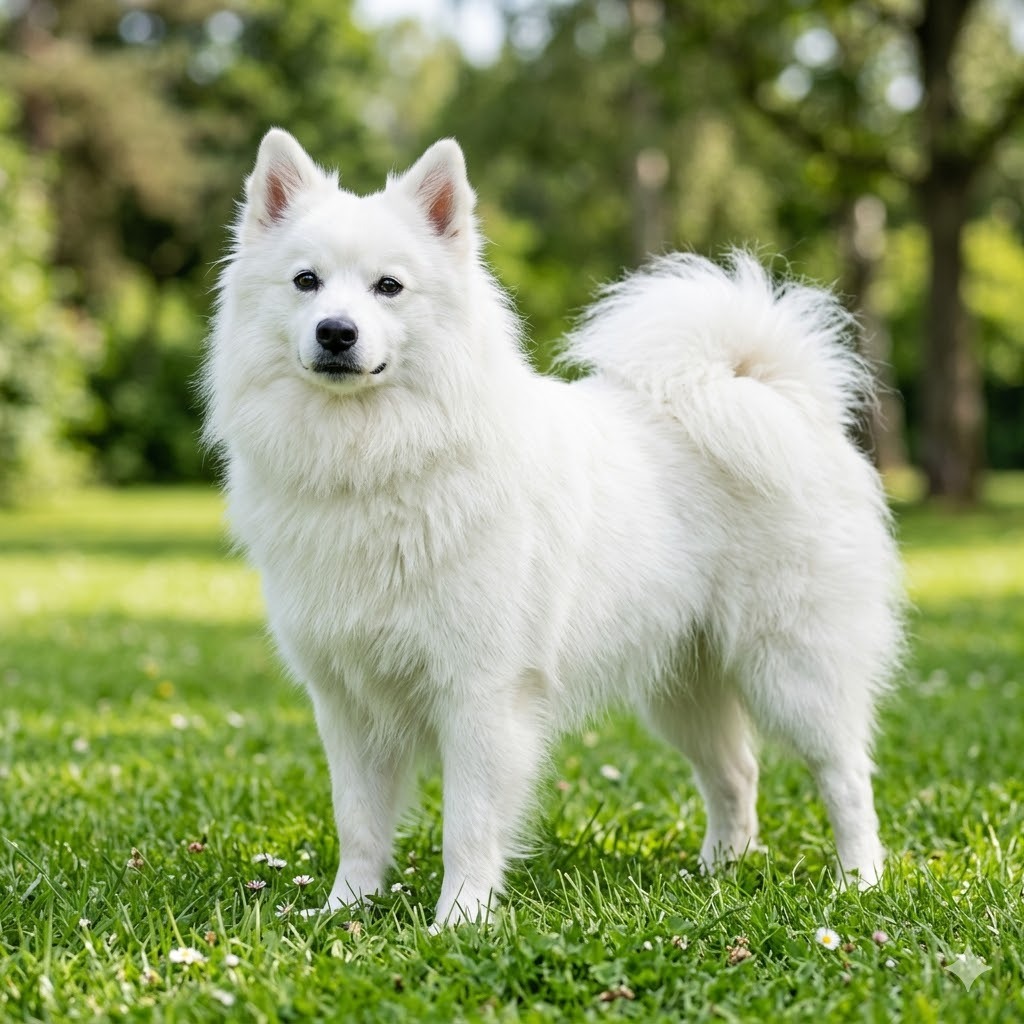
The American Eskimo Dog is a strikingly beautiful, brilliant-white spitz companion - a fluffy, wedge-faced, plumed-tailed dog that looks like a miniature snow-white wolf and behaves like a clever, affectionate family clown.
🗓️ Last reviewed: July 2026
Overview
The American Eskimo Dog is a strikingly beautiful, brilliant-white spitz companion - a fluffy, wedge-faced, plumed-tailed dog that looks like a miniature snow-white wolf and behaves like a clever, affectionate family clown. Despite the name, the breed has no connection to Eskimo peoples; it descends from German spitz dogs and earned fame in American travelling circuses for its intelligence and trainability. It comes in three sizes - toy, miniature, and standard - spanning roughly 3-16 kg (6-35 lb). The "Eskie" is smart, lively, deeply people-oriented, and needs real engagement to be happy.
History & Origins
The American Eskimo Dog descends from the German Spitz, brought to the United States by German immigrants in the 1800s. In America these white spitz dogs were popular farm and companion dogs, valued for their watchfulness, intelligence, and beauty.
The breed found its greatest early fame in the American circus during the late 1800s and early 1900s. Their striking white coats, quick minds, and natural showmanship made them star performers - walking tightropes, doing tricks, and dazzling audiences. Circus dogs were often sold to spectators after shows, spreading the breed across the country.
During the anti-German sentiment of World War I, the "German Spitz" name became a liability, and the breed was renamed the "American Eskimo Dog" - a name with no real link to its origins but one that stuck. The United Kennel Club recognised the breed in 1913, and the AKC followed in 1995, formally recognising the three size varieties. Today the Eskie is purely a companion and family dog, though its circus-era brains and trainability remain very much intact.
Appearance
A compact, balanced spitz in three sizes. Toy: 23-30 cm (9-12 in), 3-4.5 kg (6-10 lb). Miniature: 30-38 cm (12-15 in), 4.5-9 kg (10-20 lb). Standard: 38-48 cm (15-19 in), 9-16 kg (20-35 lb). All share the same proportions and expression.
Key features:
- Coat: thick, straight, stand-off double coat with a dense undercoat and a pronounced ruff around the neck, especially in males.
- Colour: pure white, or white with light biscuit-cream shading.
- Head: wedge-shaped, with a fox-like muzzle.
- Eyes: dark brown, oval, with an alert, intelligent expression; black eye rims, nose, and lips stand out against the white coat.
- Ears: erect, triangular, well-furred.
- Tail: plumed, carried loosely curled over the back.
Temperament & Character
Intelligent, alert, and affectionate. The American Eskimo Dog is one of the brightest spitz breeds - a quick learner that thrives on interaction, training, and being part of everything the family does. It is playful, lively, and often described as a perpetual puppy at heart. This is a dog that wants a job, or at least a game, and will invent its own mischief if left bored.
Eskies are devoted and people-oriented, sometimes to the point of clinginess, and they do not do well left alone for long stretches - separation-related barking and destructiveness are common in neglected dogs. They are naturally reserved and watchful with strangers, which makes them excellent alert watchdogs, and they can be quite vocal.
With children they are affectionate and playful, best supervised with the smaller varieties. With other pets they are usually sociable when raised together. Early socialisation prevents the shyness and over-reactivity the breed can develop if under-exposed.
Care
Coat & Grooming
The thick white double coat needs real commitment. Brush two to three times a week to prevent matting and to control the constant shedding, increasing to daily during the heavy twice-yearly seasonal shed. The breed is a genuinely heavy shedder, and white hair will find its way onto everything.
Despite the pristine look, the coat is fairly self-cleaning and does not carry much odour; baths every couple of months are usually enough. Never shave the double coat, as it insulates and regrows poorly. Clean ears weekly, trim nails every 3-4 weeks, and brush teeth several times a week.
Exercise & Activity Needs
Moderate to high, and heavily weighted toward mental work. Eskies need 45-60 minutes of daily physical exercise - walks, play, and off-lead running where safe - but they need mental engagement even more. This is an intelligent breed that becomes bored, noisy, and destructive without it.
The breed excels at obedience, agility, trick training, and dog sports - a direct legacy of its circus past. Puzzle toys, training games, and learning new tricks keep the mind satisfied. A well-exercised but mentally under-stimulated Eskie is still an unhappy, barking Eskie; engagement is the key to the breed.
Health & Lifespan
Average lifespan is 13-15 years - long-lived, especially the smaller varieties.
Common concerns:
- Patellar luxation - slipping kneecaps, common in smaller dogs.
- Progressive retinal atrophy and other eye conditions.
- Hip dysplasia - more relevant in the standard variety.
- Legg-Calve-Perthes disease - a hip condition in small dogs.
- Dental disease - especially in the toy and miniature sizes.
- Allergies and skin issues.
The breed is generally healthy and hardy, particularly the standard variety.
Feeding & Nutrition
Feeding depends on size: toy Eskies may eat as little as ½ cup a day, standards up to 2 cups, always divided into two meals. The breed can be prone to weight gain, especially the smaller varieties and less active individuals, so portions and treats must be measured carefully.
Choose a quality food matched to size and activity, and account for the many training treats an Eskie will happily earn. Dental-friendly feeding matters for the smaller sizes, which are prone to tooth problems. Fresh water should always be available.
Pros & Cons
Pros
- Beautiful, distinctive brilliant-white appearance.
- Highly intelligent and very trainable.
- Available in three sizes to suit different homes.
- Affectionate, playful, devoted companion.
- Healthy and long-lived.
Cons
- Heavy year-round shedding, worse seasonally - and it is white.
- Needs substantial mental engagement or becomes destructive.
- Vocal; prone to alarm-barking.
- Prone to separation anxiety if left alone too long.
- Can be shy or reactive without thorough socialisation.
Best Suited For
- Owners who enjoy training and interactive games.
- Families wanting an intelligent, affectionate companion.
- Homes where someone is around much of the day.
- Owners prepared for serious grooming and shedding.
Not suited for owners away long hours, those wanting a low-maintenance or low-shedding dog, noise-sensitive close-neighbour homes, or people unwilling to provide daily mental stimulation.
American Eskimo Dog puppy growth chart
A typical growth curve for a medium breed like the American Eskimo Dog, estimated from its adult weight of 3-16 kg. Puppies vary with sex, genetics and diet, so treat this as a guide - for your own puppy, use the puppy weight predictor.
| Age | Typical weight | % of adult |
|---|---|---|
| 2 mo | 0.8-4.3 kg | 27% |
| 3 mo | 1.2-6.4 kg | 40% |
| 4 mo | 1.5-8 kg | 50% |
| 6 mo | 2-10.9 kg | 68% |
| 9 mo | 2.6-13.6 kg | 85% |
| 12 mo | 2.9-15.5 kg | 97% |
| Adult | 3-16 kg | 100% |
American Eskimo Dog - frequently asked questions
Are American Eskimo Dogs actually from the Arctic?
No. Despite the name, the breed descends from the German Spitz and was renamed during World War I for marketing and anti-German reasons. It has no connection to Eskimo peoples or Arctic sled work.
Do they shed a lot?
Yes - heavily, all year, and even more during two seasonal coat blows. The white hair is very visible on clothing and furniture. Regular brushing is essential.
Are they easy to train?
Very. They are among the smartest spitz breeds and were famous circus performers. They love positive, reward-based training and trick work, but they need it - a bored Eskie becomes noisy and destructive.
Are they good with children?
Yes, they are affectionate and playful. The smaller toy and miniature sizes should be supervised with young children to avoid injury to the dog.
Are they hypoallergenic?
No. They are heavy shedders and produce dander.
🧠 Test yourself: guess the dog
Three clues from our quiz bank, each about another of our dogs. Can you name them?
Clue 1.This medium sled dog was developed by the Chukchi people and famously helped relay diphtheria medicine to Nome, Alaska, in 1925.
It's the Siberian Husky - read the full profile →
Clue 2.Nicknamed the 'Grey Ghost,' this large German hunting dog is famous for its silvery coat and pale amber or blue-grey eyes.
It's the Weimaraner - read the full profile →
Clue 3.A small flat-faced companion with erect bat-like ears, it descends from a cross of a Bulldog and the now-rare white English Terrier.
It's the Boston Terrier - read the full profile →
💛 Adoptable American Eskimo Dogs near you
Real dogs of this breed (and close mixes) waiting in shelters and rescues right now, live from Petfinder. We have no affiliation and earn nothing - if someone catches your eye, the link goes straight to their shelter. New to adopting? Start with our adoption guide.
Widget not loading (some ad-blockers hide it)? Search directly on petfinder.com.