Curly-Coated Retriever
The Curly-Coated Retriever is the tallest and one of the oldest of the retriever breeds - a distinctive, dignified gundog wrapped in a coat of tight, crisp curls found nowhere else in the retriever world.
🗓️ Last reviewed: July 2026
Overview
The Curly-Coated Retriever is the tallest and one of the oldest of the retriever breeds - a distinctive, dignified gundog wrapped in a coat of tight, crisp curls found nowhere else in the retriever world. Bred in England to work upland game and waterfowl in tough conditions, the "Curly" is athletic, confident, and independent, with a reserved, discerning nature that sets it apart from the effusive Labrador and Golden. Adults weigh roughly 29-45 kg. Loyal and affectionate with its own people yet aloof with strangers, this is a thinking dog for owners who appreciate a bit of independent character.
History & Origins
The Curly-Coated Retriever is among the oldest retriever breeds, with roots in England reaching back to at least the early 1800s and quite possibly earlier. It is thought to descend from a mix of the old English Water Spaniel, the St. John's water dog, and retrieving setters, with a later infusion of Poodle blood credited with tightening the curls and enhancing the water-working coat.
Prized by 19th-century gamekeepers and poachers alike for its stamina, courage, and reliability in cold water and heavy cover, the Curly became a favourite working gundog, especially for wildfowling and upland shooting. It was one of the earliest breeds shown in England, appearing in the ring by the 1860s.
The breed's popularity later faded as the Labrador and Golden Retriever rose to dominance, and both World Wars thinned its numbers severely. Dedicated breeders preserved it, and today the Curly-Coated Retriever remains rare but treasured - a working retriever that has kept its athleticism, independence, and unmistakable coat intact.
Appearance
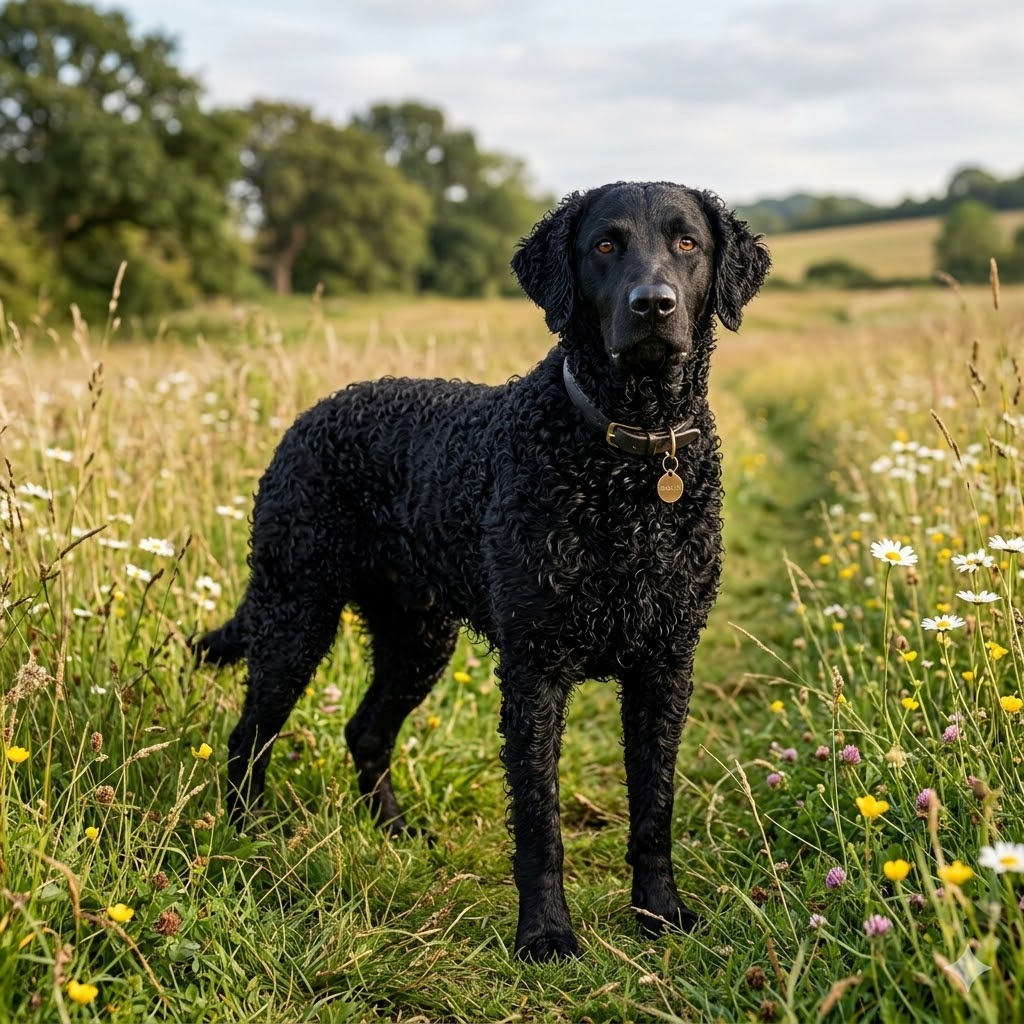
The Curly-Coated Retriever is a large, upstanding, elegant dog, taller and racier than other retrievers, with a proud carriage and an unmistakable coat. Males stand 63-69 cm (25-27 in) and weigh 32-45 kg (70-100 lb); females are smaller, roughly 29-38 kg. The build is athletic and slightly rangy, all function and endurance.
Key features:
- Coat: a mass of small, tight, crisp curls covering the entire body, including the tail; the head, face, and front of the legs are smooth by contrast. The curls are water-resistant and weatherproof, and there is minimal undercoat.
- Colour: solid black or solid liver.
- Head: long and well-proportioned, wedge-shaped, smooth-coated, with a keen expression.
- Eyes: large, almond-shaped, black or brown depending on coat colour, alert and intelligent.
- Ears: rather small, lying close to the head, covered in curls.
- Tail: carried straight or slightly up, covered in curls to the tip.
The single tight-curled coat is the breed's calling card - practical for a life spent in cold water and one of the most striking coats in dogdom.
Temperament & Character
The Curly is confident, independent, and steady, with a more reserved and self-contained temperament than the typical retriever. With its family it is loyal, affectionate, and gently devoted; with strangers it is characteristically aloof - not aggressive or fearful, simply reserved and discerning, taking its time to decide about newcomers. This wariness makes the Curly a more alert watchdog than most retrievers.
Intelligent and capable of independent thought, the breed does not offer the eager, hang-on-your-every-word biddability of a Golden. It is perfectly trainable but appreciates a reason for a request and can grow bored with drilling and repetition. Owners who enjoy a dog with opinions tend to love the Curly's character.
The breed often keeps a puppyish, playful streak for several years and matures slowly. With children in its own family it is typically good-natured and patient, and with proper socialisation it is generally fine with other dogs. Its reserve should be nurtured with early exposure so it settles into calm confidence rather than shyness.
Care
Coat & Grooming
The curly coat is refreshingly low-maintenance for its dramatic look - and, importantly, it is a low-shedding coat that leaves relatively little hair around the home. Because brushing straightens and frizzes the curls, the Curly should not be brushed like other breeds. Instead, wet the coat or bathe the dog and let the curls reform naturally; a light finger-work or occasional comb only when wet keeps things tidy.
The coat sheds seasonally, at which point some careful stripping or combing of loose curls helps. Never clip the body coat, though the tail is sometimes tidied. Dry the ears after swimming to prevent infection, trim nails regularly, and keep up dental care. Overall the grooming demands are modest.
Exercise & Activity Needs
This is an athletic working retriever with substantial exercise needs - a minimum of 60-90 minutes of vigorous daily activity, and ideally more. Swimming, retrieving, running, and hiking all suit the breed, which relishes water and open country.
Mental stimulation is equally important, given the breed's intelligence and independence. Curlies do well at field work, obedience, agility, and scent sports, and they need variety to stay engaged, since a bored, under-exercised Curly can become restless or mischievous. A satisfying job or sport brings out the breed's best.
Health & Lifespan
Average lifespan is 10-12 years - typical for a large working retriever.
Common concerns:
- Hip and elbow dysplasia.
- Progressive retinal atrophy and other eye conditions, including entropion and cataracts.
- Bloat (GDV) - a real risk in this deep-chested breed.
- Exercise-induced collapse (EIC) - a genetic condition for which testing is available.
- Glycogen storage disease (GSD IIIa) - an inherited metabolic condition seen in the breed, with a DNA test available.
- Cancer, including lymphoma, in older dogs.
- Follicular dysplasia and other coat or skin issues.
Because the gene pool is small, choosing a breeder who tests hips, elbows, eyes, and the breed-specific genetic conditions is important.
Feeding & Nutrition
Adults typically eat 3-4 cups of quality food per day divided into two meals, adjusted for size and activity; working dogs need more. The breed does best on a diet suited to large, active dogs, and staying lean protects the joints and reduces strain on this deep-chested frame.
Feed two smaller meals rather than one large one and avoid vigorous exercise within an hour either side of eating, as bloat is a genuine risk in the breed. Puppies should grow slowly on a large-breed formula to support sound joint development in this slow-maturing dog.
Pros & Cons
Pros
- Striking, low-shedding curly coat that needs little brushing.
- Intelligent, independent, and characterful.
- Athletic and versatile in the field and water.
- Loyal and affectionate with family; a good watchdog.
- Distinctive and uncommon.
Cons
- Aloof with strangers and independent-minded.
- Substantial exercise and mental-stimulation needs.
- Slow to mature, with a long adolescence.
- Deep-chested, with a real bloat risk.
- Coat care differs from other breeds and can confuse new owners.
Best Suited For
- Experienced, active owners who appreciate an independent dog.
- Homes with access to water and open space.
- People wanting a low-shedding working retriever with watchdog instincts.
- Owners happy to socialise thoroughly and train with patience.
Not suited for those wanting an instantly outgoing, eager-to-please retriever, sedentary households, or novices expecting the easy biddability of a Labrador or Golden.
Curly-Coated Retriever puppy growth chart
A typical growth curve for a large breed like the Curly-Coated Retriever, estimated from its adult weight of 29-45 kg. Puppies vary with sex, genetics and diet, so treat this as a guide - for your own puppy, use the puppy weight predictor.
| Age | Typical weight | % of adult |
|---|---|---|
| 2 mo | 6.4-9.9 kg | 22% |
| 3 mo | 9.6-14.9 kg | 33% |
| 4 mo | 12.5-19.4 kg | 43% |
| 6 mo | 17.4-27 kg | 60% |
| 9 mo | 23.2-36 kg | 80% |
| 12 mo | 26.7-41.4 kg | 92% |
| Adult | 29-45 kg | 100% |
Curly-Coated Retriever - frequently asked questions
Is the Curly-Coated Retriever hypoallergenic?
No dog is truly hypoallergenic, but the Curly is a relatively low-shedding breed and its single curly coat leaves less loose hair around the home than most retrievers. Some allergy sufferers tolerate it better, though dander is still produced.
How do you groom a curly coat?
Very differently from other breeds. Do not brush it, as brushing frizzes the curls. Instead, wet or bathe the dog and let the curls reform, using a comb only when the coat is wet, plus some careful combing during seasonal sheds. The body coat is never clipped.
Why is a Curly more aloof than other retrievers?
Reserve with strangers is a genuine breed trait - the Curly is discerning and takes time to warm to newcomers, without being aggressive. Early socialisation ensures this reads as calm confidence rather than shyness, and it also makes the breed a better watchdog than most retrievers.
Are Curly-Coated Retrievers good family dogs?
Yes, for active families that appreciate their character. They are loyal, affectionate, and good with children in their own family. They need plenty of exercise and mental work and are best matched with owners who enjoy an independent, intelligent dog.
How big do Curly-Coated Retrievers get?
They are the tallest of the retrievers. Males stand 63-69 cm and can weigh up to about 45 kg, with females somewhat smaller, making the Curly noticeably larger and racier than a Labrador or Golden Retriever.
🧠 Test yourself: guess the dog
Three clues from our quiz bank, each about another of our dogs. Can you name them?
Clue 1.Bred down from fighting stock in 19th-century Massachusetts, this compact breed shares its city's name and is its state's official dog.
It's the Boston Terrier - read the full profile →
Clue 2.This tiny toy terrier with a long, silky blue-and-tan coat was originally bred to catch rats in English textile mills.
It's the Yorkshire Terrier - read the full profile →
Clue 3.Bred in the snowy mountains of northern Japan to hunt large game like boar and bear, this thick-coated spitz-type breed is dignified and reserved with strangers.
It's the Akita - read the full profile →
💛 Adoptable Curly-Coated Retrievers near you
Real dogs of this breed (and close mixes) waiting in shelters and rescues right now, live from Petfinder. We have no affiliation and earn nothing - if someone catches your eye, the link goes straight to their shelter. New to adopting? Start with our adoption guide.
Widget not loading (some ad-blockers hide it)? Search directly on petfinder.com.