Pet First Aid Kit Essentials
Complete pet first aid kit checklist for 2026 - 25 items every dog or cat owner needs, what each is for, and how to assemble a kit for under $80.
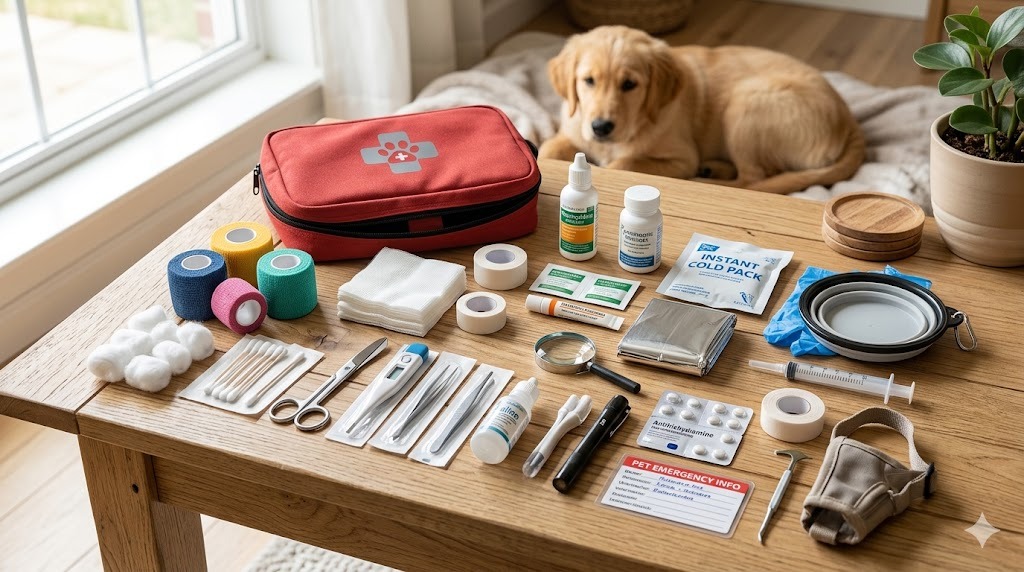
A working pet first aid kit covers four jobs: control bleeding (gauze, vet wrap, a clotting product), clean and protect wounds (saline, antiseptic, non-stick pads), handle the basics (tweezers, a tick remover, a digital thermometer, vet-approved meds), and manage an emergency (a muzzle, an emergency blanket, and your vet’s number). You can assemble the 25 essentials for under $80.
Most pet emergencies don’t happen at the vet’s office. They happen on a hiking trail at 7 p.m. when the clinic is closed, in a campsite three hours from anywhere, on a snowy sidewalk after the dog cuts a paw on hidden glass. A working pet first aid kit doesn’t replace a veterinarian - it buys you the 15 to 90 minutes you need to get one.
This guide is the kit we’d build today, item by item, for any pet-owning household - dog or cat. It’s specific about brands where brand matters, generic where it doesn’t, and honest about which items are theatre versus actually useful. Total cost for a complete kit: about $70 to $90 depending on what you already own.
What a Real Pet First Aid Kit Solves
A good kit handles four scenarios well:
- Wounds and bleeding - cuts, torn pads, broken nails, abrasions
- Toxin exposure - accidental ingestion of foods, plants, medications
- Heat, cold, and shock - overheating, hypothermia, allergic reaction
- Transport stabilization - splinting, muzzling, restraining an injured animal long enough to drive to a vet
If your kit can’t handle those four, it’s not a first aid kit - it’s a hygiene drawer. Below are the 25 items we consider non-negotiable.
The Container
The container matters more than people think. You want something waterproof, easy to grab with one hand, and small enough to stash in a car or pack. Soft cases beat hard plastic for weight; clear pockets beat opaque ones because in an emergency you don’t want to dig.
We slightly prefer building your own kit, but if you want a 30-second solution, a pre-built kit gives you about 70% of the items and a decent case.
Wound Care: The Core Eight
These are the items you’ll actually use. If you only buy eight things, buy these.
1. Self-adhering bandage (vet wrap)
Vet wrap sticks to itself, not to fur. It’s the single most useful item in a pet first aid kit - used for everything from holding a gauze pad in place to immobilizing a sprained leg.
2. Non-stick gauze pads
Get 2x2 and 4x4 sizes, sterile, individually wrapped. Press against bleeding wounds, then wrap with vet wrap.
3. Roll gauze
For larger areas a single pad won’t cover. Wrap loosely under vet wrap.
4. Cohesive medical tape
Used to secure gauze when vet wrap won’t work (around joints, on tails). Not the same as duct tape - buy medical-grade.
5. Saline wound wash
For flushing debris out of cuts and eye contaminants. Plain sterile saline is fine - don’t waste money on “pet-specific” formulations.
6. Chlorhexidine solution (2%)
Safer than hydrogen peroxide for cleaning wounds (peroxide damages healing tissue). Dilute to a light blue color and flush.
7. Hydrogen peroxide 3%
Counter-intuitively, you keep this not for wounds but for inducing vomiting in toxin emergencies - but only when a vet or poison control instructs you to. Never give for xylitol, caustics, or sharp objects.
8. Triple antibiotic ointment (no pain reliever)
Plain Neosporin without added pain reliever is safe for dogs in small amounts. Cats: only with vet approval, as their grooming exposes them to more of the active ingredient.
Tools: Get These Right
Cheap tools in a first aid kit are worse than no tools - they break or fail at the worst moment.
9. Bandage scissors with blunt tip
The blunt tip slides safely under bandages on a moving animal. Sharp-tipped scissors cut animals.
10. Tweezers (fine-tip, stainless)
Tick removal, splinter extraction, removing small foreign objects from pads.
11. Tick remover tool
A dedicated tick key or fork removes ticks without leaving the head embedded. Worth the $5.
12. Digital rectal thermometer
A pet’s normal temperature is 101-102.5°F. Anything over 104 or under 99 is an emergency. Get a pet-specific thermometer (faster, flexible tip) and a small bottle of lubricant.
13. Styptic powder
Stops bleeding from cut nails or small wound bleeds in seconds. Kwik-Stop is the standard brand.
14. Soft muzzle (sized to your dog)
A scared, injured dog will bite the person trying to help - even their owner. A soft fabric muzzle costs $10 and may save you from a bite during a paw injury. Cats: use a thick towel (“burrito wrap”) instead.
15. Slip leash
In an emergency you may not have time to find a normal leash. A nylon slip leash lives in the kit.
Toxin and Reaction Response
16. Children’s diphenhydramine (Benadryl), 25mg tablets
For mild allergic reactions to insect stings. Standard dose for dogs is 1 mg per pound, every 8-12 hours. Always check with a vet first for cats and small dogs.
17. Activated charcoal
Used in some poisoning scenarios - but only under poison control’s direction. Do not administer blindly.
18. ASPCA Animal Poison Control number printed on a card
(888) 426-4435. Open 24/7. There’s a $95 consultation fee but they will literally tell you what to do, when to induce vomiting, and what dose of what to give. This card lives in the kit.
19. Pet poison reference card
A laminated card listing common toxins (chocolate, xylitol, grapes, lilies, ibuprofen, antifreeze) and their immediate first steps.
Records and Information
20. Your pet’s medical record summary
Print one page: name, breed, weight, age, current medications, allergies, vaccination status, microchip number, your vet’s phone number, and the nearest 24-hour emergency vet’s address and phone. Update yearly.
21. Recent photo of your pet
Glued to the records sheet. Used for identification if you’re separated.
22. Emergency vet location printout
The address and phone of the closest 24-hour emergency vet to your home, your usual work, and any frequently visited area (vacation cabin, in-laws).
Comfort and Stabilization
23. Emergency blanket (mylar)
Treats shock by retaining body heat. Cheap, weighs nothing.
24. Disposable gloves
Both for hygiene and to keep your scent off a wound that may need to be assessed by a vet later. Nitrile, not latex (some pets are sensitive).
25. Cone of shame or recovery suit
You don’t need this in the kit itself, but every household should own a properly sized cone. The inflatable donut style is gentler.
What to Skip
Most pre-built kits include items that look impressive but waste space:
- Cotton balls - fibers stick to wounds. Use gauze.
- CPR mouth barriers for pets - pet CPR is rarely effective and almost never indicated by these.
- Splint kits - improvising with vet wrap and a rolled-up magazine works better than a generic splint.
- Burn gel - pet burns need vet care, not home treatment.
- Suturing kits - don’t suture a pet at home. Ever.
Where to Keep Your Kit
The kit only helps if you can reach it.
- Primary kit: mudroom, garage, or front closet - wherever you’re heading out the door.
- Car kit: smaller version in the glove box or trunk, especially if you travel with pets.
- Travel kit: if you camp or hike, a stripped-down version in your pack.
A kit in the basement behind boxes might as well not exist.
How Often to Refresh
- Every 6 months: check expiration dates on consumables (saline, hydrogen peroxide, antibiotic ointment, Benadryl).
- Yearly: replace anything expired, update the medical records sheet, confirm the emergency vet location hasn’t moved.
- After every use: replace exactly what you used. Don’t tell yourself “I’ll get to it next week.”
Frequently Asked Questions
Are pre-built pet first aid kits worth buying?
Yes, as a starting point. They give you the case and basic consumables for around $30. Plan to upgrade the scissors, tweezers, and tick remover, and add the items above that aren’t included.
Can I use a human first aid kit for my pet?
Most of the items overlap. The big differences: vet wrap (sticks to itself, not fur), pet-safe ointments, and a pet thermometer. You can adapt a human kit by adding the pet-specific items.
Should I include prescription medications in the kit?
Only if your vet has prescribed them for emergency use (such as injectable epinephrine for a known severe allergy or anti-seizure medication for an epileptic dog). Don’t stockpile leftover prescriptions.
Is it safe to give my dog Benadryl from the first aid kit?
For mild allergic reactions to insect stings, yes - 1 mg per pound for most adult dogs. For anything beyond a mild reaction, call your vet first. Never give Benadryl with combination ingredients (decongestants are toxic).
How do I take my dog’s temperature?
Lubricate a digital rectal thermometer, insert about 1 inch, hold until it beeps (usually 10-30 seconds). Normal range is 101-102.5°F. Have someone hold the dog’s head and offer a treat.
Do I need a separate kit for cats?
You can use the same base kit. Differences: cats need a smaller muzzle (or use a towel wrap), some ointments safe for dogs aren’t safe for cats, and induced vomiting is generally not recommended for cats - call poison control instead.
Final Word
A first aid kit isn’t insurance against bad things happening. It’s a tool that lets you act calmly when they do. Spend an afternoon building one, then forget about it for six months - exactly the way a good kit should work.
The kit on this page costs roughly $70 to $90 to assemble from scratch, or $30 plus upgrades if you start from a pre-built. Either way, it’s one of the highest-leverage purchases a pet owner can make.
Related Reading
Last updated: May 2026.