Briard
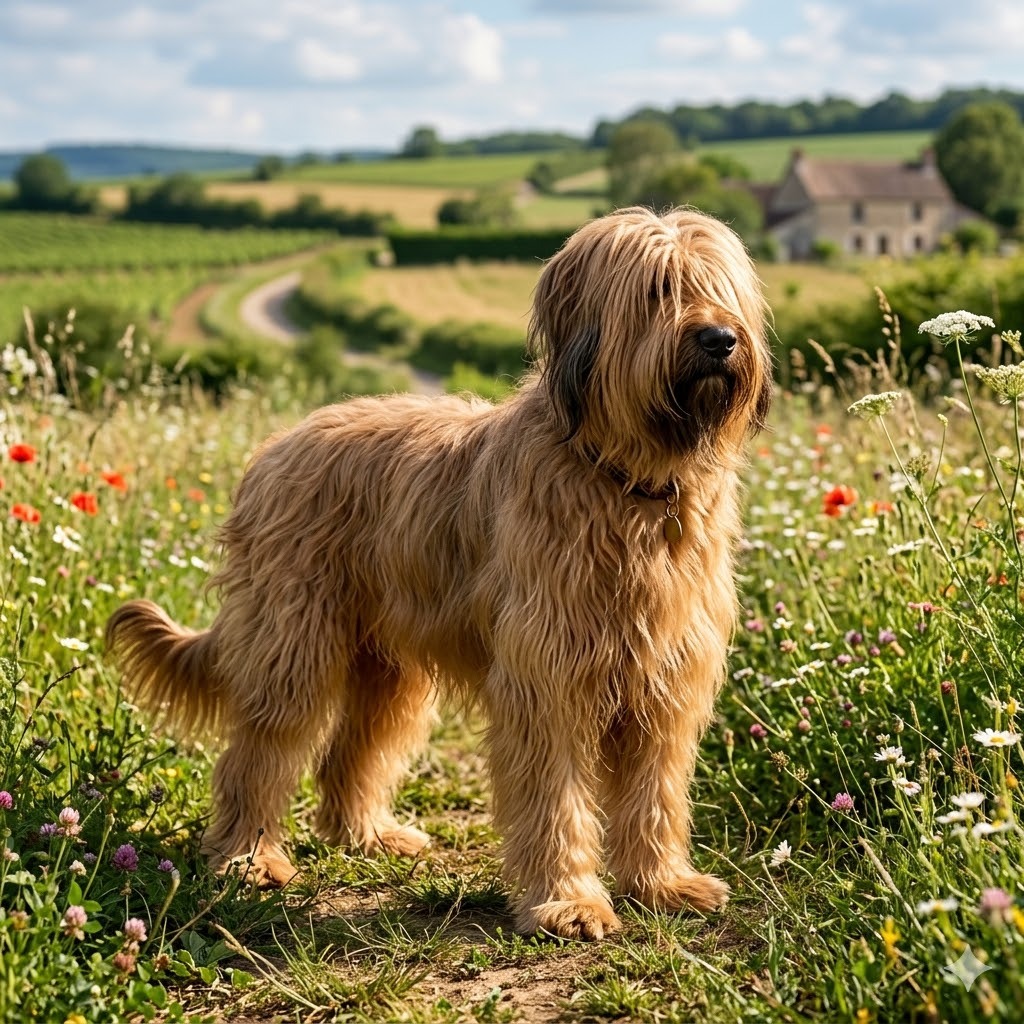
The Briard is an ancient French herding dog wrapped in a long, flowing coat that famously falls over its eyes.
🗓️ Last reviewed: July 2026
Overview
The Briard is an ancient French herding dog wrapped in a long, flowing coat that famously falls over its eyes. Behind that shaggy curtain sits a dog often described as "a heart of gold wrapped in fur" - profoundly devoted, affectionate, and intuitive with its family. But the Briard is no pushover: it is confident, headstrong, and independent, a true herding dog that thinks for itself and expects a partnership rather than blind obedience. Add a heavy, high-maintenance coat and you have a breed that rewards committed owners richly while quickly overwhelming unprepared ones. Males typically weigh 30-40 kg (66-88 lb).
History & Origins
The Briard is one of France's oldest herding breeds, with roots stretching back centuries. Dogs of this type appear in French tapestries and writings from the Middle Ages, and the breed is sometimes linked in legend to French nobility. The name is generally associated with the region of Brie, though the breed was found across the French countryside working as an all-purpose farm and flock dog.
Traditionally the Briard did two jobs at once: guarding flocks against wolves and thieves, and later moving and containing sheep. That dual role shaped a dog that is both protective and biddable, watchful yet responsive to its shepherd.
The breed gained wider fame after the French Revolution as land was divided and flocks needed managing, and it served heavily as a military dog in World War I - carrying messages, finding wounded soldiers, and pulling supplies. The American Kennel Club recognised the Briard in 1928. Today it remains a working herder in France while also thriving as a family companion and show dog.
Appearance
Large, muscular, and rugged beneath its dramatic coat. Males stand 62-68 cm (24.5-27 in) and weigh 30-40 kg (66-88 lb); females are somewhat smaller. The build is powerful and agile - a dog capable of long days in the field.
Key features:
- Coat: long, coarse, slightly wavy outer coat with a fine undercoat; the hair falls naturally over the eyes and forms a beard and eyebrows.
- Colour: solid colours including black, various shades of grey, and tawny (fawn); shading is common.
- Head: large and rectangular, framed by the falling coat, beard, and eyebrows.
- Eyes: large, dark, and calm - visible through the hair.
- Ears: set high; traditionally cropped, but natural drop ears are now standard in most countries.
- Feet: notably, the breed carries double dewclaws on each hind leg, a required breed trait.
- Tail: long, carried low with an upward hook at the tip.
Temperament & Character
Devoted, sensitive, and intelligent, the Briard bonds intensely with its family and dislikes being separated from them. This is very much a companion herder - it wants to be involved in everything the household does and can become anxious or mischievous if left out or under-stimulated.
The breed is confident and headstrong. It has strong opinions, a good memory, and the independent problem-solving mind of a working herder, which means it will test boundaries and needs an owner who leads consistently. It is protective by nature and naturally wary of strangers, so socialisation is essential.
With children in its own family the Briard is typically gentle, patient, and even nanny-like, though its herding instinct may show as nudging or gathering. It can be reserved and territorial with unfamiliar people and dogs.
Care
Coat & Grooming
The Briard's long, double coat is demanding. It needs thorough brushing and combing right down to the skin at least two or three times a week - ideally more - to prevent the mats that form readily in the dense undercoat. A quick surface brush is not enough; neglected coats mat close to the skin and must sometimes be clipped off entirely.
The beard traps food and water and needs regular cleaning, and the hair around the eyes and feet needs attention. Many owners keep a working Briard in a shorter clip for practicality. Bathe as needed, clean ears weekly, trim nails every 3 weeks, and brush teeth several times weekly. This is one of the more grooming-intensive breeds and should never be taken on lightly.
Exercise & Activity Needs
An athletic working breed that needs 60-90 minutes of daily exercise plus mental work. Long walks, hikes, running, and off-lead play in safe areas keep the body satisfied, but the Briard's active mind demands more than physical output alone.
The breed excels at herding, agility, obedience, tracking, and canine sports, and it loves having a purpose. Without enough physical and mental engagement, a Briard can become bored, vocal, and inventive in unwelcome ways.
Health & Lifespan
Average lifespan is 11-13 years.
Common concerns:
- Hip dysplasia - screen breeding stock.
- Bloat (GDV) - a risk in this deep-chested breed.
- Progressive retinal atrophy and other eye conditions - the Briard is notable in veterinary science as a model for a form of congenital night blindness.
- Hypothyroidism.
- Certain autoimmune conditions.
Responsible breeders screen hips and eyes, which matters especially in this breed.
Feeding & Nutrition
A large, active Briard typically eats 3-4 cups of quality food per day split into two meals, adjusted for age, size, and workload. Feeding two smaller meals rather than one large one, and avoiding hard exercise within an hour of eating, helps reduce the risk of bloat in this deep-chested breed.
Keep the dog lean to protect its joints, and be aware that the coat can hide weight changes - assess condition by feel, not just by eye. Slow-feeder bowls help fast eaters, and clean water should always be available.
Pros & Cons
Pros
- Deeply devoted, affectionate, and intuitive with family.
- Intelligent, versatile herding and sport dog.
- Naturally protective and watchful.
- Gentle and patient with its own children.
- Striking, distinctive appearance.
Cons
- Very high grooming demands - not for the time-poor.
- Headstrong and independent; needs experienced handling.
- Wary of strangers without strong socialisation.
- Needs substantial daily exercise and mental work.
- Can be vocal and territorial.
Best Suited For
- Experienced, committed owners who enjoy grooming.
- Active homes with time for exercise and training.
- Families with older children wanting a devoted guardian.
- Sport and herding enthusiasts.
- Households where the dog is part of daily life, not left alone for long.
Not suited for first-time owners, people short on time for coat care, sedentary households, or anyone wanting an aloof, low-maintenance dog.
Briard puppy growth chart
A typical growth curve for a large breed like the Briard, estimated from its adult weight of 30-40 kg. Puppies vary with sex, genetics and diet, so treat this as a guide - for your own puppy, use the puppy weight predictor.
| Age | Typical weight | % of adult |
|---|---|---|
| 2 mo | 6.6-8.8 kg | 22% |
| 3 mo | 9.9-13.2 kg | 33% |
| 4 mo | 12.9-17.2 kg | 43% |
| 6 mo | 18-24 kg | 60% |
| 9 mo | 24-32 kg | 80% |
| 12 mo | 27.6-36.8 kg | 92% |
| Adult | 30-40 kg | 100% |
Briard - frequently asked questions
Are Briards good family dogs?
Yes, for committed families. They are devoted, gentle with their own children, and protective, but they need significant grooming, exercise, and socialisation, which makes them best for experienced, active homes.
Can Briards see through all that hair?
Yes. The coat falls over the eyes but the dog sees perfectly well; the hair should never be cut away simply because it covers the eyes, as it is part of the breed's protection and character.
How much grooming does a Briard need?
A great deal - thorough combing to the skin several times a week to prevent matting, plus beard and eye-area cleaning. It is one of the most grooming-intensive breeds.
Are Briards stubborn?
They are independent and headstrong rather than simply stubborn. As working herders they think for themselves and respond best to patient, positive, consistent training.
What are the double dewclaws about?
Double dewclaws on each hind leg are a required breed trait, a long-standing hallmark of the Briard that is preserved in the breed standard.
🧠 Test yourself: guess the dog
Three clues from our quiz bank, each about another of our dogs. Can you name them?
Clue 1.Despite its glamorous lap-dog image, this small English breed retains a bold terrier temperament from its vermin-hunting origins.
It's the Yorkshire Terrier - read the full profile →
Clue 2.Despite weighing only a few pounds, this fine-boned companion is a tireless, athletic dog that excels at agility courses.
It's the Papillon - read the full profile →
Clue 3.A smart, eager-to-please herder with a fluffy medium coat, it craves a job and can develop bad habits if left bored.
It's the Australian Shepherd - read the full profile →
💛 Adoptable Briards near you
Real dogs of this breed (and close mixes) waiting in shelters and rescues right now, live from Petfinder. We have no affiliation and earn nothing - if someone catches your eye, the link goes straight to their shelter. New to adopting? Start with our adoption guide.
Widget not loading (some ad-blockers hide it)? Search directly on petfinder.com.