Cairn Terrier
The Cairn Terrier is a small, shaggy Scottish earth-dog with an outsized personality - hardy, cheerful, endlessly busy, and famously the breed that played Toto in "The Wizard of Oz." Bred to bolt vermin from the rocky cairns of the Highlands, this is a working terrier in a compact, weatherproof package.
🗓️ Last reviewed: July 2026
Overview
The Cairn Terrier is a small, shaggy Scottish earth-dog with an outsized personality - hardy, cheerful, endlessly busy, and famously the breed that played Toto in "The Wizard of Oz." Bred to bolt vermin from the rocky cairns of the Highlands, this is a working terrier in a compact, weatherproof package. Adults stand roughly 23-33 cm at the shoulder and weigh about 6-8 kg, making them one of the more manageable terriers for family homes while retaining every ounce of true terrier grit. Owners describe them as plucky little optimists who greet each day as an adventure.
History & Origins
The Cairn Terrier is one of Scotland's oldest working terriers, developed on the Isle of Skye and in the western Highlands to hunt foxes, badgers, otters, and rats among the piles of stones - the cairns - that dotted the landscape. Farmers needed a dog small enough to squeeze into rocky crevices yet game enough to face a cornered predator underground. For centuries these dogs were simply called "short-haired Skye terriers" and were lumped together with the ancestors of the Scottish, West Highland White, and Skye Terriers.
By the early 20th century breeders began separating the strains. The name "Cairn Terrier" was adopted around 1909 to reflect the dog's working purpose, and the Kennel Club recognised the breed in 1912. The American Kennel Club followed in 1913. The breed's public fame exploded in 1939 when a brindle Cairn named Terry played Toto, cementing the image of the scruffy, spirited little dog in popular culture. Today the Cairn remains close to its working roots, changed remarkably little by fashion.
Appearance
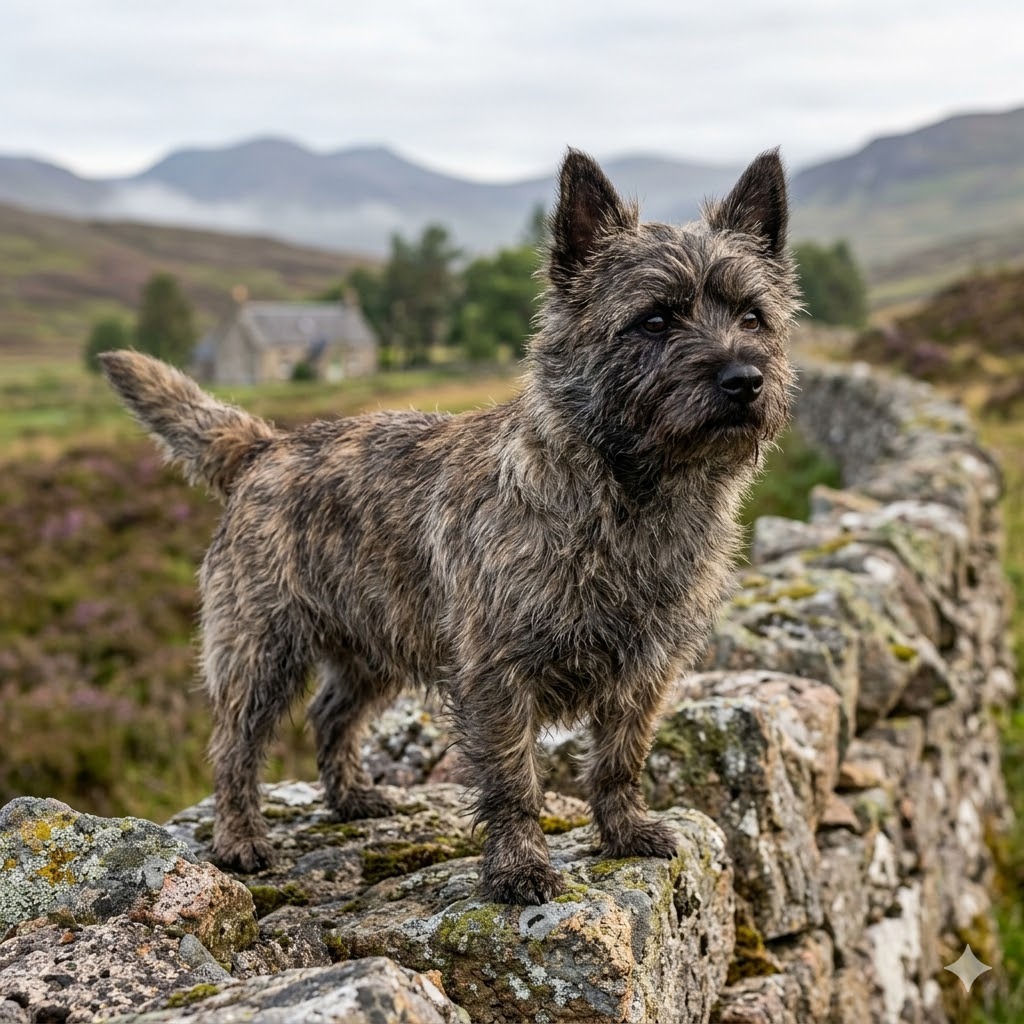
Small, sturdy, and workmanlike rather than dainty. Adults stand roughly 23-33 cm (9-13 in) at the shoulder and weigh about 6-8 kg (13-18 lb). The body is slightly longer than it is tall, with good bone and a low, level topline.
Key features:
- Coat: a harsh, weather-resistant double coat - a profuse, wiry outer layer over a soft, close undercoat.
- Colour: any colour except pure white - cream, wheaten, red, grey, sandy, and nearly black, very often brindled. Ears, muzzle, and tail tip are frequently darker.
- Head: broad and foxy, shorter and wider than most terriers, with a distinct stop and an alert, mischievous expression.
- Eyes: medium, wide-set, hazel, with shaggy brows.
- Ears: small, pointed, carried erect.
- Tail: short, carried up but not curled over the back, well furnished with hair.
The overall impression is of a shaggy, hardy little dog built for scrambling over rocks in bad weather.
Temperament & Character
The Cairn is cheerful, curious, and busy - a true terrier that lives at full tilt. Confident and fearless out of all proportion to its size, it approaches life as one long investigation. These dogs are alert and make good watchdogs, quick to announce visitors, though they are rarely aggressive.
Cairns are affectionate and people-oriented, bonding warmly with the whole family and enjoying being part of daily life. They tend to be more adaptable and less scrappy than some terriers, which is part of their long popularity as companions. With children they are typically playful and robust, well suited to older kids who respect them.
The flip side of that terrier heritage is a strong prey drive and a love of digging. A Cairn left bored in a garden will excavate it. They can be independent and stubborn, and many have a lively, opinionated streak. Early socialisation helps them get along with other dogs, though same-sex squabbles and enthusiastic chasing of cats or small pets are common terrier traits.
Care
Coat & Grooming
The harsh double coat is naturally self-cleaning and sheds little, but it needs regular attention. Brush two or three times a week to prevent mats and remove debris. The correct way to maintain coat texture is hand-stripping - plucking out dead outer hairs - two or three times a year, which keeps the jacket harsh and weatherproof. Clipping is easier but softens the coat and dulls the colour over time.
Bathe only occasionally, as the coat repels dirt well. Check and clean ears weekly, trim nails every few weeks, and brush teeth several times a week, as small breeds are prone to dental disease.
Exercise & Activity Needs
Moderate but genuine. A Cairn needs around 30-60 minutes of activity daily - brisk walks, games, and a chance to explore and sniff. They are lively and enjoy fetch, terrier sports such as earthdog and barn hunt, and safely fenced romps.
Because of the strong prey drive, a Cairn should be walked on lead near roads and wildlife, and gardens must be securely fenced with dig-proof boundaries. Mental stimulation matters as much as physical exercise; puzzle toys, training games, and scent work keep this clever, busy dog satisfied and out of mischief.
Health & Lifespan
Average lifespan is 12-15 years - a robust and generally healthy breed.
Common concerns:
- Patellar luxation - slipping kneecaps.
- Hip dysplasia.
- Progressive retinal atrophy and other eye conditions.
- Portosystemic (liver) shunt.
- Globoid cell leukodystrophy (Krabbe disease) - a rare inherited neurological disorder.
- Hypothyroidism.
- Allergies and skin sensitivities.
Responsible breeders screen for eye, knee, and liver issues. Keeping the dog lean protects the joints and adds years.
Feeding & Nutrition
Adults typically eat about ½-1 cup of quality food per day, split into two meals, adjusted for size and activity. Cairns love food and gain weight easily, so measured portions and limited treats are important - obesity strains the joints and shortens life.
Choose a complete diet suited to small breeds and life stage. Small-kibble formulas support dental health. Fresh water should always be available, and treats are best reserved for training rather than free feeding.
Pros & Cons
Pros
- Cheerful, hardy, low-drama companion with a big personality.
- Compact and adaptable to houses or flats with exercise.
- Weather-resistant coat sheds little.
- Alert watchdog without excess aggression.
- Long-lived and generally healthy.
Cons
- Strong prey drive and enthusiastic digging.
- Independent and stubborn; needs patient training.
- Coat requires regular brushing and periodic hand-stripping.
- Can be barky if bored or under-exercised.
- Not reliably off-lead near wildlife or roads.
Best Suited For
- Owners who want a small dog with a real terrier character.
- Active individuals, couples, and families with older children.
- Homes with a securely fenced garden.
- People happy to provide daily walks and mental games.
Not suited for owners wanting a placid lap-dog, homes with free-roaming small pets, gardeners protective of their flower beds, or anyone unwilling to manage a bit of stubbornness and digging.
Cairn Terrier puppy growth chart
A typical growth curve for a toy breed like the Cairn Terrier, estimated from its adult weight of 6-8 kg. Puppies vary with sex, genetics and diet, so treat this as a guide - for your own puppy, use the puppy weight predictor.
| Age | Typical weight | % of adult |
|---|---|---|
| 2 mo | 2-2.6 kg | 33% |
| 3 mo | 2.7-3.6 kg | 45% |
| 4 mo | 3.3-4.4 kg | 55% |
| 6 mo | 4.5-6 kg | 75% |
| 9 mo | 5.7-7.6 kg | 95% |
| 12 mo | 6-8 kg | 100% |
| Adult | 6-8 kg | 100% |
Cairn Terrier - frequently asked questions
Are Cairn Terriers good with children?
Yes, especially with older children who play respectfully. They are sturdy and playful, though their busy energy suits active families better than very quiet homes.
Do Cairn Terriers shed a lot?
No. The harsh double coat sheds minimally, which many owners appreciate, but it still needs regular brushing and periodic hand-stripping to stay in good order.
Is a Cairn Terrier the same as Toto?
Toto in the 1939 film was played by a Cairn Terrier named Terry, so the breed is forever linked to the character, though the original book did not specify a breed.
Do Cairn Terriers bark a lot?
They are alert watchdogs and will sound off at visitors and odd noises. Excessive barking usually signals boredom and eases with enough exercise and mental work.
Can Cairn Terriers live in an apartment?
Yes, provided they get daily walks and stimulation. They are compact and adaptable, but their curiosity and occasional barking mean they are not a silent, sedentary breed.
🧠 Test yourself: guess the dog
Three clues from our quiz bank, each about another of our dogs. Can you name them?
Clue 1.This versatile liver-spotted gundog freezes and aims its whole body at hidden game, even in water.
It's the German Shorthaired Pointer - read the full profile →
Clue 2.This imposing Italian mastiff, whose name roughly means 'bodyguard dog', descends from Roman war dogs.
It's the Cane Corso - read the full profile →
Clue 3.With a luxuriant mane and a sharp, sensitive mind, this compact herder excels at obedience and agility trials.
It's the Shetland Sheepdog - read the full profile →
💛 Adoptable Cairn Terriers near you
Real dogs of this breed (and close mixes) waiting in shelters and rescues right now, live from Petfinder. We have no affiliation and earn nothing - if someone catches your eye, the link goes straight to their shelter. New to adopting? Start with our adoption guide.
Widget not loading (some ad-blockers hide it)? Search directly on petfinder.com.