Mushroom Coral
"Mushroom coral" is a trade nickname, not a species.
🗓️ Last reviewed: July 2026
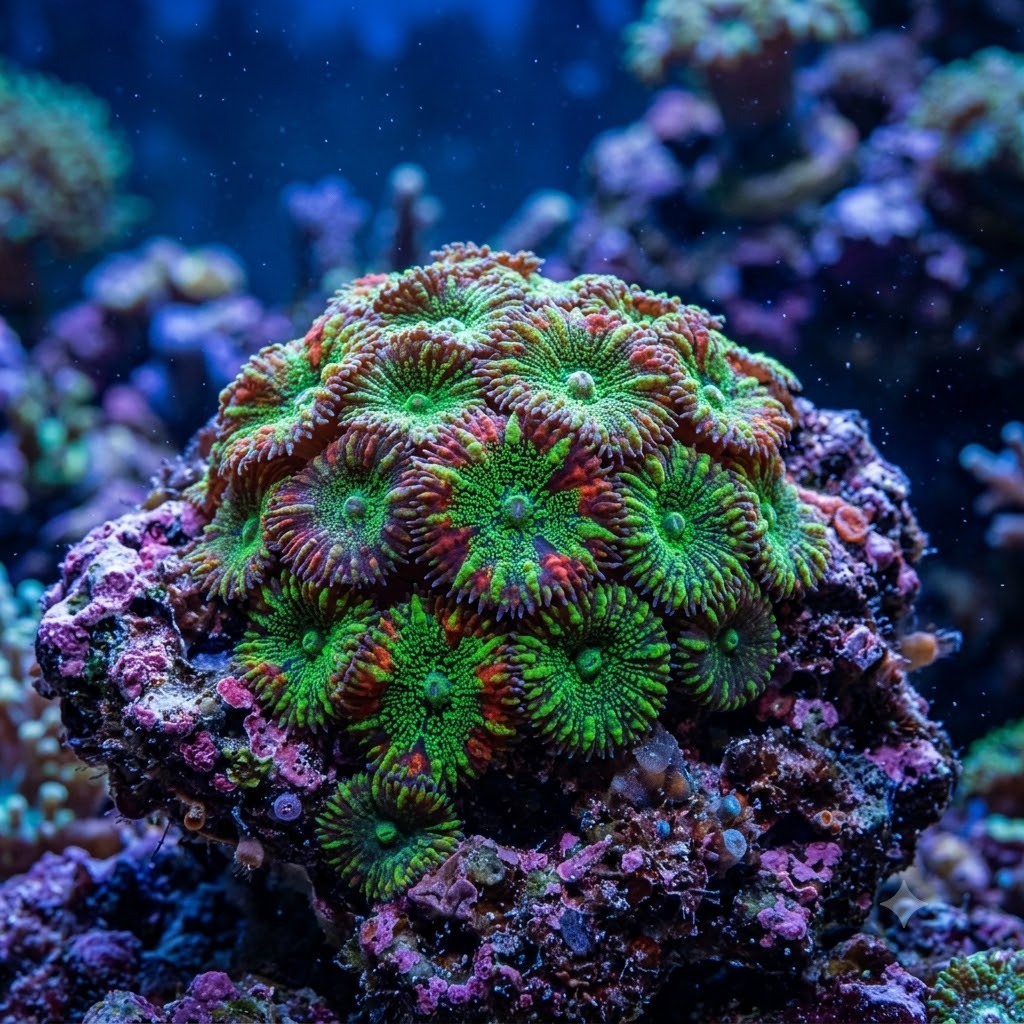
Overview
"Mushroom coral" is a trade nickname, not a species. It covers the corallimorphs - an order of skeleton-free animals that sit between anemones and stony corals - sold under three genus names that behave quite differently in a tank. This page is the overview: what the group has in common, how to tell Discosoma, Rhodactis and Ricordea apart in a shop tank, and which one actually suits your setup.
The Three Mushrooms, Side by Side
Nearly every "mushroom" in the hobby is one of three genera, and the differences matter more than the shared nickname suggests.
- Discosoma - smooth, flat discs with no raised mouth cone, 2-8 cm across. The most forgiving of the three and the cheapest. Best pick for a first coral.
- Rhodactis - textured, bumpy or "hairy" discs, often larger. Just as hardy, and the bigger ones will genuinely eat meaty food. Fancy bounce morphs come from this genus and carry collector prices.
- Ricordea - covered in tight bead-like vesicles, the most vividly fluorescent of the three. R. florida is Caribbean, R. yuma Indo-Pacific; yuma wants a bit more light than the others and is the fussiest mushroom you are likely to meet.
If you are choosing blind: Discosoma for a low-light beginner tank, Rhodactis if you want size and texture, Ricordea if colour is the whole point and your lighting is decent.
Origin & Habitat
All three genera live on tropical reefs - Ricordea florida in the Caribbean and western Atlantic, the rest across the Indo-Pacific from the Red Sea to the central Pacific. The shared habitat is the part worth remembering: shaded ledges, rubble zones, lagoon walls and lower reef slopes, where light is diffuse, flow is gentle and the water carries more nutrients than the reef crest. That niche is why mushrooms tolerate the imperfect conditions of a young aquarium so well.
Appearance
Every corallimorph is a soft, disc-shaped polyp attached to rock by a short foot, with no hard skeleton underneath. Surface texture is the giveaway between genera - smooth for Discosoma, bumpy or fuzzy for Rhodactis, beaded for Ricordea. Colours run through green, red, blue, purple, brown and metallic mixes, often with a contrasting mouth. Discs curl their edges when the light is too strong, when they are catching food, or when something in the water is off.
The One to Watch Out For
Two large corallimorphs are sold in the same tanks under the same "mushroom" label and are not reef-safe with small fish: **elephant ear mushroom (Amplexidiscus fenestrafer)** and the largest Rhodactis forms. They can fold the disc shut like a purse around a sleeping fish or shrimp and digest it. A palm-sized "mushroom" with a deep funnel shape is not a beginner Discosoma - ask what species it is before it goes in a tank with gobies, firefish or cleaner shrimp.
Placement & Temperament
Mushrooms have no stinging sweeper tentacles, so they will not burn a neighbour the way a torch or a hammer coral does. Their weapon is patience: they bud, detach and re-attach, and a happy patch will carpet the rock it started on and shade out slower corals over months. Give them a defined low or mid-level rock, or their own island, with a couple of centimetres of clear space around anything you care about. Keep them off bright, high-flow peaks - that is where they detach and go wandering into a powerhead.
Tank & Water Conditions
Salinity 1.024-1.026, temperature 24-27 C (75-81 F), alkalinity 8-11 dKH, calcium 400-450 ppm, magnesium 1300-1350 ppm. Corallimorphs build no skeleton, so they draw far less calcium and alkalinity than stony corals and forgive nutrients that would bleach an Acropora. Stability beats precision here - a steady tank slightly off the textbook numbers keeps mushrooms happier than a perfect one that swings.
Lighting & Flow
Low to moderate light, roughly 40-100 PAR, and gentle indirect flow across the whole group; Ricordea yuma sits at the upper end of that range, Discosoma at the lower. Under strong light mushrooms pale, shrink and eventually let go of the rock. Under strong flow the discs never open fully. If a mushroom keeps detaching from one spot, it is telling you that spot is too bright or too turbulent.
Feeding
All three host symbiotic zooxanthellae and get most of their energy from light, so target feeding is optional. The textured genera capture particles better than the smooth ones: hairy Rhodactis and larger Ricordea will take finely chopped meaty food or a coral blend once or twice a week and grow noticeably faster for it. Discosoma rarely needs anything beyond light and the nutrients already in the water.
Health & Growth
This is the hardiest group of corals in the hobby and the usual advice for a first purchase. Growth happens by budding and splitting rather than skeletal build-up, so a single polyp becomes a patch in months. Warning signs are the same across genera: discs that stay puckered for days, thinning or bleaching (too much light), a slimy or shrinking disc (a parameter swing or irritation), and detaching. Most of it reverses once the light, flow or stability problem is fixed. Fragging is as simple as coral gets - a clean cut through the disc with a sharp blade gives two polyps, both of which heal.
Sourcing
Mushrooms propagate so readily that tank-raised frags are everywhere and cheap; choose aquacultured or hobbyist-fragged stock over wild-collected rock. Corallimorphs are not covered by the CITES listing that applies to stony corals (Scleractinia), so the paperwork question that comes up with hard corals does not apply here - but the responsible choice is still propagated stock, and it arrives already adapted to aquarium life. If a shop cannot tell you which genus a mushroom is, that is worth knowing before you buy, not after.
Pros & Cons
Pros
- The most forgiving corals available - a realistic first purchase
- Thrive on low light and gentle flow, so a modest setup is enough
- Spread on their own and frag with a single cut
- No sweeper tentacles, so no chemical warfare with neighbours
Cons
- Spread into a carpet and crowd slower corals over time
- Loose polyps drift into pumps and overflows
- The largest species can eat small fish and shrimp
- Colour fades under lighting meant for stony corals
Mushroom Coral - frequently asked questions
What is the difference between Discosoma, Rhodactis and Ricordea?
Texture, mostly. Discosoma discs are smooth and flat, Rhodactis are bumpy or hairy and often larger, Ricordea are covered in tight bead-like vesicles and fluoresce hardest. Care is broadly the same, except that Ricordea yuma wants a little more light and big Rhodactis will eat meaty food.
Are mushroom corals safe with small fish?
The common small ones are. The exceptions are elephant ear mushroom (Amplexidiscus fenestrafer) and the largest Rhodactis forms, which can close around a sleeping fish or shrimp and digest it - check the species before adding a palm-sized specimen to a tank with gobies or cleaner shrimp.
What is the easiest coral for a first reef tank?
Discosoma mushrooms and green star polyps top most lists. Mushrooms in particular shrug off low light and gentle flow, which is exactly where a young beginner tank sits.
My mushroom detached and moved - is it dying?
Usually not. Mushrooms let go and relocate when the light or flow where they sit does not suit them. Catch the loose polyp before it reaches a pump intake, put it in a low-flow spot or a frag rack, and it will re-attach within a week or two.
🧠 Test yourself: guess the exotic
Three clues from our quiz bank, each about another of our exotic. Can you name them?
Clue 1.Sold cheaply at beach shops, this pet has one oversized claw used to seal the entrance of its home.
It's the Hermit Crab - read the full profile →
Clue 2.Belonging to an order whose name means 'apparition,' this insect includes some of the longest insects on Earth.
It's the Stick Insect (Phasmid) - read the full profile →
Clue 3.With triangular head, swiveling neck, and grasping front limbs, this stick-mimicking insect strikes prey in a fraction of a second.
It's the Praying Mantis - read the full profile →