Dog Car Travel Safety 2026
Honest guide to dog car safety in 2026 - which harnesses pass real crash testing, when crates beat harnesses, and what the data says about loose dogs in cars.
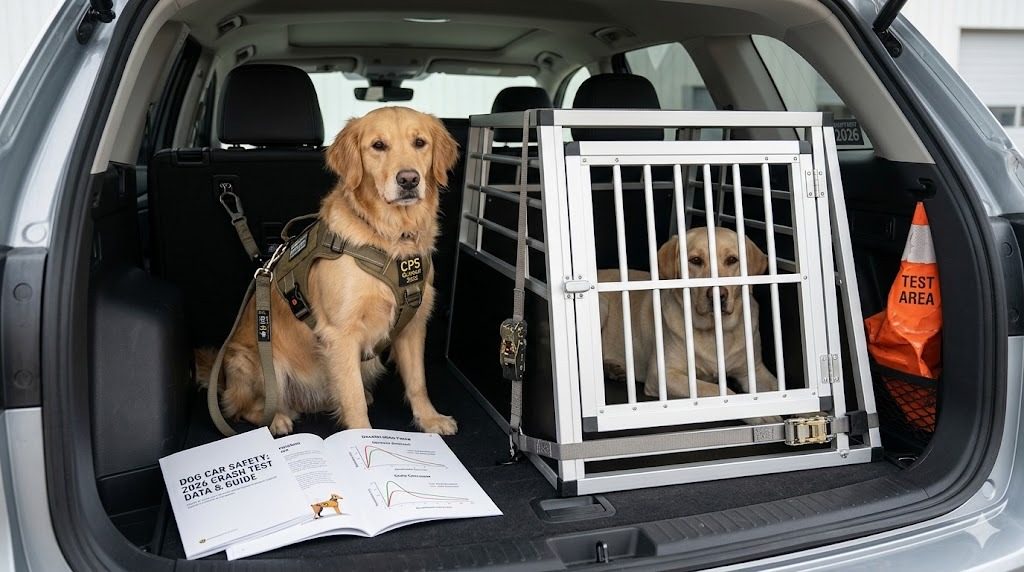
For dog car safety, the only setups backed by real crash testing are a harness certified by the Center for Pet Safety (Sleepypod’s is the standout) used on the back seat, or a genuinely crash-tested crate in the cargo area. Most “crash-tested” Amazon harnesses fail at real crash speeds, so look for the CPS certification, not the marketing.
The marketing on dog car safety products is mostly nonsense. Almost every “crash-tested” harness on Amazon will fail at the speeds a real crash happens. Almost every crate sold as “vehicle safe” was tested for door durability, not occupant protection. The actual data - published quietly by the Center for Pet Safety since 2013 - is brutal and unflattering to the industry.
This guide cuts through that. We’ll cover what the crash data actually shows, the small handful of products that have passed independent testing, and the realistic trade-offs between harnesses, crates, and barriers - which come down largely to your dog’s size, so check the weight ranges in our dog breed guides. The honest answer for most dogs is more boring than the product industry would like.
Why This Matters More Than Owners Think
A 60-pound dog in a 35-mph crash exerts roughly 2,700 pounds of force on whatever stops it - usually the back of the front seats, the windshield, or another passenger. An unrestrained dog isn’t just at risk; it’s a projectile that endangers everyone in the car. Even at 25 mph, a small dog can break a child’s ribs.
Owners consistently underestimate this. AAA surveys show that fewer than 20% of dog owners restrain their dog in the car, and of those who do, most use products that have never been tested at highway speeds.
What “Crash Tested” Actually Means
There is no government safety standard for pet car restraints in the United States. Any manufacturer can write “crash tested” on a label without specifying:
- What speed the test was conducted at
- What weight of dog (a test dummy)
- Whether the harness, the dog, or both survived
- Whether the dog was injured even if “contained”
The only meaningful independent benchmark is the Center for Pet Safety (CPS) certification, which tests at 30 mph using weighted dog dummies. CPS publishes pass/fail results. Most popular harnesses fail.
The Honest Pick: CPS-Certified Harnesses
As of 2026, very few harnesses pass CPS testing. The standout is the Sleepypod Clickit Sport and Terrain series, which is the only harness we recommend for in-car use without reservation.
Why most harnesses fail
The cheap harnesses on Amazon use a single tether attached to a standard back D-ring. In a crash, the force concentrates on the dog’s spine or neck. The CPS tests routinely show dogs being decapitated, paralyzed, or ejected in this design.
The Sleepypod design instead spreads force across a padded chest plate via three separate attachment points. The seatbelt routes through a dedicated channel, not through a flimsy fabric loop.
When a Crate Beats a Harness
For dogs over 75 pounds, a crash-tested crate in the cargo area generally outperforms any harness. The crate creates a rigid containment zone and prevents the dog from being launched.
CPS has tested only a handful of crates. The Gunner Kennels G1 series passes at 30 mph and has Subaru certification. It costs $500-800, which is more than most owners want to spend - but for SUV and truck owners with large dogs, it’s the only crash-tested solution.
For most owners, a less expensive plastic airline-style kennel strapped down with cargo straps is a reasonable middle ground - not crash-certified but dramatically better than loose-dog-in-back-seat.
What About Cargo Barriers?
Cargo barriers (mesh or metal dividers between back seats and cargo) prevent a dog from being launched forward into the passenger area. They do nothing to protect the dog itself. Most independent tests show dogs being thrown into the barrier hard enough to break bones.
A barrier is better than nothing. It is dramatically worse than a crate or crash-tested harness. Treat barriers as the lowest acceptable tier, not the recommended one.
The Booster Seat Question (Small Dogs)
Dog booster seats - those little elevated baskets you see on Instagram - are almost universally unsafe. They tether the dog with a short connector to a flimsy hook. In any meaningful crash, the dog is launched.
The exception: a few brands now offer crash-tested booster seats for small dogs. Look specifically for ones that route the car’s actual seatbelt through the seat itself, not just a tether to the dog.
Where to Put the Restrained Dog
Best: cargo area of an SUV (in a crash-tested crate)
The cargo area is the safest zone in a rear-end or front collision. Dogs in crates in this position have the best outcomes.
Good: rear seat (harnessed)
The rear seat is safer than the front seat. Use a harness that attaches to the latch system or the seatbelt - never to the headrest only.
Don’t: front passenger seat
Airbags deploy at speeds that can kill a dog instantly. Even if the airbag is disabled, the front seat puts the dog at higher risk in a frontal collision.
Don’t: pickup truck bed
Loose dogs in truck beds are illegal in some states for good reason. A 35-mph turn can throw a dog into traffic. If you must transport a dog in a truck bed, it needs to be in a crate strapped to the bed in multiple points.
Real-World Common Mistakes
1. Buying a harness that’s too small
A harness that fits snugly in the store may be too tight when the dog’s chest expands during deep breathing. Add a finger’s width to all fit checks.
2. Buying the wrong attachment
Many “car safety” harnesses use a stretchy bungee tether. This increases crash injury by giving the dog room to accelerate before being stopped. Use only fixed-length seatbelt connectors.
3. Treating familiarity as safety
A dog that’s traveled in your lap for years isn’t safer because it’s used to it. The day there’s a crash, that history matters zero.
4. Crating without anchoring
A loose crate in the cargo area becomes a projectile of its own. Use cargo straps through the door slots and tie-down points.
5. Letting the dog hang out the window
The eye damage from debris and wind is real, the bug strike injuries are real, and a sudden bird or squirrel can prompt a dog to jump from a moving car. Crack the window 3 inches, not 12.
Cost vs. Risk Calibration
Here’s a rough framework based on how often you drive with your dog:
| How often you drive with dog | Reasonable spend on safety |
|---|---|
| Rarely (vet visits only) | $50-100 (basic harness) |
| Weekly (parks, errands) | $100-200 (CPS-certified harness) |
| Daily (work, regular travel) | $200-500 (harness + travel crate) |
| Frequent road trips | $500-1000 (Gunner-tier crate) |
Most owners are in the “weekly” tier and should own a CPS-certified harness. Anyone doing multi-hour highway trips with a large dog should consider a Gunner kennel.
What to Pack for Long Trips
- Water bottle and collapsible bowl (our water intake calculator helps you plan how much to pack)
- Cooling mat or frozen towel (heat is the #1 travel killer)
- Familiar blanket or bed (anxiety reducer)
- Pickup bags
- Pet first aid kit
- Recent photo of dog (in case of escape during a rest stop)
- Vaccination records (if crossing state lines)
Frequently Asked Questions
Are there any government regulations on dog car restraints?
In the U.S., no federal standard exists. A handful of states (New Jersey, Hawaii, Rhode Island) have laws against unrestrained pets in cars but enforce them mainly as part of distracted-driving citations.
What’s the safest position in the car?
Cargo area of an SUV in a crash-tested crate, followed by rear seat in a crash-tested harness. Front passenger seat with airbag enabled is the most dangerous.
Can I use a regular walking harness with a seatbelt?
No. Walking harnesses are designed for sustained pulling, not single-event crash forces. The D-ring will rip out or the harness will tear. Always use a car-specific harness.
Are bungee tethers safer because they absorb impact?
Counter-intuitively, no. CPS testing shows bungee tethers worsen outcomes by giving the dog room to accelerate before deceleration. Fixed-length tethers are safer.
Should I disable the passenger airbag if my dog rides shotgun?
The right answer is: don’t put your dog in the front seat. If you must, yes, disable the airbag - but the rear seat is still safer.
My dog gets carsick. Does this affect safety choices?
Yes - a sick dog moving around the car is a distraction risk. Crate-trained dogs often do better in enclosed spaces, and our pet behavior problem-solver covers building calm car associations. Consult your vet about anti-nausea medication for longer trips.
Final Word
The dog car safety industry is overdue for regulation, and until that happens, the burden falls on owners to filter the noise. The shortlist is small: Sleepypod for harnesses, Gunner for large-dog crates, Petmate strapped down as a budget compromise.
Don’t trust “crash tested” claims unless backed by CPS certification. The hour you spend learning to use a real safety harness is worth more than 50 hours of comparison shopping for a bad one.
Related Reading
Last updated: May 2026.