Ways to Remember Your Pet
Gentle, concrete memorial ideas: a planted tree or shrub, a memory box, paw prints, photo books and letters, donations in your pet's name, and what grief counsellors say about when a next pet makes sense.
 AI illustration
The best pet memorial is the one you will actually visit - in the garden, on a shelf, in a book you can open. There is no correct format, no minimum budget and no deadline. Humane World for Animals suggests marking the loss with a bereavement ritual of your own, and many of the ideas below come from its list. Take one idea or none; the remembering matters more than the object.
In the garden: living memorials
Living memorials suit people who want somewhere to go.
- A memorial tree or shrub. Humane World suggests planting a native tree or a flowering shrub in memory of your pet.
- Ashes in a special place. It also suggests spreading your pet’s ashes somewhere special, or keeping a place in your home for the ashes and photos. If you want to bury ashes under a new plant, ask the crematorium how best to do it.
- A favourite-spot marker. If your pet had a sunbathing corner or a lookout post, mark it with a stone, a small border or a solar lantern.
- A memorial stone. Humane World mentions commissioned memorial stones; a hand-painted stone made at home costs nothing, and weatherproof paint pens with a clear sealant help it last outdoors.
- A container version for renters: a large planted pot with a small marker moves with you between homes.
If you plan to bury your pet at home, check the rules where you live first. They differ between countries and local areas, and your local authority can tell you which apply.
Keepsakes: something to hold
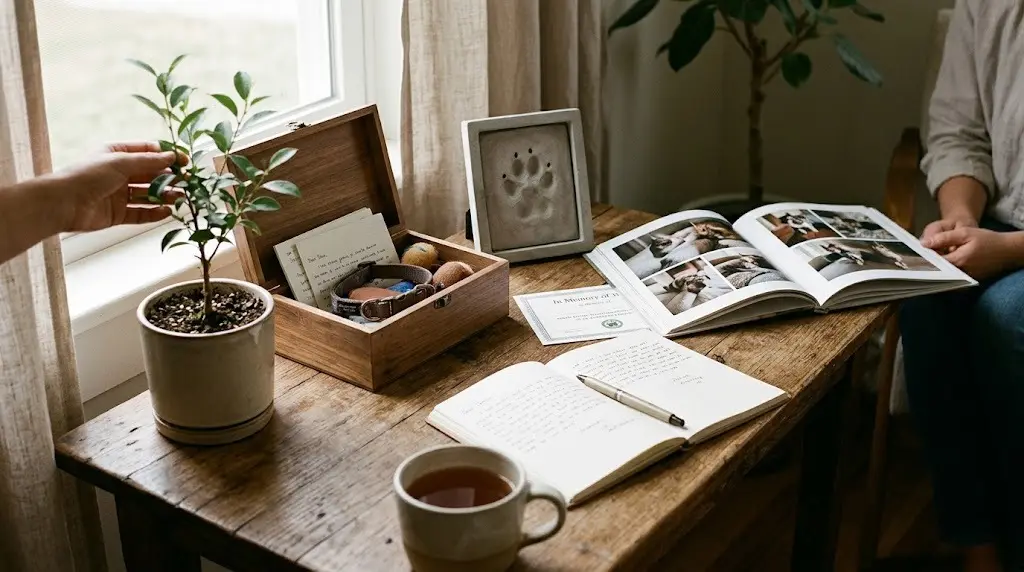
- A memory box. Humane World suggests a box with your pet’s collar or favourite toys. A shadow box behind glass, with the collar, tag, a toy, a photo and perhaps a paw print, works the same way and can be a family project.
- Paw and nose prints. Ask your vet or the crematorium whether they can take a print. If your pet is still with you and you are reading this ahead of time, a clay or ink print taken on a calm afternoon is easier on everyone.
- Fur and whiskers. A small clipping of fur in a locket or keepsake jar, or whiskers found around the house, cost nothing.
- The collar and tag. On a hook beside a photo, in a shadow box, or clipped to your keys for a while.
- Jewellery and glasswork with ashes. Humane World mentions necklaces, bracelets, rings and suncatchers that include a pet’s ashes. Quality and prices vary widely, so read recent reviews carefully, and consider sending only a small portion of the ashes rather than all of them.
- A portrait or figure. Humane World also mentions commissioning a painting, a statue or a plush figure of your pet.
Paper and pixels: the story kept
- The photo book. Include the ordinary photos, not just the flattering ones, and let everyone in the household pick a few pages.
- A letter or an obituary. Humane World suggests writing about your feelings, writing a letter to your pet about everything you would like to say, or writing an obituary. One page on their habits and sounds, the spot where they waited every evening, their opinion of the vacuum cleaner, keeps details that are vivid today.
- Sharing. Humane World also mentions sharing photos and memories of your pet on social media, if that feels right.
- A video compilation. A minute or two of clips with their sounds - the bark, the purr, the jingle of the tags - keeps what photos cannot. It is fine to make it now and watch it much later.
Children
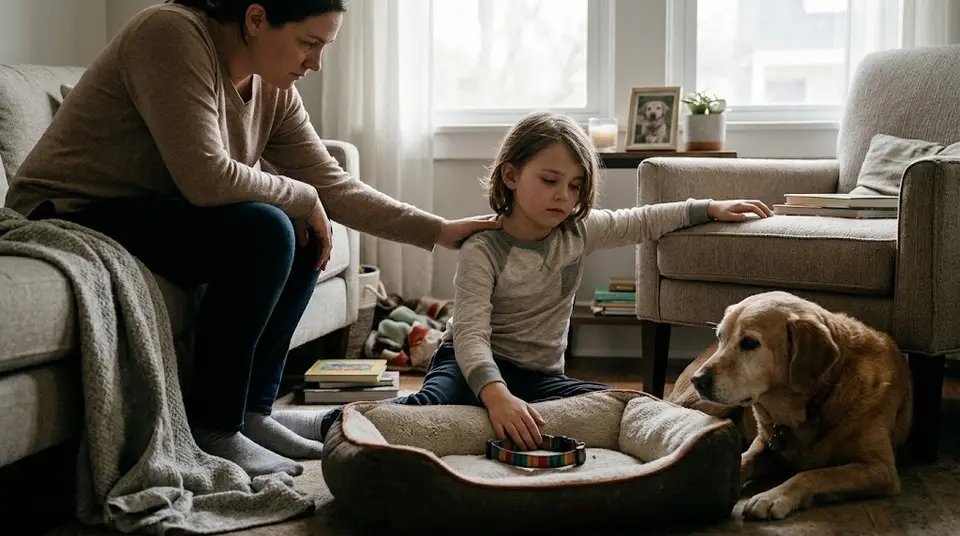
Humane World advises telling children the truth in a way that suits their age rather than saying the pet ran away, and letting them say goodbye if the death is expected. It suggests children can join in mourning rituals that suit their age, such as drawing pictures of their pet, writing to it or sharing happy memories. Their drawings belong in the photo book too.
Generosity as memorial
Some memorials help the animals still waiting.
- A donation in your pet’s name. Many shelters and animal charities accept memorial gifts; Humane World runs one itself.
- Donate the things. Unopened food, beds, crates and leads can help a shelter. Ask first what it can accept, especially for medicines.
- Sponsor an animal. Ask your local rescue whether it has a sponsorship scheme for older or hard-to-home animals.
- Volunteer or foster, later, when there is room in you for it.
When to welcome the next one
Cornell’s Pet Loss Support Hotline answers this question directly: there is no “correct” time to get another animal. Some people feel they can and should get another soon, and Cornell says the joy a new pet brings should not be tinged with guilt; for others, years pass before the time feels right.
- A new pet, not a replacement. Cornell notes that no animal can replace the relationship you had with the one you lost, and that expecting it to would be unfair to the new animal, while every animal brings its own uniqueness.
- Be ready for what it takes. Cornell’s advice is to make sure you are prepared for the time and emotions a new pet needs, and that if looking at animals brings up too many painful memories, it is fine to stop and wait.
- Older owners. Humane World notes that for older owners the decision can be complicated by the chance that a pet may outlive them, or that one day they may not be able to care for it physically.
- There is no disloyalty in either direction. Adopting soon does not cheapen the old love, and waiting years, or never adopting again, does not overstate it.
When the time comes, our pet match quizzes can make the choosing thoughtful rather than impulsive, and if a new arrival stirs up unexpected problems, the problem solver is there. If adoption becomes part of your story, our adoption and breed resources will be there when you are ready.
The short version
- Pick the memorial that matches your comfort: a place (tree, shrub, stone), an object (memory box, paw print, collar), a story (photo book, letter, video) or generosity (donations, sponsorship, fostering).
- Free counts: a painted stone, a written page, the tag on your keyring.
- Check local rules before a home burial, and research ashes jewellery before you send anything.
- Let children make something, and tell them the truth.
- A next pet has no correct timing: a new relationship, never a replacement.
However you remember them, the remembering itself is the memorial.
Sources
- Humane World for Animals (formerly the Humane Society of the United States), “How to cope with the death of your pet” (read 28 October 2026): humaneworld.org
- Cornell University College of Veterinary Medicine, Pet Loss Support Hotline, “FAQs” (read 28 October 2026): vet.cornell.edu
Recommended Gear on Amazon
- Paw print casting kit - browse current options and reviews on Amazon.
- Memorial stone - browse current options and reviews on Amazon.
- Photo frame - browse current options and reviews on Amazon.
As an Amazon Associate, we earn from qualifying purchases - at no extra cost to you. This helps us keep producing free, in-depth guides.