Mobility Aids for Aging Pets
Ramps, pet steps, slings and harnesses, wheelchairs and floor grip for older dogs and cats: which aid fits which problem, the signs that need a vet first, and what to check before you buy.
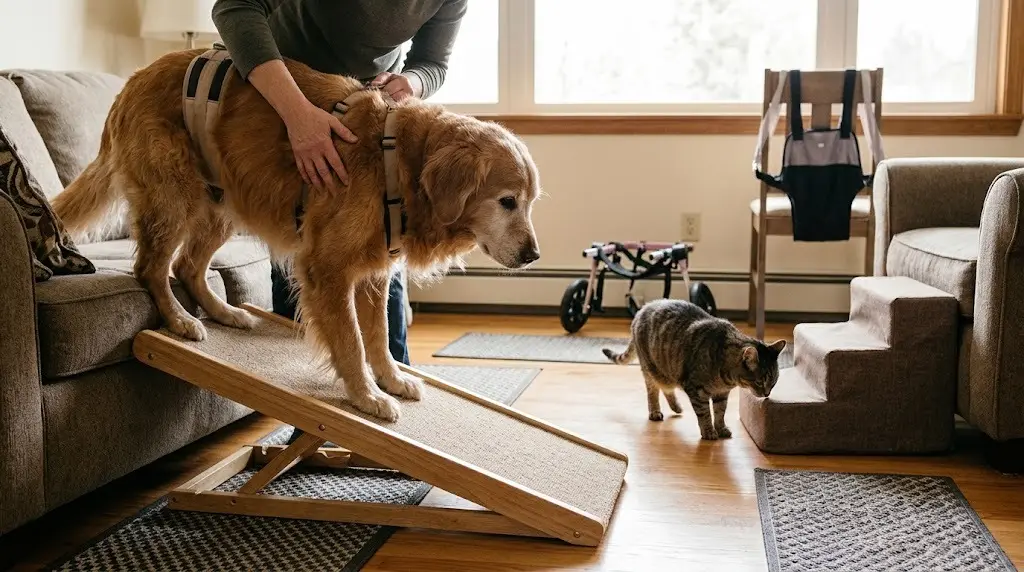 AI illustration
Not veterinary advice. This is general information only. For anything medical, your vet is the right person to ask, and the aids below support a vet’s plan rather than replace it.
The right mobility aid depends on what your pet can still do. Cornell’s Riney Canine Health Center, in its advice for dogs losing strength in the hind legs, lists the same household aids this guide covers: rugs, carpets or yoga mats on hard floors, ramps or steps where needed, a sling or harness to help with walking and standing, booties to protect scuffed paws, and a wheelchair to support the hind limbs. International Cat Care gives a similar list for cats with arthritis. Match the aid to the problem, and let your vet name the problem first.
Start with the problem, not the product
Before buying anything, watch your pet for a few days and name the difficulty:
| What you see | What the sources suggest |
|---|---|
| Hesitates or refuses to jump onto the sofa, bed or windowsill | Ramp or steps (Cornell, International Cat Care) |
| Slips on hard floors | Rugs, carpets, yoga mats or other mats; nails and foot hair kept trimmed (Cornell, International Cat Care) |
| Struggles to stand up or walk steadily | Sling or harness to help with walking and standing (Cornell) |
| Scuffs or drags its back paws | Vet first; booties to protect scuffed paws (Cornell) |
| Hind legs failing | Vet first; a wheelchair can be considered (Cornell) |
| Cat struggles to get into the litter tray | A tray with at least one low side (International Cat Care) |
The vet comes first because the same signs can have different causes. Cornell lists difficulty rising, hind limb weakness, loss of coordination, muscle loss and scuffed toenails on the hind limbs among the signs of degenerative myelopathy, a spinal cord disease, and says several tests may be needed to rule out other spinal problems. International Cat Care notes that cats may not show many signs in the clinic, and suggests filming your cat going up stairs or jumping down from a chair to show your vet. If you are still narrowing down what is going on, our problem solver can help you organise what you have noticed.
Ramps and steps
Both let a pet reach the sofa, the bed or the car without jumping. What to check before you buy:
- Slope. For a given height, only a longer ramp gives a gentler slope, so a high car boot needs a long ramp.
- Surface. A textured, grippy walking surface.
- Width and stability. Wide enough for your pet to walk normally, steady under its full weight, with a weight rating above your pet’s weight.
- For a car ramp, its own weight. You will lift it on every trip; the listing states it.
- For steps: a low rise per step, a tread deep enough for your pet’s whole body, and a non-slip base.
For cats, International Cat Care suggests a series of steps or a ramp up to high places such as the sofa, a windowsill or the cat flap, and making sure food, water and litter trays can be reached without climbing stairs. Weights and sizes for specific breeds are in our dog guides.
Slings and support harnesses
Cornell lists a sling or harness among the ways to help a weakening dog walk and stand. You will find three broad types for sale:
- Handle harnesses: a walking harness with a handle over the back, worn during the day, for a steadying hand on stairs or into the car.
- Rear-support slings: a padded band under the belly or hips with handles on top, put on when needed.
- Full-body support harnesses: front and rear sections with lifting handles, for dogs that need help many times a day.
Whichever you choose, ask your vet which level of support fits your dog. Fit it snug but not tight at the armpits and groin, with padding wide enough to spread the load, and check the skin under the straps for rubbing, especially in the first days.
Wheelchairs (carts)
Cornell lists considering a wheelchair to support the hind limbs among the management options for dogs with degenerative myelopathy. Carts are sized from your dog’s own measurements following the maker’s guide, so measure carefully, and make the decision on timing and fit together with your vet or a veterinary rehabilitation practitioner.
Floor grip
Sometimes the aid a pet needs is grip. Cornell suggests rugs, carpets or yoga mats on hardwood or tiled floors, and keeping the nails and the hair on your dog’s feet trimmed to help with walking. International Cat Care suggests mats around the home to make slippery floors easier and trimming a cat’s claws when needed. For dogs that scuff their paws, Cornell suggests booties.
Helping a pet get used to a new aid
Go slowly and keep it pleasant: let your pet look at and sniff the ramp, steps or harness first, reward calm interest with treats, and make each step small. Never force a nervous pet onto a ramp, and stay close the first few times it uses one so it does not slip or fall.
The rest of the plan
Aids are one part of a bigger picture. Cornell’s list for dogs with degenerative myelopathy also includes physical therapy to help maintain muscle, keeping a healthy weight, and dealing with other problems such as arthritis that add to the difficulty. International Cat Care adds that extra weight puts strain on sore joints. These are conversations for your vet.
The short version
- Match the aid to the problem: ramps or steps instead of jumping, a sling or harness for help walking and standing, a wheelchair when the hind legs fail.
- New weakness, wobbling or scuffed paws mean vet first, shopping second.
- Ramps: long enough for a gentle slope, grippy and steady. Steps: low rise, deep tread, no wobble.
- Rugs or mats on slippery floors, and nails and foot hair kept short.
Sources
- Cornell University College of Veterinary Medicine, Riney Canine Health Center, “Degenerative myelopathy” (read 28 October 2026): vet.cornell.edu
- Cornell University College of Veterinary Medicine, Riney Canine Health Center, “Senior dog dementia”, for keeping nails and foot hair trimmed (read 28 October 2026): vet.cornell.edu
- International Cat Care, “Arthritis in cats” (read 28 October 2026): icatcare.org
Recommended Gear on Amazon
- Lifting harness - browse current options and reviews on Amazon.
- Pet ramp - browse current options and reviews on Amazon.
- Non-slip floor runners - browse current options and reviews on Amazon.
As an Amazon Associate, we earn from qualifying purchases - at no extra cost to you. This helps us keep producing free, in-depth guides.