Airedale Terrier
The Airedale Terrier is the largest of all terriers, earning the nickname "King of Terriers." Bred in the Aire Valley of Yorkshire as an all-purpose working dog, the Airedale combines the boldness and drive of a terrier with the size and versatility of a hunting and guarding breed.
🗓️ Last reviewed: July 2026
Overview
The Airedale Terrier is the largest of all terriers, earning the nickname "King of Terriers." Bred in the Aire Valley of Yorkshire as an all-purpose working dog, the Airedale combines the boldness and drive of a terrier with the size and versatility of a hunting and guarding breed. It is smart, energetic, independent-minded, and endlessly curious - a dog that can turn its paw to almost anything, from hunting vermin to serving as a war messenger. This is a big terrier with a big personality, and it rewards owners who match its intelligence with structure and its energy with real activity.
History & Origins
The Airedale emerged in the mid-19th century in the industrial valleys of West Yorkshire, along the River Aire. Working-class hunters and factory workers wanted a single dog that could hunt rats along the riverbanks, work larger game, and guard the home. They crossed the now-extinct Old English Black and Tan Terrier with the Otterhound, producing a large, water-capable, hard-working terrier with a keen nose and a fearless nature.
The breed was first shown in the 1860s and standardised over the following decades. Its versatility made it famous. Airedales served extensively in World War I as messenger and sentry dogs, carrying communications across battlefields and locating wounded soldiers. Many showed remarkable courage under fire. The breed also worked as a police and guard dog across Britain, Europe, and the United States before the German Shepherd rose to dominance in those roles.
Airedales were hugely popular in the early 20th century - three American presidents kept them. Today the breed is less common but still valued as a companion, working terrier, and versatile family dog.
Appearance
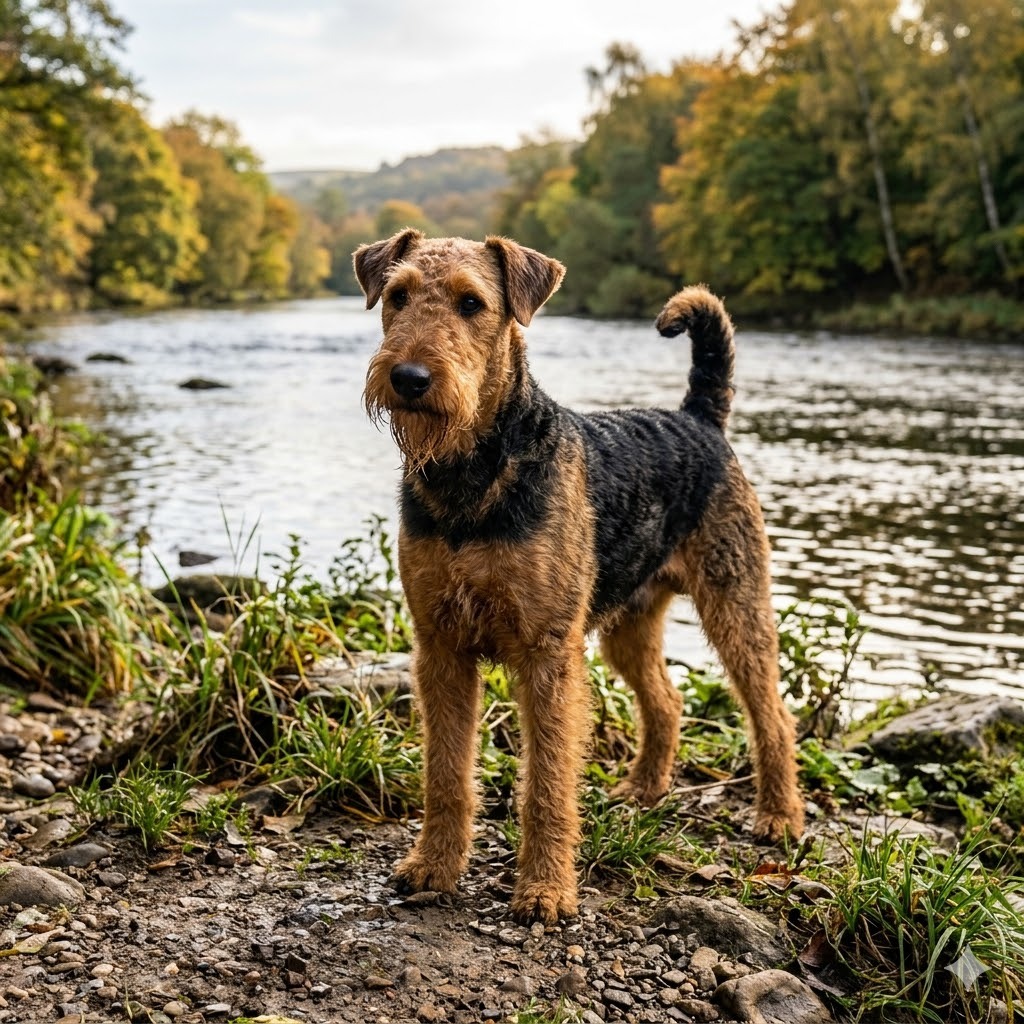
The Airedale is a sturdy, square, well-muscled dog. Males stand around 58-61 cm (23-24 in) at the shoulder and typically weigh 20-30 kg (44-66 lb); females are slightly smaller. The build is athletic and balanced, giving an impression of strength without heaviness.
Key features:
- Coat: hard, dense, wiry outer coat over a softer undercoat. The texture is crinkly rather than curly.
- Colour: the classic terrier tan-and-black (or grizzle) pattern - a tan head, ears, legs, and underside, with a black or dark grizzle "saddle" over the back and sides.
- Head: long and flat, with a strong muzzle and a distinct beard that gives the breed its characteristic terrier expression.
- Eyes: small, dark, keen and full of intelligence.
- Ears: small, V-shaped, folding to the side.
- Tail: set high and carried upright; traditionally docked, though natural tails are common where docking is banned.
Temperament & Character
The Airedale is confident, alert, and playful, with a strong independent streak. It is deeply loyal to its family and often forms a particularly close bond, but it is not a soft or biddable dog by nature - it thinks for itself and will test boundaries. Bored Airedales become inventive and often destructive.
The breed has a good sense of humour and a mischievous side; many owners describe living with an Airedale as sharing the house with a clever, headstrong comedian. It is protective without being aggressive, and makes an excellent watchdog, quick to alert but rarely reactive when well socialised.
As a terrier, the Airedale carries strong prey drive and can be scrappy with unfamiliar dogs, particularly of the same sex. Early and ongoing socialisation matters. With children in its own family the breed is typically affectionate and tolerant, though its size and exuberance mean it can knock over toddlers. Small pets such as rodents are rarely safe around an unmanaged Airedale.
Care
Coat & Grooming
The wiry double coat needs regular attention. To keep the correct hard texture and rich colour, the coat should be hand-stripped - the dead hairs plucked out by hand or with a stripping knife - two to three times a year. Clipping is easier but softens the coat and dulls the colour over time, and clipped coats shed more.
Between strippings, brush two or three times a week to prevent matting, especially in the beard and legs. The beard traps food and water and needs regular cleaning. Airedales shed relatively little when the coat is properly maintained, which is part of their appeal. Clean ears weekly, trim nails every few weeks, and brush teeth regularly.
Exercise & Activity Needs
The Airedale is a genuine working breed and needs substantial daily exercise - at least 60-90 minutes of active work, plus mental engagement. Long walks, running, hiking, swimming, and vigorous play all suit the breed. Airedales excel at agility, obedience, tracking, and earthdog and hunting activities.
Mental stimulation is as important as physical exercise. This is a problem-solving dog that becomes destructive, vocal, and difficult when under-exercised or bored. Puzzle games, training sessions, and varied outings keep an Airedale balanced. A securely fenced yard is valuable, as the breed's prey drive and curiosity make it a determined explorer.
Health & Lifespan
Average lifespan is 11-14 years. The Airedale is a generally robust breed, but responsible breeding and health screening matter.
Common concerns:
- Hip dysplasia.
- Hypothyroidism.
- Skin conditions and allergies - the breed can be prone to dermatitis.
- Bloat (GDV) - a risk in deep-chested dogs.
- Progressive retinal atrophy and other eye conditions.
- Certain cancers, including lymphoma, in older dogs.
Buying from a breeder who screens for hips, eyes, and thyroid function reduces risk. Keeping the dog lean and fit supports long-term joint and organ health.
Feeding & Nutrition
An adult Airedale typically eats around 2-3 cups of quality food per day, split into two meals; active and working dogs need more. The breed does well on a balanced diet appropriate to its life stage and activity level.
Because of the bloat risk, avoid a single large daily meal and heavy exercise immediately before or after eating. Slow-feeder bowls help fast eaters. Monitor body condition - Airedales should stay lean and muscular, not heavy, to protect their joints. The beard tends to get messy at mealtimes and may need a wipe afterwards.
Pros & Cons
Pros
- Versatile, capable, and highly intelligent.
- Loyal and affectionate with family.
- Excellent watchdog and protector.
- Coat sheds little when properly maintained.
- Robust and athletic; a great partner for active owners.
Cons
- Independent and stubborn; not an easy first dog.
- High exercise and mental-stimulation needs.
- Strong prey drive; can be sharp with other dogs.
- Coat needs regular hand-stripping.
- Destructive and vocal if bored or under-exercised.
Best Suited For
- Active, experienced owners who enjoy training and outdoor activity.
- Homes wanting a versatile working dog or a protective companion.
- Owners committed to grooming or willing to pay for it.
- Families with older, dog-savvy children.
Not suited for sedentary households, owners wanting a soft and biddable dog, homes with small pets, or first-time owners who underestimate the breed's independence and drive.
Airedale Terrier puppy growth chart
A typical growth curve for a large breed like the Airedale Terrier, estimated from its adult weight of 20-30 kg. Puppies vary with sex, genetics and diet, so treat this as a guide - for your own puppy, use the puppy weight predictor.
| Age | Typical weight | % of adult |
|---|---|---|
| 2 mo | 4.4-6.6 kg | 22% |
| 3 mo | 6.6-9.9 kg | 33% |
| 4 mo | 8.6-12.9 kg | 43% |
| 6 mo | 12-18 kg | 60% |
| 9 mo | 16-24 kg | 80% |
| 12 mo | 18.4-27.6 kg | 92% |
| Adult | 20-30 kg | 100% |
Airedale Terrier - frequently asked questions
Why is the Airedale called the "King of Terriers"?
It is the largest of all terrier breeds and historically the most versatile - able to hunt, guard, and serve as a working and military dog. The nickname reflects both its size and its all-round capability.
Do Airedales shed a lot?
When the wiry coat is properly hand-stripped and maintained, shedding is minimal. Clipped coats shed more, which is one reason enthusiasts prefer stripping.
Are Airedales good with other dogs?
They can be, with early socialisation, but the breed has terrier boldness and prey drive and may be scrappy with unfamiliar dogs, especially of the same sex. Small pets are generally not safe around them.
Are Airedales good family dogs?
Yes, for active families. They are loyal and affectionate with their people and tolerant of children in the family, though their size and energy suit homes with older children better than those with toddlers.
Is the Airedale a good guard dog?
Yes. The breed is naturally alert, protective, and territorial, making it an excellent watchdog and deterrent, without the indiscriminate aggression of some guarding breeds.
🧠 Test yourself: guess the dog
Three clues from our quiz bank, each about another of our dogs. Can you name them?
Clue 1.Legend says this breed became all-white after a reddish terrier was mistaken for a fox and shot during a hunt.
It's the West Highland White Terrier - read the full profile →
Clue 2.With a curly, cotton-ball coat that sheds very little, this little dog was historically a popular circus and street-performer dog because it loves tricks and attention.
It's the Bichon Frise - read the full profile →
Clue 3.A tireless, people-loving bird dog, this spaniel is often used to sniff out drugs and explosives.
It's the English Springer Spaniel - read the full profile →
💛 Adoptable Airedale Terriers near you
Real dogs of this breed (and close mixes) waiting in shelters and rescues right now, live from Petfinder. We have no affiliation and earn nothing - if someone catches your eye, the link goes straight to their shelter. New to adopting? Start with our adoption guide.
Widget not loading (some ad-blockers hide it)? Search directly on petfinder.com.