Basenji (Canis lupus familiaris)
The Basenji is an ancient African hunting dog famous as the "barkless dog" - a small, elegant, catlike hound that does not bark in the usual sense but instead produces a distinctive yodel-like sound often called a "baroo." Originating in central Africa, where it was prized for flushing and tracking game, the Basenji is intelligent, intensely curious, fastidiously clean, and strikingly independent.
🗓️ Last reviewed: June 2026
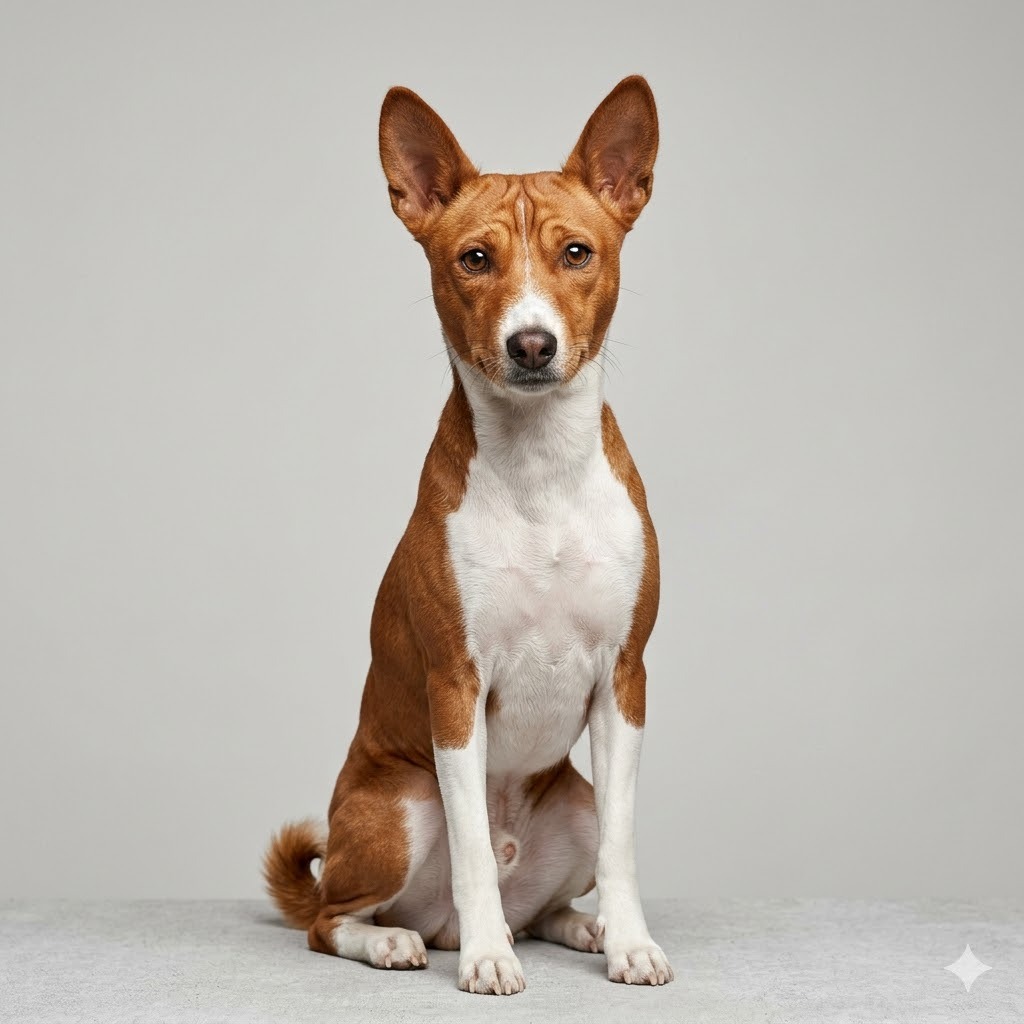
Overview
The Basenji is an ancient African hunting dog famous as the "barkless dog" - a small, elegant, catlike hound that does not bark in the usual sense but instead produces a distinctive yodel-like sound often called a "baroo." Originating in central Africa, where it was prized for flushing and tracking game, the Basenji is intelligent, intensely curious, fastidiously clean, and strikingly independent. It grooms itself like a cat, is nearly odourless, and carries itself with the poise of a small antelope. It is also one of the most challenging breeds to train, with a stubborn, self-directed streak that delights its admirers and exasperates anyone hoping for an obedient, biddable pet.
History & Origins
The Basenji is one of the oldest dog types in the world, a primitive sighthound-scenthound from central Africa with roots stretching back thousands of years. Dogs of distinctly Basenji-like type appear in ancient Egyptian art, and the breed shares genetic markers with other ancient and primitive dogs. In its homeland - particularly the Congo region - it was, and in places still is, a valued hunting dog used to track and flush game and to control vermin in villages, sometimes wearing a wooden bell so hunters could locate it in dense bush.
European explorers encountered the breed in the nineteenth century and attempted to bring specimens back to Britain, but early imports repeatedly died of distemper before the breed could be established. It was not until the 1930s that healthy dogs were successfully imported and bred in Britain and subsequently the United States. The name "Basenji" is generally translated as something like "dog of the bush" or "small wild thing from the bush."
The American Kennel Club recognised the Basenji in 1943. To broaden the breed's limited gene pool and reduce health problems, later imports of native African stock - including dogs that introduced the brindle colour - were incorporated into Western breeding programmes. The Basenji remains a relatively uncommon breed, cherished by enthusiasts who appreciate its unique, primitive character.
Appearance
A small, lightly built, square, and finely boned dog with the elegance and poise of a miniature gazelle. Adults stand roughly 40-43 cm (16-17 in) and weigh about 9-11 kg (20-24 lb), with males slightly larger. The overall impression is of grace, alertness, and aristocratic refinement.
Key features:
- Coat: very short, fine, and sleek, lying tight to the skin - one reason the breed is so easy to keep clean.
- Colour: rich chestnut red, black, tricolour (black and red), or brindle, all with white feet, chest, and tail tip.
- Forehead wrinkles: the characteristic fine wrinkles on the forehead, especially noticeable when the dog is alert, giving a worried or quizzical expression.
- Tail: set high and curled tightly over to one side, often a double curl.
- Ears: small, erect, and hooded, set well forward and slightly forward-pointing.
- Eyes: dark, almond-shaped, and far-seeing.
- Build: square, with long legs relative to the body, a level topline, and a light, swift, tireless gait.
Temperament & Character
The Basenji is alert, intelligent, energetic, and intensely curious, with a personality often described as catlike. It is affectionate with its own people, frequently bonding closely with one or two, while tending to be reserved or aloof with strangers. It is playful and mischievous but also independent and self-willed to a remarkable degree, and it is not a dog that lives to please its owner.
Several traits set the breed apart. It does not bark, instead producing a unique repertoire of yodels, chortles, and "baroo" sounds (it can also growl, whine, and scream). It grooms itself meticulously like a cat and is almost free of doggy odour. And it possesses a powerful prey drive and a keen hunting instinct, which means it will chase cats, small animals, and anything else that bolts, and its recall can be unreliable.
The Basenji is also a notable escape artist and problem-solver - capable of climbing, digging, and opening doors and latches - and it can be destructive if bored or left alone too long. It is best understood not as a typical companion dog but as a clever, independent, primitive hunter that happens to live in a home.
Care
Coat & Grooming
Grooming could hardly be simpler. The short, fine coat needs only an occasional wipe or brush with a soft brush or grooming mitt, and the breed sheds very little. Famously catlike, the Basenji grooms itself, is fastidiously clean, and is nearly odourless, so baths are rarely needed.
Routine care covers the rest: check and clean the ears regularly, trim nails roughly monthly (some Basenjis dislike having their feet handled, so accustom them young), and brush the teeth several times a week. For most owners the breed's minimal coat care is one of its great practical advantages.
Exercise & Activity Needs
The Basenji is an athletic, high-energy hunting hound that needs a good amount of daily exercise plus mental stimulation. Brisk walks, active play, and the chance to run in a securely enclosed area suit the breed well; many enjoy lure coursing, which channels their natural chase instinct. A bored, under-exercised Basenji becomes restless, vocal, and destructive.
Two cautions matter. First, the strong prey drive and unreliable recall mean off-lead freedom is risky except in fully enclosed spaces - a Basenji that spots prey will give chase and ignore commands. Second, the breed is an accomplished climber and digger, so secure, high fencing (and attention to gaps and latches) is essential to prevent escapes. Mental challenges, puzzle toys, and training games help satisfy this clever breed's busy mind.
Health & Lifespan
Average lifespan is 12-14 years. The breed is generally healthy and long-lived but has some specific concerns, several linked to its historically narrow gene pool:
- Fanconi syndrome - a serious inherited kidney disorder, well known in the breed, in which the kidneys fail to reabsorb nutrients properly. A DNA test is available, and a monitoring and treatment protocol exists; insist on parental testing.
- Progressive retinal atrophy (PRA) - an inherited eye condition that leads to blindness; a DNA test is available.
- Pyruvate kinase (PK) deficiency - an inherited form of haemolytic anaemia; a DNA test is available.
- Hip dysplasia and patellar luxation.
- Hypothyroidism and certain digestive conditions reported in the breed.
Responsible breeders DNA-test for Fanconi syndrome, PRA, and PK deficiency. Always ask for these results.
Feeding & Nutrition
The Basenji is a small, active breed and typically eats around 1-1.5 cups of quality dry food per day, divided into two meals and adjusted to size and activity. It is generally a moderate, sometimes fussy eater rather than a greedy one, and many Basenjis self-regulate reasonably well, though portions should still be measured to maintain a lean, athletic condition.
A quality diet suited to small, active dogs works well for most. Because of the breed's predisposition to Fanconi syndrome, owners should be alert to early signs such as excessive thirst and urination and follow veterinary guidance if the condition is diagnosed, as affected dogs need specific dietary and supplement support. Provide constant access to fresh water and introduce any dietary changes gradually.
Pros & Cons
Pros
- Does not bark - quiet in the conventional sense.
- Extremely clean, catlike, and nearly odourless.
- Minimal grooming and very low shedding.
- Elegant, athletic, and full of character.
- Generally healthy and long-lived for a purebred dog.
Cons
- Highly independent and stubborn - very hard to train.
- Strong prey drive and unreliable recall.
- Accomplished escape artist - needs secure, high fencing.
- Can be destructive and vocal (yodelling, screaming) if bored.
- Not suited to homes with cats or small pets, or to inexperienced owners wanting obedience.
Best Suited For
- Experienced owners who appreciate an independent, catlike, primitive breed.
- People who want a quiet (non-barking) but lively and characterful dog.
- Active households able to provide secure exercise and mental challenge.
- Homes with secure, high fencing and a tolerance for a clever escape artist.
- Owners who can enjoy the breed's stubbornness rather than fight it.
Not suited for first-time owners expecting an obedient dog, homes with cats or small pets, owners wanting reliable off-lead reliability, or anyone unable to provide escape-proof containment and consistent mental stimulation.
Basenji (Canis lupus familiaris) puppy growth chart
A typical growth curve for a medium breed like the Basenji (Canis lupus familiaris), estimated from its adult weight of 9-11 kg. Puppies vary with sex, genetics and diet, so treat this as a guide - for your own puppy, use the puppy weight predictor.
| Age | Typical weight | % of adult |
|---|---|---|
| 2 mo | 2.4-3 kg | 27% |
| 3 mo | 3.6-4.4 kg | 40% |
| 4 mo | 4.5-5.5 kg | 50% |
| 6 mo | 6.1-7.5 kg | 68% |
| 9 mo | 7.7-9.4 kg | 85% |
| 12 mo | 8.7-10.7 kg | 97% |
| Adult | 9-11 kg | 100% |
Basenji (Canis lupus familiaris) - frequently asked questions
Do Basenjis really not bark?
Correct - the Basenji does not bark in the usual way, owing to the unusual shape of its larynx. Instead it makes a distinctive yodel-like sound often called a "baroo," along with chortles, growls, whines, and even screams. It is far from a silent dog, but it does not bark.
Are Basenjis good with cats and small pets?
Generally not. The breed has a strong prey drive and may chase or harm cats, rabbits, rodents, and similar animals. Some Basenjis raised with a particular cat can coexist, but lifelong caution is advised, and the breed is not recommended for homes with small pets.
Are Basenjis easy to train?
No - they are among the most challenging breeds to train. They are very intelligent but independent and stubborn, and they will not obey simply to please. Patient, creative, reward-based training and realistic expectations are essential.
Do Basenjis shed or smell?
Very little, and almost no odour. The short, fine coat sheds minimally, and the breed grooms itself like a cat, making it exceptionally clean and one of the lowest-odour dogs there is.
Why do female Basenjis only come into season once a year?
Unlike most domestic dogs, which cycle roughly twice a year, the Basenji typically has a single annual breeding season - a primitive trait it shares with some wild canids and reflecting its ancient origins.
🧠 Test yourself: guess the dog
Three clues from our quiz bank, each about another of our dogs. Can you name them?
Clue 1.Developed in southern Africa from native dogs and European breeds, this muscular hunter is nicknamed the lion dog.
It's the Rhodesian Ridgeback - read the full profile →
Clue 2.One of the heaviest dog breeds on Earth, this gentle giant can top 200 pounds and once guarded estates and fought in arenas.
It's the English Mastiff - read the full profile →
Clue 3.Developed by English gamekeepers to pin poachers without mauling them, this giant tan or brindle guardian has a black mask.
It's the Bullmastiff - read the full profile →
💛 Adoptable Basenji (Canis lupus familiaris)s near you
Real dogs of this breed (and close mixes) waiting in shelters and rescues right now, live from Petfinder. We have no affiliation and earn nothing - if someone catches your eye, the link goes straight to their shelter. New to adopting? Start with our adoption guide.
Widget not loading (some ad-blockers hide it)? Search directly on petfinder.com.