Flat-Coated Retriever
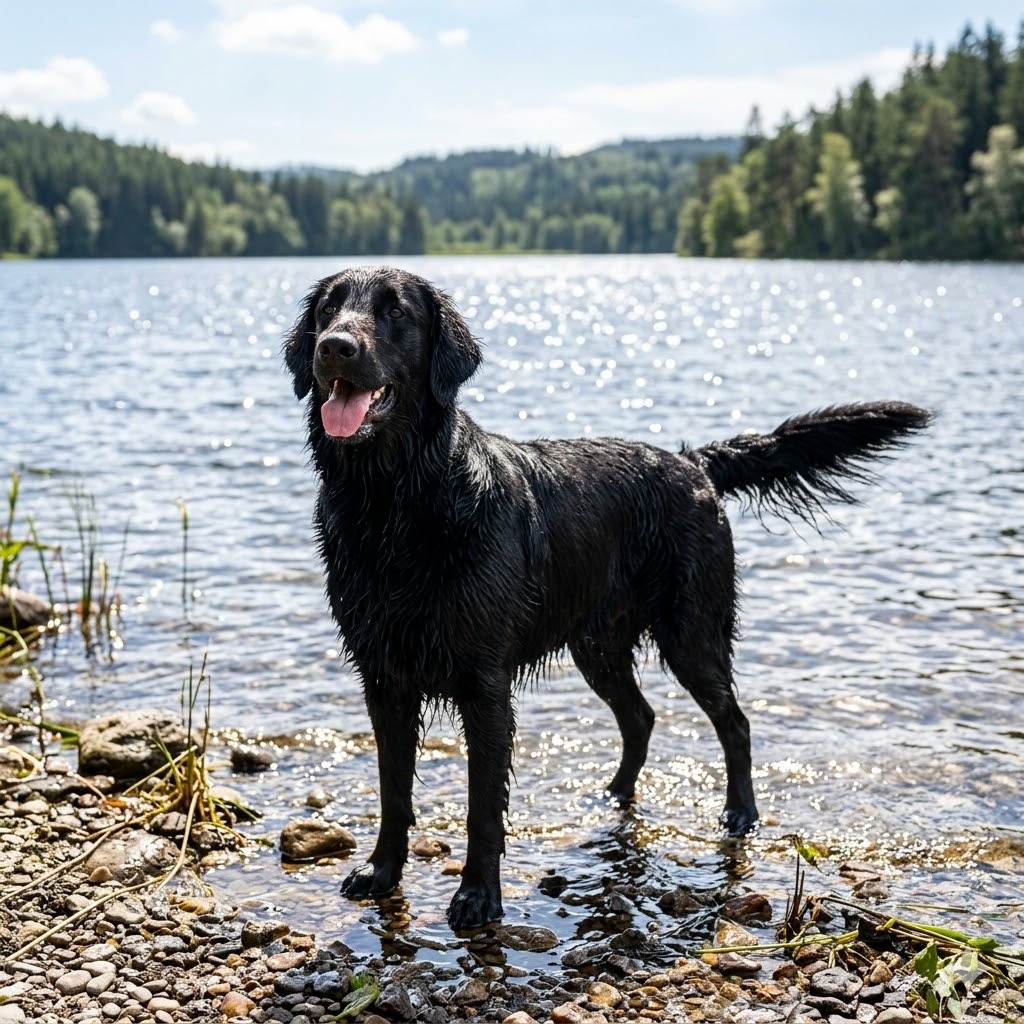
The Flat-Coated Retriever is the eternal optimist of the gundog world - a glossy, jet-black (or liver) retriever famous for a wagging tail that never seems to stop and a joyful, forever-young spirit that has earned it the nickname the "Peter Pan of dogs." Elegant, athletic, and deeply people-oriented, this is a working retriever that stays puppyish in outlook well into old age.
🗓️ Last reviewed: July 2026
Overview
The Flat-Coated Retriever is the eternal optimist of the gundog world - a glossy, jet-black (or liver) retriever famous for a wagging tail that never seems to stop and a joyful, forever-young spirit that has earned it the nickname the "Peter Pan of dogs." Elegant, athletic, and deeply people-oriented, this is a working retriever that stays puppyish in outlook well into old age. Adults weigh roughly 25-36 kg. Devoted owners adore the breed's exuberance and sweetness - though it must be said honestly that the Flat-Coat carries an unusually high cancer risk that anyone considering one should understand up front.
History & Origins
The Flat-Coated Retriever was developed in Britain during the mid-19th century, as sportsmen sought a single dog that could retrieve reliably from both land and water. Early breeders blended the St. John's water dog (ancestor of the modern retrievers) with setter, sheepdog, and possibly Newfoundland and spaniel blood, producing a stylish, versatile gundog.
By the 1870s the breed - then often called the "Wavy-Coated Retriever" - had been refined, with credit given to breeder S.E. Shirley, a founder of the English Kennel Club, for stabilising type. For a period around 1900 the Flat-Coat was the most popular retriever in Britain, a fashionable choice on shooting estates.
Its fortunes then reversed sharply. The rise of the Labrador and Golden Retriever pushed the Flat-Coat aside, and the two World Wars devastated breeding stock to the point of near-extinction. Dedicated enthusiasts revived the breed from a small base after 1945. Today it remains relatively uncommon - a deliberately preserved working retriever that has never been over-bred for popularity.
Appearance
The Flat-Coated Retriever is a medium-to-large, gracefully built dog with a distinctive long, clean "one-piece" outline - the head flowing smoothly into a level topline. Males stand 58-62 cm (23-24.5 in) and weigh 27-36 kg (60-80 lb); females are lighter, roughly 25-32 kg. The overall impression is one of power and elegance without heaviness.
Key features:
- Coat: moderately long, straight and flat (hence the name), glossy and dense, with feathering on the legs, chest, and tail.
- Colour: solid black or solid liver. No other colours are correct.
- Head: long and cleanly moulded, described as "one-piece" - a hallmark of the breed.
- Eyes: medium, dark brown to hazel, set well apart, with a warm, intelligent, kindly expression.
- Ears: small, well-feathered, lying close to the head.
- Tail: straight, feathered, carried happily and in near-constant motion.
The glossy coat and ever-wagging feathered tail give the Flat-Coat a bright, joyful presence unmistakable in the field.
Temperament & Character
If any breed embodies happiness, it is the Flat-Coat. Bright, sociable, and endlessly enthusiastic, it greets life - and everyone in it - as a friend. This is a demonstrative, affectionate dog that thrives on human company and stays mentally young for its whole life. The exuberance is genuine and constant; a Flat-Coat rarely does anything by halves.
That perpetual puppyhood is charming but demanding. The breed matures slowly, both physically and mentally, and remains bouncy, mouthy, and high-spirited long after other retrievers have settled. Owners need patience and a sense of humour.
Flat-Coats are excellent with children and typically friendly with other dogs and strangers - their sociability makes them poor guard dogs but wonderful family companions. They do not cope well with isolation and can become bored, noisy, or destructive if left alone too long or under-stimulated.
Care
Coat & Grooming
The moderate, feathered coat needs regular attention but is not high-maintenance. Brush thoroughly once or twice a week to prevent tangles in the feathering and to manage steady shedding. Pay attention to the feathering behind the ears, on the legs, and under the tail, where mats form. Occasional light tidying of the feet and ears keeps a neat outline; the breed should never be heavily clipped.
Bathe as needed - the coat is naturally somewhat water-repellent for its working role. Clean the ears weekly, especially in a dog that swims, trim nails regularly, and keep up dental care.
Exercise & Activity Needs
This is a genuine working retriever with high energy and stamina. Adults need at least 90 minutes of vigorous daily exercise - retrieving, swimming, hiking, running, and off-leash play in open space. Fetch is close to a religion for the breed, and water work is a delight.
Mental exercise matters just as much. Flat-Coats excel at gundog work, obedience, agility, and scent work, and a bored Flat-Coat quickly invents its own (usually destructive) entertainment. A tired, engaged Flat-Coat is a beautifully behaved one.
Health & Lifespan
Average lifespan is 8-11 years - noticeably shorter than most retrievers, and this must be stated honestly.
The overriding concern is cancer. The Flat-Coated Retriever has one of the highest cancer rates of any breed, and malignancies - particularly histiocytic sarcoma and other aggressive tumours - are the leading cause of death, often striking in middle age. Prospective owners should go in with clear eyes about this.
Other concerns:
- Histiocytic sarcoma and malignant histiocytosis - the signature cancers of the breed.
- Other cancers including lymphoma and osteosarcoma.
- Hip and elbow dysplasia.
- Progressive retinal atrophy and glaucoma.
- Patellar luxation.
- Bloat (GDV).
Responsible breeders screen hips, elbows, and eyes, but no test yet predicts the cancer risk, which makes choosing lines with longevity all the more important.
Feeding & Nutrition
Adults typically eat 3-4 cups of quality food per day split into two meals, adjusted for this active breed's high energy output. Working dogs need more. The Flat-Coat can be greedy and food-motivated, so portion carefully and keep the dog lean - excess weight strains joints and worsens every health risk.
Feed two meals rather than one to reduce bloat risk, and avoid hard exercise within an hour either side of eating. A large-breed puppy formula supports slow, steady growth in this slow-maturing breed.
Pros & Cons
Pros
- Joyful, affectionate, endlessly good-natured.
- Excellent with children and other dogs.
- Highly trainable and versatile working retriever.
- Beautiful, moderate-maintenance coat.
- Stays youthful and playful for life.
Cons
- Very high cancer risk and a shorter lifespan.
- Slow to mature - years of bouncy adolescence.
- Needs substantial daily exercise and stimulation.
- Mouthy and prone to jumping without training.
- Cannot tolerate long periods alone.
Best Suited For
- Active families and individuals who want a joyful, involved companion.
- Homes with time for daily exercise and training.
- Gundog, agility, or dog-sport enthusiasts.
- Owners prepared, emotionally and practically, for the breed's health realities.
Not suited for sedentary households, people wanting a calm dog quickly, owners away long hours, or anyone unable to face the elevated cancer risk and shorter life expectancy.
Flat-Coated Retriever puppy growth chart
A typical growth curve for a large breed like the Flat-Coated Retriever, estimated from its adult weight of 25-36 kg. Puppies vary with sex, genetics and diet, so treat this as a guide - for your own puppy, use the puppy weight predictor.
| Age | Typical weight | % of adult |
|---|---|---|
| 2 mo | 5.5-7.9 kg | 22% |
| 3 mo | 8.3-11.9 kg | 33% |
| 4 mo | 10.8-15.5 kg | 43% |
| 6 mo | 15-21.6 kg | 60% |
| 9 mo | 20-28.8 kg | 80% |
| 12 mo | 23-33.1 kg | 92% |
| Adult | 25-36 kg | 100% |
Flat-Coated Retriever - frequently asked questions
Why are Flat-Coated Retrievers called the "Peter Pan of dogs"?
Because they mature slowly and stay youthful, playful, and puppyish in outlook throughout their lives. Even senior Flat-Coats retain a bouncy, joyful spirit rarely seen in other breeds of their age.
Is it true they have a high cancer risk?
Yes, and it should not be glossed over. The Flat-Coat has one of the highest cancer rates of any breed, with aggressive tumours often appearing in middle age. This is the single most important thing a prospective owner must understand.
How is a Flat-Coat different from a Labrador or Golden Retriever?
The Flat-Coat is racier and more elegant, with a longer "one-piece" head, and it stays exuberant far longer. It comes only in black or liver, is far less common, tends to be more energetic and mouthy, and unfortunately has a shorter average lifespan.
Are Flat-Coats good with children?
Excellent, given supervision. They are gentle, tolerant, and playful. The main caution is their bounciness, which can accidentally knock over small children until impulse control is trained.
Do they need a lot of exercise?
Yes. At least 90 minutes of vigorous daily activity plus mental stimulation. This is a true working retriever, not a low-energy companion, and it needs an active home to thrive.
🧠 Test yourself: guess the dog
Three clues from our quiz bank, each about another of our dogs. Can you name them?
Clue 1.A medium, often black-and-white dog famous for agility and frisbee skills, it is endlessly energetic and eager to learn new tasks.
It's the Border Collie - read the full profile →
Clue 2.This small companion dog's name translates roughly to 'little lion' in Chinese, and it was bred for centuries inside imperial palaces.
It's the Shih Tzu - read the full profile →
Clue 3.Despite its name suggesting the outback, this medium herding dog was actually developed on American ranches and is often born with a naturally short tail.
It's the Australian Shepherd - read the full profile →
💛 Adoptable Flat-Coated Retrievers near you
Real dogs of this breed (and close mixes) waiting in shelters and rescues right now, live from Petfinder. We have no affiliation and earn nothing - if someone catches your eye, the link goes straight to their shelter. New to adopting? Start with our adoption guide.
Widget not loading (some ad-blockers hide it)? Search directly on petfinder.com.