Great Pyrenees (Canis lupus familiaris)
The Great Pyrenees is a giant white livestock guardian dog bred for centuries to live alone on remote mountain pastures, defending flocks of sheep from wolves and bears.
🗓️ Last reviewed: June 2026
Overview
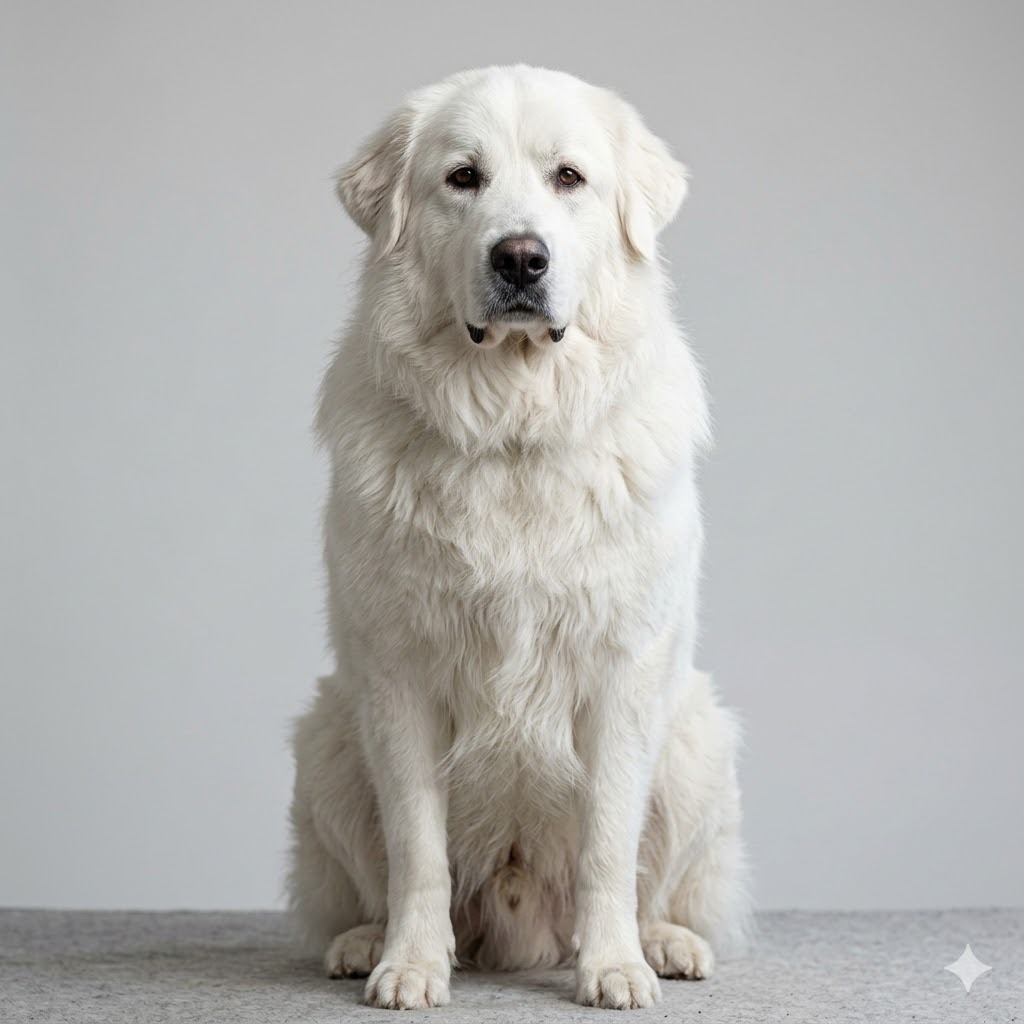
The Great Pyrenees is a giant white livestock guardian dog bred for centuries to live alone on remote mountain pastures, defending flocks of sheep from wolves and bears. Calm, patient, and deeply independent, it carries itself with a quiet dignity that has earned it the nickname "the gentle giant of the mountains." This is not a dog that waits for commands - it was bred to make its own decisions in the dark, far from any human, and that hard-wired independence shapes everything about living with one. Indoors it is famously serene, content to lie like a great white rug for hours, then patrol the perimeter of its territory at night with a deep, booming bark.
History & Origins
The breed takes its name from the Pyrenees mountains that form the border between France and Spain, where it worked the high summer pastures for at least a thousand years. Its ancestors were almost certainly large white flock-guarding dogs brought into Europe from Asia Minor thousands of years ago, part of the same ancient family that produced the Maremma, the Kuvasz, and other European livestock guardians.
For most of its history this was a peasant's working dog, not a fashionable one. That changed in the seventeenth century when the breed was adopted at the French court - the young Dauphin, later Louis XIV, is said to have taken a liking to them, and the dog became known as a guardian of French nobility and their chateaux. The breed was officially declared the Royal Dog of France in 1675.
By the early twentieth century numbers had collapsed, and unscrupulous dealers were selling crossbred animals to tourists as genuine Pyrenees. A serious restoration effort in France in the 1920s rebuilt the breed from authentic mountain stock. The first dogs reached the United States in the 1930s, and the American Kennel Club recognised the breed in 1933. In many countries it is known by its French name, the Chien de Montagne des Pyrenees, or the Pyrenean Mountain Dog.
Appearance
A large to giant dog of considerable substance, built for endurance rather than speed. Males stand 70-82 cm (27-32 in) and weigh from around 45 kg (100 lb) upward; females are noticeably smaller at 65-74 cm (25-29 in) and 38 kg (85 lb) and up. The overall impression is of unhurried power wrapped in a thick weatherproof coat.
Key features:
- Coat: a long, coarse, weather-resistant outer coat over a dense woolly undercoat - built to shed rain, snow, and the teeth of predators.
- Colour: principally white, sometimes with markings of grey, tan, reddish-brown, or badger on the head, ears, and tail.
- Double dewclaws: a breed hallmark - two dewclaws on each hind leg, a trait deliberately preserved.
- Head: wedge-shaped with a gentle expression, dark brown almond eyes, and small to medium triangular ears carried low.
- Tail: long and plumed, carried low at rest and curled over the back ("making the wheel") when alert.
Temperament & Character
The Great Pyrenees is calm, gentle, and affectionate with its own family, and quietly confident rather than excitable. Around its flock - whether that flock is sheep or children - it is patient, tolerant, and protective without being aggressive. With strangers it is reserved and watchful, sizing up every newcomer before deciding they are acceptable.
What defines the breed above all is independence. A livestock guardian was bred to work without supervision, to think for itself, and to act on its own judgement. As a result the Pyrenees is not a biddable, command-following dog like a retriever. It will hear you, consider your request, and decide whether it agrees. This is not stubbornness so much as the breed doing exactly what it was designed to do.
Two behaviours surprise nearly every new owner. The first is nocturnal barking - the breed patrols and announces itself at night, and the bark is enormous. The second is roaming - a guardian instinctively expands and patrols its territory, and an unfenced Pyrenees will wander for miles. Neither can be trained away entirely; both must be managed.
Care
Coat & Grooming
The thick double coat needs brushing once or twice a week to prevent mats, and far more during the heavy seasonal sheds in spring and autumn, when the dog drops its undercoat in great clumps. A slicker brush plus an undercoat rake works well; pay particular attention behind the ears, on the trousers, and around the ruff.
Despite the white coat the breed is surprisingly low-odour and somewhat dirt-shedding - mud often brushes out once dry. Never shave a Pyrenees: the coat insulates against heat as well as cold and protects pale skin from sunburn. Bathe only every couple of months or as needed. Check and clean ears regularly, trim nails - including the double hind dewclaws, which do not wear down naturally - and brush teeth several times a week.
Exercise & Activity Needs
This is a working breed with surprisingly moderate exercise needs. An adult Pyrenees is content with one or two good walks a day plus access to a securely fenced area to patrol. They are not jogging companions or frisbee athletes; they were bred to conserve energy across long shifts and to explode into action only when needed.
Crucially, exercise must be on lead or inside secure fencing. Recall in this breed is unreliable by design - a Pyrenees following its nose or expanding its patrol will simply keep going. Mental engagement matters too: a guardian with a real or substitute "job," a calm routine, and a clear territory is a settled dog, while a bored, under-stimulated one barks more, digs, and tries to escape.
Health & Lifespan
Average lifespan is 10-12 years, good for a giant breed. Like all large dogs it carries some orthopaedic and cardiac risks:
- Hip and elbow dysplasia - common in large breeds; insist on OFA or equivalent hip and elbow evaluations on both parents.
- Bloat (gastric dilatation-volvulus) - deep-chested dogs are at real risk; this is a life-threatening emergency.
- Patellar luxation and other joint issues.
- Osteosarcoma (bone cancer) - a risk in giant breeds.
- Eye conditions such as entropion and progressive retinal atrophy.
- Neurological conditions including a breed-associated form of deafness and, occasionally, degenerative myelopathy.
- Anaesthetic sensitivity - like several large breeds, some Pyrenees are sensitive to certain anaesthetic drugs, so use a vet experienced with the breed.
Feeding & Nutrition
A giant breed eats less per kilogram of bodyweight than people expect, but the totals are still large - typically 4-6 cups of quality dry food daily for an adult, split into at least two meals and adjusted to bodyweight, age, and activity. Use a large-breed formula with controlled calcium and phosphorus, especially during growth, since giant-breed puppies must grow slowly to protect developing joints.
Feed two or three smaller meals rather than one large one, avoid heavy exercise around mealtimes, and consider a slow-feeder or raised approach for dogs that gulp, because the breed's deep chest puts it at risk of bloat. Keep the dog lean; excess weight is hard on giant-breed joints and shortens life.
Pros & Cons
Pros
- Calm, gentle, and devoted family guardian.
- Wonderful, patient nature with children and livestock.
- Naturally protective without training.
- Surprisingly moderate exercise needs for its size.
- Striking, majestic appearance.
Cons
- Heavy, year-round shedding of a giant coat.
- Loud, persistent night-time barking.
- Strong roaming instinct - needs secure high fencing.
- Independent and slow to obey - frustrating for owners wanting a biddable dog.
- Giant size means large food, medication, and equipment costs.
Best Suited For
- Owners with secure, well-fenced rural or suburban property.
- Families who want a calm, protective guardian rather than a sporty companion.
- People who genuinely understand and accept livestock-guardian independence.
- Homes where night-time barking will not enrage the neighbours.
- Anyone seeking a gentle, dignified giant to share a quiet life.
Not suited for apartment dwellers, owners wanting an obedient off-lead companion, neighbours close enough to be disturbed by nocturnal barking, or anyone unprepared for relentless giant-breed shedding.
Great Pyrenees (Canis lupus familiaris) - frequently asked questions
Are Great Pyrenees good with children?
Generally excellent - patient, gentle, and naturally protective. As with any giant breed, supervise interactions with small children simply because of the dog's sheer size.
Why does my Great Pyrenees bark so much at night?
It is doing its ancient job - patrolling and warning off perceived threats in the dark. The instinct can be reduced with management and routine but rarely eliminated. Bringing the dog indoors at night helps most.
Can a Great Pyrenees be let off the lead?
Rarely safely. The breed's guardian instinct drives it to roam and patrol, and recall is unreliable. Use secure fencing and long lines instead.
Do Great Pyrenees shed a lot?
Yes. They shed year-round and "blow" their dense undercoat heavily twice a year. Expect white hair throughout the home.
Why does my dog have extra claws on its back legs?
Double dewclaws on the hind legs are a defining, deliberately preserved feature of the breed. They need regular trimming because they do not wear down on their own.
🧠 Test yourself: guess the dog
Three clues from our quiz bank, each about another of our dogs. Can you name them?
Clue 1.Developed along the hilly frontier between two British nations, this tireless sheepdog needs constant mental and physical work or it grows destructive.
It's the Border Collie - read the full profile →
Clue 2.This large, powerful Japanese dog with a curled tail and bear-like head became a national symbol of loyalty after one famously waited years at a train station for its deceased owner.
It's the Akita - read the full profile →
Clue 3.This tuxedo-marked little dog earned the nickname 'the American Gentleman' for its dapper black-and-white coat.
It's the Boston Terrier - read the full profile →
💛 Adoptable Great Pyrenees (Canis lupus familiaris)s near you
Real dogs of this breed (and close mixes) waiting in shelters and rescues right now, live from Petfinder. We have no affiliation and earn nothing - if someone catches your eye, the link goes straight to their shelter. New to adopting? Start with our adoption guide.
Widget not loading (some ad-blockers hide it)? Search directly on petfinder.com.