Irish Wolfhound
The Irish Wolfhound is the tallest dog breed in the world - a giant, rough-coated sighthound bred to run down wolves and elk across the Irish countryside.
🗓️ Last reviewed: July 2026
Overview
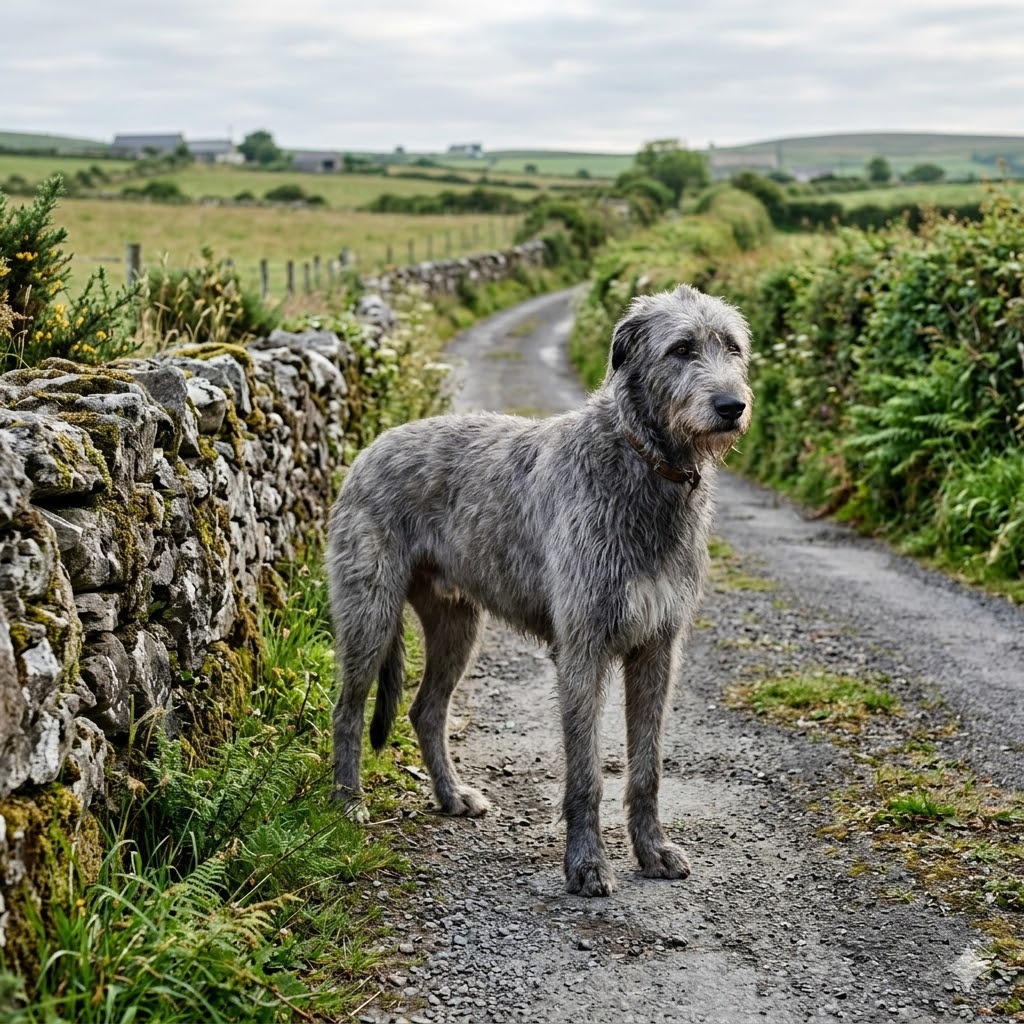
The Irish Wolfhound is the tallest dog breed in the world - a giant, rough-coated sighthound bred to run down wolves and elk across the Irish countryside. Despite a size that stops strangers in the street, the breed is famous for the opposite of ferocity: a calm, gentle, almost dreamy temperament that has earned it the title "gentle giant." Males stand over 81 cm at the shoulder and weigh 54-70 kg. This is a dog that fills a room by lying down in the middle of it, then quietly asks to lean on you. The heartbreak of the breed is its tragically short life - most Irish Wolfhounds live only 6-8 years - so every owner takes on a giant, sweet-natured companion knowing the time together will be brief.
History & Origins
The Irish Wolfhound is an ancient type. Large Irish hounds were recorded by the Romans as early as 391 AD, when a Roman consul received a gift of seven great dogs that "all Rome viewed with wonder." Through the medieval period these enormous coursing hounds were owned by Irish chieftains and nobility, prized for hunting wolves, Irish elk, and boar, and for guarding homesteads against wolves and raiders.
As wolves were hunted to extinction in Ireland by the late 1700s, the breed lost its purpose and nearly vanished. Export of the remaining dogs had already been restricted because so few were left. By the early 1800s the Irish Wolfhound was on the edge of extinction.
The breed was rescued and rebuilt in the second half of the 19th century by Captain George Augustus Graham, a British army officer, who gathered the last surviving Irish hounds and crossed them carefully with Deerhounds, Great Danes, and other large breeds to restore the type. The modern Irish Wolfhound descends from Graham's work. The breed was recognised by the Kennel Club in the 1880s and by the AKC in 1897, and today serves as a beloved companion and a national symbol of Ireland.
Appearance
Enormous, commanding, but built on graceful sighthound lines rather than heavy mass. This is the tallest breed in the world. Males stand a minimum of 81 cm (32 in) and often taller, weighing 54-70 kg (120-155 lb); females are minimum 76 cm (30 in) and 48-60 kg. The overall impression is of great size combined with a rough, shaggy dignity.
Key features:
- Coat: rough and hard, wiry, especially over the eyes and under the jaw, giving a bearded, bushy-browed look.
- Colour: grey, brindle, red, black, pure white, fawn, and wheaten - grey is the most familiar.
- Head: long, carried high, with a moderately pointed muzzle.
- Eyes: dark, calm, and gentle in expression.
- Ears: small, rose-shaped, folded back.
- Body: deep chest, long back, tucked-up loin - the running frame of a sighthound scaled up enormously.
- Tail: long, slightly curved, well covered with hair.
Temperament & Character
Calm, gentle, sweet, and dignified. The Irish Wolfhound is one of the most placid of all giant breeds indoors - a quiet presence that spends most of the day sprawled and sleeping. The old breed motto captures it: "gentle when stroked, fierce when provoked," though in practice modern Wolfhounds are so mellow that the fierce half is rarely seen.
The breed bonds deeply and quietly with its family. Wolfhounds are affectionate without being pushy, and they lean, rest their great heads on laps, and follow their people from room to room at a slow, contented pace. They are typically wonderful with children, patient and tolerant, though their sheer size means a wagging tail or a turning body can knock a toddler over by accident.
Wolfhounds make poor guard dogs. They are generally friendly or indifferent toward strangers and rarely aggressive. Their size alone is deterrent enough. As sighthounds they retain a prey drive and may chase small running animals, but toward people they are gentleness itself.
Care
Coat & Grooming
The rough double coat needs weekly brushing to remove dead hair and prevent matting, with more attention during seasonal shedding. Occasional hand-stripping keeps the harsh texture. The beard and eyebrows collect food and moisture and benefit from regular wiping.
Bathe as needed, every couple of months or when dirty. Clean ears weekly, trim the large nails regularly, and brush teeth several times weekly. Because of the breed's size, a soft, thick, orthopaedic bed is essential - hard floors cause pressure sores and calluses on the elbows and hocks.
Exercise & Activity Needs
Moderate, not extreme. Adult Irish Wolfhounds need daily walks plus regular access to a safe, large space where they can stretch into a gallop. They are sprinters, not endurance athletes - a Wolfhound will happily run flat-out for a short burst and then return to lounging for hours. Two good walks a day plus weekly free running suits most adults.
Puppies and adolescents must have controlled exercise. Giant-breed bones and joints develop slowly, and over-exercising a young Wolfhound - forced running, stairs, jumping - can cause lasting joint damage. Free play at their own pace is fine; structured hard exercise should wait until the dog is grown, around 18 months.
Space matters more than intensity. This breed does not suit a small flat. It needs room simply to move, turn, and lie stretched out, and secure fencing for its safe galloping.
Health & Lifespan
Average lifespan is 6-8 years - one of the shortest of any breed, and the hardest truth of Wolfhound ownership.
Common concerns:
- Dilated cardiomyopathy (DCM) - the leading cause of death in the breed; annual heart screening is strongly advised.
- Bloat and gastric torsion (GDV) - a major, life-threatening risk in this deep-chested giant.
- Bone cancer (osteosarcoma) - sadly common in giant breeds.
- Hip and elbow dysplasia.
- Liver shunt (portosystemic shunt) - seen in some lines, screened for in puppies.
- Von Willebrand's disease - a bleeding disorder.
Careful breeding, heart screening, and giant-breed-appropriate feeding help, but owners should go in clear-eyed about the short lifespan and cancer risk.
Feeding & Nutrition
A giant, fast-growing breed with specific needs. Puppies must be fed a large- or giant-breed formula with controlled calcium and calorie levels - overfeeding or over-supplementing during growth causes serious skeletal problems. Slow, steady growth is the goal.
Adults typically eat a large volume split across two or three meals rather than one big meal, to reduce bloat risk. Feed from a raised or floor-level slow feeder, and never allow hard exercise within an hour either side of eating. Keep the dog lean - excess weight is brutal on giant-breed joints and heart. Fresh water always available.
Pros & Cons
Pros
- Calm, gentle, sweet-natured - a true gentle giant.
- Wonderful, patient companion, often excellent with children.
- Quiet and low-key indoors.
- Moderate exercise needs for such a large dog.
- A magnificent, dignified presence.
Cons
- Tragically short lifespan of 6-8 years.
- High risk of heart disease, bloat, and bone cancer.
- Enormous - needs space, a big vehicle, and giant-sized everything.
- Expensive to feed, medicate, and insure.
- Not a guard dog despite its size.
Best Suited For
- Owners with plenty of indoor and outdoor space, including a securely fenced area.
- Families wanting a calm, gentle giant companion.
- People prepared emotionally and financially for a short-lived giant breed.
- Homes that can provide soft orthopaedic bedding and giant-breed care.
Not suited for apartment dwellers, owners on a tight budget, people wanting a guard dog or a long-lived breed, or anyone unable to lift or manage a very large dog in an emergency.
Irish Wolfhound puppy growth chart
A typical growth curve for a giant breed like the Irish Wolfhound, estimated from its adult weight of 54-70 kg. Puppies vary with sex, genetics and diet, so treat this as a guide - for your own puppy, use the puppy weight predictor.
| Age | Typical weight | % of adult |
|---|---|---|
| 2 mo | 9.7-12.6 kg | 18% |
| 3 mo | 15.1-19.6 kg | 28% |
| 4 mo | 20-25.9 kg | 37% |
| 6 mo | 28.1-36.4 kg | 52% |
| 9 mo | 37.8-49 kg | 70% |
| 12 mo | 44.8-58.1 kg | 83% |
| Adult | 54-70 kg | 100% |
Irish Wolfhound - frequently asked questions
How big does an Irish Wolfhound get?
It is the tallest breed in the world. Males stand over 81 cm at the shoulder and weigh 54-70 kg; standing on the hind legs, an adult towers over most people.
Why do Irish Wolfhounds live such short lives?
Like most giant breeds, they age quickly and are prone to heart disease and bone cancer. The average lifespan is only 6-8 years, and this is the hardest part of owning the breed.
Are Irish Wolfhounds good with children?
Generally yes - they are famously gentle and patient. The main caution is their size: an adult can knock a small child over simply by turning around, so supervision is sensible.
Do Irish Wolfhounds make good guard dogs?
No. They are calm and friendly and rarely aggressive. Their sheer size is a deterrent, but they are companions, not protectors.
Are they good apartment dogs?
Not really. Although quiet indoors, they need room to stretch out and a safe space to gallop. A small flat cannot accommodate a dog of this size.
🧠 Test yourself: guess the dog
Three clues from our quiz bank, each about another of our dogs. Can you name them?
Clue 1.This rugged, non-shedding working dog has webbed feet and was once a fisherman's helper, even carrying messages between boats.
It's the Portuguese Water Dog - read the full profile →
Clue 2.This fluffy white Arctic dog is famous for a perpetually upturned mouth nicknamed the smile.
It's the Samoyed - read the full profile →
Clue 3.Unmistakable for its egg-shaped head and tiny triangular eyes, this muscular breed was once a long-running beer mascot.
It's the Bull Terrier - read the full profile →
💛 Adoptable Irish Wolfhounds near you
Real dogs of this breed (and close mixes) waiting in shelters and rescues right now, live from Petfinder. We have no affiliation and earn nothing - if someone catches your eye, the link goes straight to their shelter. New to adopting? Start with our adoption guide.
Widget not loading (some ad-blockers hide it)? Search directly on petfinder.com.