Scottish Deerhound
The Scottish Deerhound is a tall, wiry-coated coursing sighthound bred to pursue and bring down the red deer across the open Highlands of Scotland.
🗓️ Last reviewed: July 2026
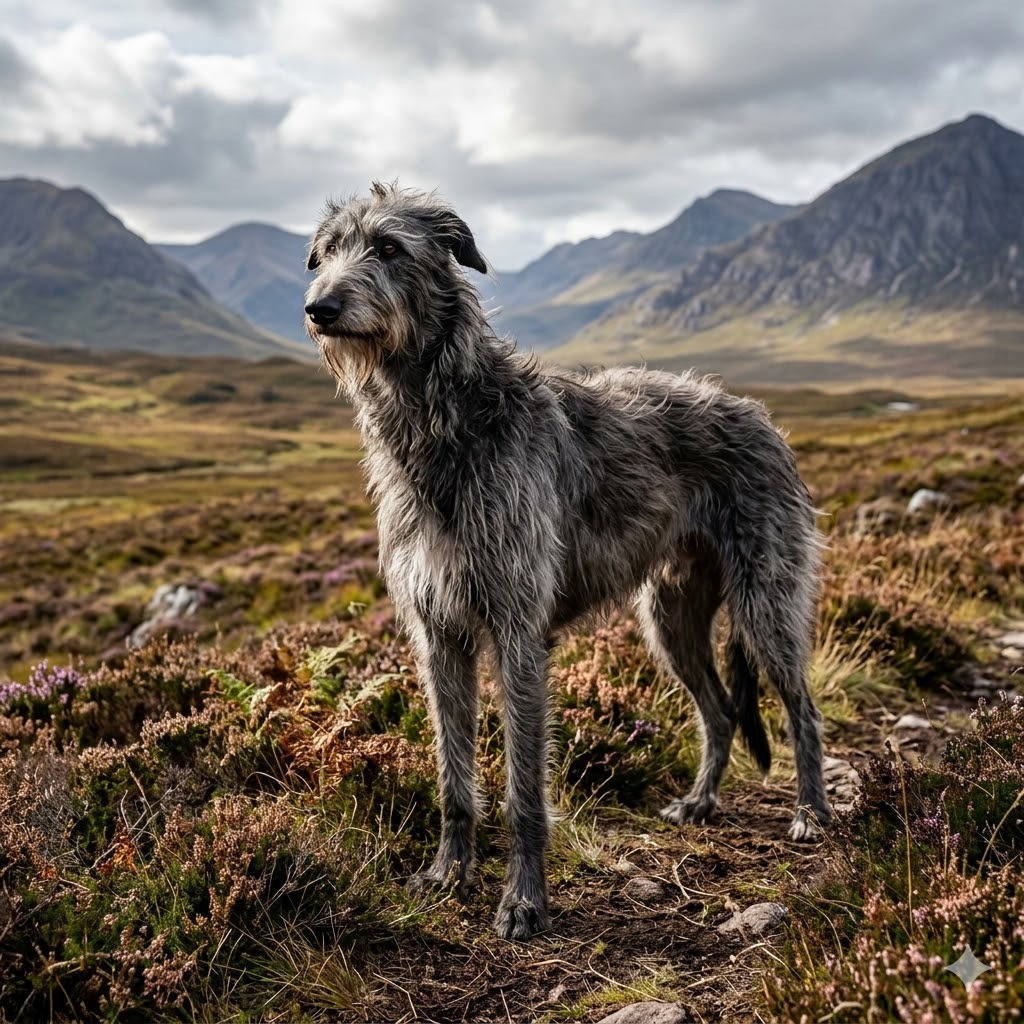
Overview
The Scottish Deerhound is a tall, wiry-coated coursing sighthound bred to pursue and bring down the red deer across the open Highlands of Scotland. Slightly smaller and lighter than its cousin the Irish Wolfhound, the Deerhound combines great height with a lean, greyhound-like grace and a soft, ragged grey coat. Males stand 76 cm or more at the shoulder and weigh 39-50 kg. Off the field it is one of the most gentle and dignified of all breeds - quiet, courteous, and devoted, with a poet's reputation ("the most perfect creature of Heaven," wrote Sir Walter Scott). But this calm indoor companion carries a serious prey drive and the need to sprint, so it belongs in a home that can offer both a soft place to rest and a safe place to run.
History & Origins
The Scottish Deerhound is an ancient Highland breed, developed to course the large and powerful red deer over rough, open country before firearms. Large rough-coated hounds of this type existed in Scotland for many centuries, and by the Middle Ages the deer-coursing hound was closely tied to the Highland clans.
For a long period the breed was jealously guarded by the Scottish nobility. Under the clan system, ownership of a Deerhound was at times restricted to those of high rank - no one below the rank of earl was permitted to keep one - which both preserved the breed's quality and, later, endangered it. When the clan system collapsed after the Battle of Culloden in 1746, the breed's fortunes fell with it.
By the early 19th century the Deerhound had become rare. It was rescued and rebuilt largely through the efforts of two brothers, Archibald and Duncan McNeill, who worked to restore the type in the 1820s. The rise of deer-stalking as a Highland sport, and the romantic writings of Sir Walter Scott, renewed interest in the breed. The Deerhound was recognised by the AKC in 1886 and today is kept mainly as a companion and a lure-coursing and show dog, still rare but devotedly maintained.
Appearance
Tall, lean, and elegant - like a larger, rough-coated greyhound. The Deerhound is built for speed and stamina over rough ground. Males stand a minimum of 76 cm (30 in) and weigh 39-50 kg (85-110 lb); females are around 71 cm (28 in) and 34-43 kg. The whole dog gives an impression of graceful power and quiet dignity.
Key features:
- Coat: harsh, wiry, and ragged, 7-10 cm long on the body, softer on the head, chest, and belly, with a distinct silky beard and moustache.
- Colour: dark blue-grey is the classic and most prized colour; also grey, brindle, yellow, and sandy-red.
- Head: long and level, with a moderately pointed muzzle and a good beard.
- Eyes: dark, soft, and keen.
- Ears: small, folded back rose-shaped, raised when alert.
- Body: deep chest, arched loin, drawn-up belly - the classic running frame.
- Tail: long, thick at the root, tapering, reaching almost to the ground, carried low with a slight curve.
Temperament & Character
Gentle, dignified, and quietly affectionate. Indoors the Scottish Deerhound is calm, undemanding, and mannerly - a peaceful presence that would rather lie stretched by the fire than cause any trouble. The breed is deeply devoted to its family and enjoys close company, leaning in for gentle attention without being clingy or boisterous.
Deerhounds are friendly and polite toward strangers and are not guard dogs; they greet visitors with courteous interest rather than suspicion. They are typically excellent with children, patient and mild, though their size and sweeping tail call for supervision around toddlers.
The other side of the breed is the sighthound instinct. On the open ground a Deerhound is transformed - a fast, focused, powerful hunter with a strong drive to chase anything that runs. This prey drive is genuine and cannot be trained away, so cats and small pets, and off-lead freedom near wildlife or roads, must be managed with care.
Care
Coat & Grooming
The harsh, ragged coat is fairly low-maintenance. Brush weekly to remove dead hair and prevent tangles, and hand-strip occasionally to keep the wiry texture and neaten the outline. The beard and moustache collect food and water and benefit from regular wiping.
Bathe only as needed. Clean ears weekly, trim nails regularly, and brush teeth several times a week. As with all tall, lean breeds, a thick, soft, orthopaedic bed is important - bony elbows and hips press hard on floors, and a Deerhound stretched out on a hard surface will develop pressure calluses.
Exercise & Activity Needs
Moderate but with a specific requirement: room to sprint. Adult Deerhounds need daily walks plus regular access to a large, safe, enclosed space where they can open up into a full gallop. Like other sighthounds they are sprinters - short, explosive bursts of speed followed by long stretches of rest. A couple of good walks a day plus frequent free running keeps an adult happy and fit.
Puppies and adolescents must have carefully controlled exercise. Their large frames grow slowly, and forced running, stairs, and jumping during growth can damage developing joints. Let young dogs play at their own pace and save structured hard exercise until they are grown, around 18 months.
Because of the strong prey drive, off-lead running should happen only in securely fenced areas or in open country well away from roads, livestock, and wildlife. This breed needs sprint room, not just a walk around the block.
Health & Lifespan
Average lifespan is 8-11 years.
Common concerns:
- Dilated cardiomyopathy (DCM) - a significant heart concern in the breed; screening is advised.
- Bloat and gastric torsion (GDV) - a serious risk in this deep-chested breed.
- Bone cancer (osteosarcoma) - the leading cause of death, common in tall breeds.
- Cystinuria - a hereditary condition causing bladder stones, seen in some lines.
- Factor VII deficiency - a usually mild bleeding disorder detectable by DNA test.
- Hypothyroidism.
Deerhounds are also very sensitive to anaesthesia and certain drugs, as their lean, low-fat bodies process them differently - vets experienced with sighthounds are a real advantage.
Feeding & Nutrition
A tall, lean, deep-chested breed with growth and bloat considerations. Puppies should be fed a large-breed formula with controlled calcium and calories to encourage slow, steady growth and protect developing joints - overfeeding a growing Deerhound is harmful.
Adults do best on two or three smaller meals a day rather than one large one, to reduce the risk of bloat, and should not exercise hard within an hour either side of eating. Keep the dog lean - the natural build is slim, with the last ribs faintly visible; excess weight burdens joints and heart. Fresh water always available.
Pros & Cons
Pros
- Gentle, dignified, and quietly affectionate.
- Calm and easy indoors - happy to lie by the fire.
- Often excellent with children.
- A graceful, striking, and rare breed.
- Moderate grooming needs.
Cons
- Strong prey drive - unreliable off-lead near running animals.
- Needs a large, safe space to sprint.
- Prone to heart disease, bloat, and bone cancer, with a modest lifespan.
- Sensitive to anaesthetics and some medications.
- Large, needs soft bedding, and not a guard dog.
Best Suited For
- Owners with a securely fenced space or safe open land for sprinting.
- Quiet homes wanting a gentle, dignified companion.
- Sighthound and lure-coursing enthusiasts.
- Households able to manage a strong prey drive around small pets.
Not suited for apartment dwellers, homes with small free-roaming pets and no plan to manage them, owners wanting reliable off-lead recall, or people wanting a guard dog.
Scottish Deerhound puppy growth chart
A typical growth curve for a large breed like the Scottish Deerhound, estimated from its adult weight of 39-50 kg. Puppies vary with sex, genetics and diet, so treat this as a guide - for your own puppy, use the puppy weight predictor.
| Age | Typical weight | % of adult |
|---|---|---|
| 2 mo | 8.6-11 kg | 22% |
| 3 mo | 12.9-16.5 kg | 33% |
| 4 mo | 16.8-21.5 kg | 43% |
| 6 mo | 23.4-30 kg | 60% |
| 9 mo | 31.2-40 kg | 80% |
| 12 mo | 35.9-46 kg | 92% |
| Adult | 39-50 kg | 100% |
Scottish Deerhound - frequently asked questions
How is a Scottish Deerhound different from an Irish Wolfhound?
They are closely related, but the Deerhound is lighter, leaner, and racier - built like a rough-coated greyhound - while the Wolfhound is taller, heavier, and more massive. The Deerhound also tends to live a little longer.
Do Scottish Deerhounds have a strong prey drive?
Yes. They were bred to chase and catch red deer, and the instinct to pursue anything that runs is powerful and instinctive. They should not be trusted off-lead near wildlife, small pets, or roads.
Are they good with children?
Generally very good - they are gentle and patient. Their large size and long sweeping tail mean supervision is wise around very small children.
Are Scottish Deerhounds calm indoors?
Yes. Despite being athletic sprinters, they are famously quiet and undemanding in the house, content to rest for long stretches once their exercise needs are met.
Do they make good guard dogs?
No. They are friendly and courteous toward strangers and lack any guarding instinct. They are companions and coursing hounds, not protectors.
🧠 Test yourself: guess the dog
Three clues from our quiz bank, each about another of our dogs. Can you name them?
Clue 1.One of the heaviest dog breeds on Earth, this gentle giant can top 200 pounds and once guarded estates and fought in arenas.
It's the English Mastiff - read the full profile →
Clue 2.This small, merry scent hound with a white-tipped tail is famously used to sniff out contraband food in airports because of its keen nose and friendly nature.
It's the Beagle - read the full profile →
Clue 3.Named for a region of northwestern France, this leggy, tailless-or-bobtailed gun dog both points and retrieves upland birds.
It's the Brittany - read the full profile →
💛 Adoptable Scottish Deerhounds near you
Real dogs of this breed (and close mixes) waiting in shelters and rescues right now, live from Petfinder. We have no affiliation and earn nothing - if someone catches your eye, the link goes straight to their shelter. New to adopting? Start with our adoption guide.
Widget not loading (some ad-blockers hide it)? Search directly on petfinder.com.